| Piú viste - Venus |

8-Venus.jpgVenus from 2.700.000 Km (Galileo Probe)172 visiteUna meravigliosa visione di Venere, davvero simile alla Terra vista dalla Luna, mentre la fitta coltre di nuvole che la ricopre riflette i raggi del Sole. Come avevamo detto in sede di commento alle prime foto, Venere suggerisce un'idea di "tranquillità e benessere".
Un Mondo bianco e azzurro apparentemente simile al nostro ma, come avete visto insieme a noi, in realtà violento ed assolutamente inospitale.
Un Mondo comunque bellissimo da guardare, ammirare e studiare, ma ... Restando lontan!
...Molto lontani...
|
|

Venusian_Surface-Venera_13-06-DPM-PCF-LXTT-IPF-1.jpgTerra Incognita (Additional Credits: Don P. Mitchell - perspective visualization - and Dr Paolo C. Fienga - Colorization)162 visiteFollowing yesterday's APOD, we have decided to take you once again on the Surface of the Planet Venus (as imaged by the Soviet Lander Venera 13) and we are proud to show you the result of a combined effort: the perspective imaging of the Venusian Surface as seen from the the Lander (a work carried out by the American Researcher Dr Don P. Mitchell) with the Absolute Natural Colorization of the landscape and Sky (this job carried out by the Italian Researcher Dr Paolo C. Fienga). The result, as you can see, is a deeply suggestive (and, maybe, even a little scary...) vision of what has been called by many Scientists and Researchers, "The Venusian Inferno": such as a World that, from every point of view, seems to be completely hostile to the human concept of Life itself.
And here is a brief story of what happened that day, such as March 1st, 1982, when the Descent Module of the Venera 13 Spacecraft landed on Venus, as told us by Dr Don P. Mitchell himself:"...Two optical-mechanical cameras repeatedly scanned 180° or 60° through Clear and Colored Filters and at higher resolution than the Venera 9/10 System. The camera system was developed by Dr A.S. Selivanov's Team at the Institute of Space Device Engineering. The main Spacecraft, flying on a Fly-By Trajectory, remained in radio contact with the Lander for 127 minutes. It relayed the video to Earth as a phase-modulated digital signal, at 9 bits per pixel. The Venera 13 (and Venera 14 too) Lander/s transmitted digital images with a depth of 9 bits and an approximately logarithmic encoding of photometric brightness. Multiple panoramas were scanned by the camera, including some with red, green or blue glass filters in place. The entire transmission was relayed to Earth in real time, and also replayed from digtal tape recordings onboard the Venera 13 Spacecraft. This peculiar tecnique permitted the reconstruction of an almost noiseless version from the multiple transmissions. An accurate conversion of that encoding to linear brightness has also been derived, using calibration information included with the images (to be noted is the improved rendering of shape and details in very dark and very light portions of the image). The original Soviet versions of this frame included a full panorama from Clear-Filter images, and color panoramas from the red, green and blue-filter images. The signal to noise was poorer for the color images, because they were much darker. I (meaning Dr Don P. Mitchell) combined the two types of panoramas by adding the Chroma Signal (in CIE Lab Color Space) from the color images with the luminance from the clear images, thus obtaining simply spectacular results. Furthermore, the Venera 13 panoramas were just spherical projections and therefore they had to be remapped to perspective projections and overlayed (using Adobe Photoshop CS2) to produce views that were good enough to give us a better subjective impression of the Venusian Surface. In the overhead view, notice the subtle shadowing existing around the Lander. The Surface illumination is from the uniformly bright hemisphere of the Sky, but the Lander (as you can better see in the spherical projections) blocks part of the Sky from nearby Ground. In addition to the above, please notice that in this frame the thick yellow-orange color of the Sky is due to Rayleigh Scattering of the Sunlight by the thick Venusian Atmosphere and, possibly, by an additional (still) unknown blue-absorbing Gas Component. Brightness has been normalized. Please remember that the variations in the color of the Surface and Sky that you may certainly notice once you will have compared different color images taken by the different Soviet Venera Class Landers that made it to the Venusian Surface, are due to differing Atmospheric Depths and Opacities, as well as to the differing Sun Angles existing at the different Landing Sites...".
MareKromium
|
|

Venus-Volcano-NasaRubin_1600.jpgVenusian "Active" Volcano150 visiteCaption NASA Originale:"What would an erupting volcano on Venus look like? Evidence of currently active volcanoes on Venus was announced earlier this year with the unexplained warmth of regions thought to contain only ancient volcanoes.
Although large scale images of Venus have been taken with radar, thick sulfuric acid clouds would inhibit the taking of optical light vistas. Nevertheless, an artist's reconstruction of a Venusian volcano erupting is featured.
Volcanoes could play an important role in a life cycle on Venus as they could push chemical foods into the cooler upper atmosphere where hungry microbes might float. Pictured, the plume from an erupting volcano billows upwards, while a vast lava field covers part of the hot and cracked surface of Earth's overheated twin. The possibility of airborne microbial Venusians is certainly exciting, but currently controversial".MareKromium
|
|

Venusian_Surface-Venera_13-02.jpgVenus from Venera 13 (camera 2)149 visitenessun commento
|
|

Venus_Clouds_-_Akatzuki_960.jpgVenusian Clouds145 visitenessun commentoMareKromium
|
|

6-Venus.jpgVenus from Galileo142 visiteCaption NASA originale:"This colorized picture of Venus was taken February 14, 1990, from a distance of almost 1,7 MMs, about 6 days after Galileo's closest approach to the planet. It has been colorized to a bluish hue to emphasize subtle contrasts in the cloud markings and to indicate that it was taken through a violet filter. Features in the sulfuric acid clouds near the top of the planet's atmosphere are most prominent in violet and ultraviolet light".
|
|

Volcanoes-Sapas_Mons-02.jpgMagellan Probe: radio image of Sapas Mons Volcano (detail)141 visiteUna così rapida decisione di considerare persa la Sonda può lasciare sorpresi (basti pensare agli innumerevoli tentativi compiuti dai Tecnici NASA di ripristinare i contatti radio, per esempio, con il Mars Polar Lander oppure con la Sonda ESA "Beagle", prima di dichiarare la perdita delle Navicelle) e che cosa sia effettivamente accaduto a Magellano non lo sa nessuno, ma non è da escludere, tuttavia, che la rapidità adottata nel prendere questa decisione sia stata determinata, fra l'altro, in ragione dell'avvenuto conseguimento della (quasi) totalità degli scopi della Missione.
|
|
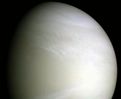
1-Venus_Galileo_Visible.jpgVenus140 visiteUna magnifica ricostruzione di Venere - ad opera dello "Space Artist" Don P. Mitchell - nei colori in cui un umano che fosse nello spazio la vedrebbe.
Queste le annotazioni originali dell'Artista:
Full spectral data is rarely available, and instead we must use views through color filters. Above, the Galileo probe captured Venus through a clear filter (left) and through a 410 nm violet filter, which reveals the subtle yellow and white clouds. Unfortunately, many different color images could result in the same two clear and violet signals above. Even when so-called red, green and blue filters are used, the problem is just as difficult, because the filters are not really the right red, green and blue to just plug into the channels of a color display. Theoretically, information from the two images above and from the Cassini spectrum could be combined using Bayesian decision theory, to compute the most probable color image. If colors are estimated correctly, there is a final issue of tone mapping. How bright does the image appear to the eye in a given context. The image above is the best color image of Venus I've found, showing the planet as it would likely appear to a human observer in space. It was made by Turkish astronomer A. Tayfun Oner, using the two color channels from the Galileo camera, and a third interpolated channel.
|
|

Volcanic_Features-_Volcanic_Domes_in_Tinantin_Planitia.jpgMagellan Probe: radio image of Volcanic Domes in Tinatin Planitia138 visiteTra le altre cause della perdita del contatto radio possiamo anche includere l'impatto della Navicella con un "corpo vagante" o magari il verificarsi di un repentino mutamento nell'orbita di Magellano causato da un fenomeno di influenza gravitazionale (p.e.: un altro corpo celeste che transita in prossimità della Navicella e la "spinge" fuori dalla propria orbita).
Forse la Sonda si è "rotta" o forse essa ha, semplicemente, esaurito la propria "energia vitale" e si è spenta per sempre: ognuno può pensare quello che vuole e, anche se la verità non la sapremo mai, i risultati del lavoro di Magellano, qualunque sia stata la causa della sua fine, renderanno questa Sonda, comunque, degna di una memoria immortale.
|
|

Craters-Adivar_Crater-0.jpgMagellan Probe: radio image of Adivar Crater137 visiteLa missione che ha ci dato, sino ad ora, i maggiori (e migliori) risultati in termini di mappatura della superficie del Pianeta - operando con l'ausilio di uno speciale strumento radar (il SAR e cioè il Synthetic Aperture Radar) - è stata la Missione Magellano.
Il lancio della Navicella avvenne il 4 Maggio 1989 e l'arrivo su Venere, con inserimento della stessa in un'orbita ellittica definita "presso/circa-polare" (near-polar elliptical orbit), occorse il 10 Agosto 1990.
La mappatura radar di Venere fu, come testimoniano ampiamente le immagini che Vi proponiamo, un grande successo.
|
|

Aeolian_Features-Windstreaks.jpgMagellan Probe: radio image of Windstreaks132 visiteUn'immagine decisamente chiara e relativa a quel fenomeno che viene chiamato 'wind streaking' e che ci indica, fra l'altro, la direzione usuale dei venti e la capacità di resistenza che i rilievi oppongono ad essi.
|
|

Volcanoes-Sapas_Mons-03.jpgMagellan Probe: radio image of Sapas Mons Volcano Area131 visiteInoltre - e per rendersi conto di questo dato basta verificare i documenti relativi all'operato della Sonda magellano - è fortemente probabile che la perdita del contatto radio sia stata causata dalla semplice e naturale consunzione della Navicella, costretta (per 4 anni) al lavoro in condizioni alquanto ostili.
|
|
| 126 immagini su 11 pagina(e) |
2 |  |
|
|
|
|
|
|
|
|





