| |

| Piú viste - Saturn: the "Ringed Beauty" and His Moons |

Saturn-PIA07563.jpgSaturn or Van Gogh?57 visiteSaturn's turbulent atmosphere is reminiscent of a Van Gogh painting in this view. However, unlike the famous impressionist painter, Cassini records the world precisely as it appears to the spacecraft's cameras.
The feathery band that cuts across from the upper left corner to the right side of this scene has a chevron, or arrow, shape near the right. The center of the chevron is located at the latitude (about 28° South) of an eastward-flowing zonal jet in the atmosphere. Counter-flowing eastward and westward jets are the dominant dynamic features seen in the giant planet atmospheres. A chevron-shaped feature with the tip pointed East means that this is a local maximum in the eastward wind and a region of horizontal wind shear where clouds to the North and South of the jet are being swept back by the slower currents on the sides of the jet.
The image was taken in visible light with the Cassini spacecraft narrow-angle camera on July 6, 2005, at a distance of approx. 2,5 MKM from Saturn using a filter sensitive to wavelengths of infrared light centered at 727 nanometers. The image scale is 14 kilometers (9 miles) per pixel.
|
|

Rhea-PV-PIA07566.jpgRhea, from about 239.000 Km57 visiteOriginal caption:"Like the rest of Rhea's surface, the Southern Polar Region of this Saturn moon has been extensively re-worked by cratering over the eons. This close-up shows that most sizeable craters have smaller, younger impact sites within them. Near the left lies an intriguing gash (---> taglio lungo e profondo, ivi sinonimo di "chasm" o "cleft").
The largest well-defined crater visible here is an oval-shaped impact toward the upper right. The crater is 115 by 91 Km (such as 71 by 57 miles) in size. Cassini acquired this view during a distant flyby of Rhea on July 14, 2005.
The image was taken in visible light with the Cassini spacecraft narrow-angle camera at a distance of approx. 239.000 Km (such as 149.000 miles) from Rhea and at a Sun-Rhea-spacecraft angle of 56°. The image was obtained using a filter sensitive to wavelengths of infrared light centered at 930 nnmts. The image scale is about 1 Km per pixel".
|
|

RingsStructure-2-PIA03550.jpgThe "Rings' Structure"57 visiteSaturn's Rings make up an enormous, complex structure. From edge-to-edge, the Ring System would not even fit in the distance between Earth and the Moon. The 7 main rings are labeled in the order in which they were discovered. From the planet outward, they are D, C, B, A, F, G and E. The D-Ring is very faint and closest to Saturn. The main Rings are A, B and C. The outermost Ring, easily seen with Earth-based telescopes, is the A-Ring. The Cassini Division is the largest gap in the Rings and separates the B from the A-Ring. Just outside the A-Ring is the narrow F-Ring, shepherded by tiny moons Pandora and Prometheus. Beyond that are 2 much fainter Rings named G and E. Saturn's diffuse E-Ring is the largest planetary ring in our Solar System, extending from Mimas' orbit to Titan's orbit, about 1 MKM.
The particles in Saturn's rings are composed primarily of water ice and range in size from microns to tens of meters. The rings show a tremendous amount of structure on all scales; some of this structure is related to gravitational interactions with Saturn's many moons, but much of it remains unexplained. One moonlet, Pan, actually orbits inside the A ring in a 330-kilometer-wide (200-mile) gap called the Encke Gap. The main rings (A, B and C) are less than 100 meters (300 feet) thick in most places, compared to their radial extent of 62,120 kilometers (38,600 miles). The main rings are much younger than the age of the solar system, perhaps only a few hundred million years old. They may have formed from the breakup of one of Saturn's moons or from a comet or meteor that was torn apart by Saturn's gravity.
|
|

Rhea-PIA07575.jpgTirawa Impact Basin on Rhea57 visiteThe giant Tirawa impact basin straddles the day and night boundary on Saturn's moon Rhea in this view from the Cassini spacecraft. The ancient basin is 5 Km deep in places, as measured in NASA Voyager images. The whole basin is about 360 Km across.
The prominent bright splotch to the southeast of Tirawa is ejecta from a fairly fresh crater. This view of Rhea (1.528 Km, such as about 949 miles across) reveals terrain slightly to the East of a similar Cassini view, released earlier (see Diversity of Impacts). The sunlit surface in this view is principally on the leading hemisphere of Rhea. North is up and rotated 13° to the left.
The image was taken in visible light with the Cassini spacecraft narrow-angle camera on Aug. 13, 2005, at a distance of approx. 2 MKM (about 1,2 MMs) from Rhea and at a Sun-Rhea-spacecraft, or phase, angle of 50°. Resolution in the original image was 12 kilometers (7 miles) per pixel. The image has been contrast-enhanced and magnified by a factor of two to aid visibility.
|
|

Rings-PIA07716.jpgCan the "clumps" in the Rings be the TSP (Transient Saturnian Phoenomena)?57 visite"Scientists have long suspected that small moons hiding among Saturn's Rings strands might be producing some of the unusual structure observed in the F-Ring. While the shepherd moon Prometheus is the main culprit behind the strange behavior of Saturn's F-Ring, it cannot explain all observed features. The current dilemma facing scientists is that Cassini is detecting extended objects like those pictured here - that may be either solid moons or just loose clumps of particles within the Ring. This montage of 4 enhanced Cassini narrow-angle camera images shows bright clump-like features at different locations within the F-Ring.
Two objects in particular, provisionally named S/2004 S3 and S/2004 S6, have been repeatedly observed by Cassini over the past 13,5 months and 8,5 months, respectively. The orbits for these 2 objects have not yet been precisely determined, in part because perturbations from other nearby moons make the orbits of objects in this region complicated. Thus, scientists cannot be completely confident at the present time if they in fact have observed new sightings of S3 and S6, or additional transient clumps.
The upper two images show features that may be S6. From previous observations, S6 appears to have an orbit that crosses that of the main F ring. This unexpected behavior currently is a subject of great interest to ring scientists.
The upper left image was taken on June 21, 2005, and shows an object in the outer ringlets of the F ring. The radial (or lengthwise) extent of the feature is approximately 2,000 kilometers (1,200 miles). The radial resolution on the ring is about 13 kilometers (8 miles) per pixel.
The image at the upper right was taken on June 29, 2005, and shows a bright feature within the F ring's inner ringlets. The radial extent of the feature seen here is about 2,000 kilometers (1,200 miles); the radial resolution is 36 kilometers (22 miles).
The image at the lower left was taken on August 2, 2005, and shows a feature that may be S3. S3 has been found to have an orbital path that is tightly aligned with that of the main F ring. The radial resolution in the image is 3.5 kilometers (2.2 miles) per pixel.
The lower right image was taken on April 13, 2005, and has a radial resolution of 7 kilometers (4 miles) per pixel. This object does not appear to be either S3 or S6.
Structures like knots and clumps within the F ring often are transient, appearing and then disappearing within months. Repeated observation of the objects seen in this region hopefully will give scientists firm evidence about whether these features are actual moons that disturb the material around them or perhaps the short-lived products of interactions between the F ring and larger moons such as Prometheus.
|
|

KeelerMoon-PIA07584.jpgS/2005 S1: the "Keeler-Gap" Moon57 visiteCassini's cameras were retargeted to capture the tiny Keeler Gap Moon S/2005 S1, visible at the center and first discovered by Cassini a few months ago. Waves raised in the gap edges by the Keeler moonlet's gravity are clearly visible here. Scientists can use the height of the waves to determine the little moon's mass.
The Keeler moon is 7 Km (about 4,3 miles) across and orbits within its 42-km (about 26-mile) wide gap. The much larger Encke Gap (325 Km, or 200 miles wide) is seen here at the upper right (...). This image was taken in visible light with the Cassini spacecraft narrow-angle camera on Aug. 1, 2005, at a distance of approx. 853.000 Km (or about 530.000 miles) from Saturn. The image scale is 5 Km (3 miles) per pixel. The image has been contrast-enhanced and magnified by a factor of 3 to aid visibility.
|
|
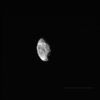
Hyperion-N00040155.jpgHyperion (1)57 visiteUn passaggio davvero ravvicinato, questa volta, ci permette di dare una rapida occhiata ad Hyperion, un'altra luna minore di Saturno, le cui caratteristiche superficiali la rendono davvero interessantissima.
In questo frame siamo ancora lontani (quasi 245.000 Km) da Hyperion, ma la sua 'porosità' - che, come vedremo meglio nelle prossime immagini, la fa assomigliare ad una pietra pomice che vaga nello Spazio - già si può intuire...
|
|

Hyperion-N00040174.jpgHyperion (2)57 visitePoco più di 123.000 Km ci separano dalla superficie di Hyperion: il rilievo maggiormente interessante sembra costituito da una sorta di cratere a forma di ellisse (irregolare) il quale presenta delle pareti frastagliate ed altissime, mentre la sua base è completamente crivellata da altri crateri di grandi, medie e piccole dimensioni. Non abbiamo immagini anaglifiche di questa luna, ma la sensazione - sebbene, per ora, meramente visuale - che, proprio nella zona centrale di questo bacino (da impatto?) ellittico, vi sia una montagna (un picco?), è decisamente forte.
I rilievi scientifici che possiamo svolgere guardando questi frames possono essere - al momento - di natura solo speculativa. Comunque ne evidenziamo uno su tutti: che l'attuale configurazione superficiale di Hyperion possa essere il risultato della sola attività (intensa e martellante, almeno in epoche passate) di bombardamento meteorico a noi, in tutta onestà, sembra un'ipotesi MOLTO azzardata.
|
|

Hyperion-N00040201.jpgHyperion (3)57 visiteQuali altri processi possano aver condotto ad un simile risultato, però, è ancora un mistero e noi non pensiamo che sarà uno scherzo giungere alla Verità (con tutto il rispetto per le interessanti Teorie del Gruppo che si chiama "Thunderbolts")...
In questo frame, siamo a poco più di 100.000 Km da Hyperion.
|
|
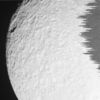
Tethys-N00040034.jpgTethys Fly-By (1)57 visiteIl passaggio ravvicinato di Cassini accanto a Tethys, un'altra enigmatica luna di Saturno (già, ma quale luna non contiene "enigmi" e stranezze?), ci offre nuovi spunti di riflessione e nuovi argomenti per anticipare le più famose "correnti di pensiero" sulla Natura e le ragioni circa i caratteri e le configurazioni che le superfici di questi lontani e piccoli corpi rocciosi hanno assunto nelle ere.
Partiamo dunque, con questa visione di Tethys ottenuta da circa 78.000 Km di distanza: un numero - tendenzialmente - infinito di crateri ricopre la superficie di Tethys in ogni direzione e, in alto a Sx, quasi a ridosso della linea del Terminatore, possiamo già vedere un grande ed antico bacino (forse da impatto?), decisamente profondo e sicuramente interessante, vista anche l'ombra anomala che si stende, partendo dalla parete Sud, verso il suo centro. Un'ombra così anomala e squadrata (notate l'angolo retto che forma alla sua fine, circa al centro del bacino), da farci subito pensare male...
|
|
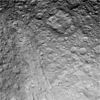
Tethys-N00040044.jpgTethys Fly-By (2)57 visiteSiamo a 67.000 Km circa dalla superficie di Tethys: le "striations", come le chiamano alla NASA sembrano caratterizzare questo ruvido panorama, fatto di centinaia di crateri, un grande canalone che 'taglia' il paesaggio dall'alto in basso (a Sx) e svariati mini-canali che, a loro volta, tagliano il canalone maggiore (nonchè tantissimi altri rilievi) e che, a ben vedere, non sembrano essere molto antichi.
Qualche striscia di crateri che segna il possibile impatto, sul suolo di Tethys, di corpi celesti già frammentati (comete?), si riesce a scorgere, in particolare sul quadrante alto a Sx del frame. Molto intrigante, poi, il bacino di forma vagamente quadrata (cerchiato in grigio), che contiene una serie di crateri dalle forme veramente curiose e che difficilmente possono essere ricondotte ad attività di impatto.
|
|
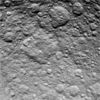
Tethys-N00040064.jpgTethys Fly-By (3)57 visiteLa stessa area di cui al frame precedente, ma ora siamo a circa 44.000 Km di distanza.
|
|
| 2245 immagini su 188 pagina(e) |
|
|
|
|
|
97 | |
|
|
|
|
|
|





