| Piú viste - Saturn: the "Ringed Beauty" and His Moons |

Hyperion-N00035398.jpgHyperion, from about 202.000 Km (3)57 visiteE' davvero semplice 'caos' quell'estrema complessità che caratterizza il moto di Iperione, così come la struttura di alcuni lontanissimi 'oggetti' di origine forse stellare (quali i Buchi Neri, i Quasar ed i Pulsar etc.), oppure anche questi 'movimenti' e queste 'strutture', così lontane dal nostro pensare e sapere, obbediscono a delle Logiche Maggiori che, oggi, non riusciamo neppure ad immaginare?
Questa piccola diversione filosofica non è, a nostro modo di vedere, un inutile esercizio dialettico: noi siamo sempre più convinti, infatti, che la disarmante 'semplicità' con cui la Scienza Consolidata cerca di spiegare alcuni fenomeni, unita all'estrema - ed inutile - complessità con cui Essa cerca di spiegarne altri, sìano entrambe espressioni di un notevole imbarazzo di fondo il quale si manifesta davanti ad una realtà piuttosto evidente.
Quale? La realtà che l'Universo è ancora molto lontano non solo dall'essere compreso nei suoi meccanismi quanto, addirittura, dall'essere anche solo immaginato...
|
|

TheRings-PIA07522.jpgFour versions of the "F-Ring"57 visiteCaption NASA originale:"This montage of 4 images of Saturn's knotted F-Ring shows different locations around the Ring itself. Even though all the images were taken within a few hours of each other, there is remarkable variation in the structure of the F-Ring at these four locations.
For example, the number of ring strands differs from image to image and in some images, kinks are clearly visible in the F-Ring, while other regions appear more smooth.
Astronomers believe that the structure of Saturn's F-Ring is governed by its shepherding moons, Prometheus and Pandora. The F-Ring's appearance is expected to vary depending on how recently a ring section has encountered each moon and how close the moon came to the ring".
Nota: nel primo quadro (in alto a Sx) c'è qualcosa, posto proprio al di sopra del 'nodo' centrale visibile sull'intreccio più luminoso dell'Anello F, che sembra un 'filamento' o, comunque, un oggetto estraneo all'Anello F stesso, ma reale (NON crediamo che sia un photo-artifact). Cos'è?
|
|

Pandora-PIA07530.jpgPandora: the closest view so far!57 visiteCaption NASA originale:"This is one of Cassini's closest views to date of Saturn's F-Ring shepherd moon Pandora. At least one crater is visible on the surface of this moon, which is thought to be an icy rubble pile, loosely bound together by gravity. Pandora is 84 Km across.
Several of Saturn's Ring moons, including Pandora, show elongated, oval-like shapes with their long axes oriented along the moon-Saturn line. In this view, Cassini is looking at the side of Pandora facing away from Saturn. The image shows the moon's leading hemisphere (although, as mentioned, Pandora is not actually round). To the right, much of the moon's surface is in shadow. The image was taken in visible light with the Cassini spacecraft narrow-angle camera on May 20, 2005, at a distance of approx. 346.000 Km from Pandora and at a Sun-Pandora-spacecraft, or phase, angle of 21°".
|
|

Epimetheus-PIA07531.jpgEpimetheus57 visiteCaption NASA originale:"Cassini continues to survey the small worlds that orbit near Saturn's Rings, capturing this view of Epimetheus.
The moon's lumpy, irregular topography can be seen here, along with several impact craters. The image was taken in visible light with the Cassini spacecraft narrow-angle camera on May 20, 2005, at a distance of about 345.000 Km from Epimetheus and at a phase angle of 26°.
Resolution in the original image was 2 Km per pixel.
The view was also magnified by a factor of two and contrast-enhanced to aid visibility of the moon's surface".
|
|
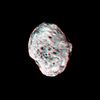
Hyperion-anagliph-PIA06244.jpgStereo-Hyperion! (from about 176.000 Km)57 visiteCaption NASA originale:"Saturn's moon Hyperion pops into view in this stereo anaglyph (or 3D view) created from Cassini images. Images taken from slightly different viewing angles allow construction of such stereo views, which are helpful in interpreting the moon's irregular shape.
Hyperion's unusual dimensions are 164 by 130 by 107 Km (such as 102 by 81 by 66 miles).
Craters are visible on the moon's surface down to the limit of resolution in this image, about 1 Km (0,6 mile) per pixel. The fresh appearance of most of these craters, combined with their high spatial density, makes Hyperion look something like a sponge. The moon's spongy-looking exterior is an interesting coincidence, as Hyperion's density seems to indicate that it is porous and much of its interior is filled with voids.
Dark material is concentrated in the bottoms of many craters visible here, perhaps resulting from the down slope movement of material, combined with sublimation of brighter ice".
|
|

Enceladus-N00037076.jpgGood-bye Enceladus! (1)57 visiteEncelado è ormai una splendida "falce" nel cielo e questo ci fa capire che la Sonda Cassini ha ormai superato il suo punto di maggior vicinanza a questo mondo di ghiaccio e di neve, i cui caratteri superficiali terranno impegnati Scienziati e Ricercatori per mesi (o forse anni...).
Cassini si allontana rapidamente ed ora si sta proiettando, ancora una volta, verso lo Spazio di Saturno.
Ma ritornerà...
|
|

Enceladus-N00037083.jpgGood-bye Enceladus! (3)57 visiteUna curiosità (valida anche per i frames precedenti): notate come si riescono a vedere bene anche quei rilievi di Encelado che, superata la linea del terminatore, sono ora immersi nella notte.
E' un peccato che la maggior parte dei frames ottenuti fra i 500 ed i 600 Km di distanza da Encelado sìano risultati, alla fine, completamente (o quasi) neri.
|
|

Prometheus_and_Pandora-PIA07544.jpgPrometheus and Pandora57 visiteSaturn's moons Prometheus and Pandora are captured here in a single image taken from less than 1° above the dark side of Saturn's Rings. Pandora is on the right and Prometheus is on the left. Prometheus is 102 Km (63 miles) across, while Pandora is 84 Km (52 miles) across.
The two moons are separated by about 69.000 Km (about 43.000 miles) in this view. The F-Ring, extending farthest to the right, contains a great deal of fine, icy material that is more the size of dust than the boulders thought to comprise the dense B-Ring.
These tiny particles are particularly bright from this viewing geometry, especially at right near the ansa, or edge.
At left of center, a couple of ringlets within the Encke gap (325 Km or 200 miles wide) can also be easily seen due to their fine dust-sized material. The other dark features in the Rings are density waves and bending waves. The image was taken in visible light from a mean distance of 1,85 MKM from the moons.
|
|

Saturn-W00009483.jpgHow many moons around Saturn? (1) - frame W0000948357 visiteUna piccola sequenza fatta di 4 frames che ci mostra 2 delle (tante) lune in transito accanto - almeno dal punto di vista di Cassini - al "Signore degli Anelli".
A dire il vero si tratta di immagini difficili da interpretare, in quanto non solo sono leggermente "mosse", ma anche estremamente povere in termini di informazioni circostanziali. Non sappiamo, quindi, quali lune stiamo guardando (anche se la più grande e luminosa potrebbe essere Titano); ciò che sappiamo è che, ad un certo punto, gli oggetti luminosi ripresi da Cassini aumenteranno e cambieranno configurazione.
Guardate Voi stessi...
|
|

Mimas-Thunderbolts.jpgThese "Holes" are way too big for such a small Moon...57 visite"The impact theory of crater formation may not survive the discovery of gigantic craters on relatively small moons or rocks. A good case in point is Saturn’s moon Mimas. Electric Universe proponents say that only electric discharge could produce the observed depression without shattering the moon". Il che significa, in altre e più semplici parole, che la Teoria Shoemakeriana che vuole il 99,99% dei crateri che vediamo sui vari corpi celesti quali mere conseguenze di impatti, alla fine, NON REGGE!
Dopo le teorizzazioni del Dr Feltri e le speculazioni di Lunar Explorer, ora ci accorgiamo che anche ALTRI Ricercatori hanno iniziato a valutare nuovi dati ed elementi per la costruzione di una Teoria Alternativa a quella del (comunque) insigne Shoemaker.
E' possibile che tutti questi "Studi Alternativi" stiano concretando, in una certa misura, l'alba di un periodo di transizione scientifica la cui portata e durata, tuttavia, non sono ancora - ad oggi - stimabili.
|
|

Saturn-PIA07545.jpgSaturn and Tethys57 visiteCaption NASA originale:"The majesty of Saturn overwhelms in this image from Cassini. Saturn's moon Tethys glides past in its orbit and the icy rings mask the frigid northern latitudes with their shadows. The image was taken in visible green light with the Cassini spacecraft wide-angle camera on June 10, 2005, at a distance of approx. 1,4 MKM (about 900.000 miles) from Saturn. The image scale is 80 Km (about 50 miles) per pixel".
|
|

Telesto~0.jpgThe Trojan Moons: Telesto, from 533.000 Km57 visiteCaption NASA originale:"This is Cassini's best look yet at the Trojan moon Telesto (24 Km, or 15 miles across), which orbits Saturn about 60° ahead of the much larger Tethys (1.071 Km, or 665 miles across). Calypso (22 Km, or 14 miles across) is the other Tethys Trojan and trails the larger moon by 60°. Trojan moons are found near gravitationally stable points ahead or behind a larger moon.
Cassini is able to partly resolve Telesto's shape in this view, but surface features are too small to be visible from this distance.
The image was taken in visible light with the Cassini spacecraft narrow-angle camera on May 20, 2005, at a distance of approx. 533.000 Km (331.000 miles) from Telesto. The image scale is 3 Km (about 2 miles) per pixel. This view of Telesto has been magnified by a factor of three and sharpened to aid visibility".
|
|
| 2245 immagini su 188 pagina(e) |
 |
|
|
|
|
96 | |
|
|
|
|





