| Piú viste - Saturn: the "Ringed Beauty" and His Moons |
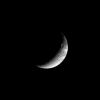
Dione-PIA10577.jpgCrescent Dione57 visiteCaption NASA:"This high-phase view of Dione shows the great contrast between the highly reflective "wisps" and the surrounding terrain. These wispy lines are geologically young fractures exposing the icy surface of the moon.
Lit terrain seen here is on the Trailing Hemisphere of Dione (about 1123 Km, or approx. 698 miles, across). North on Dione is up.
The view was acquired from a position 39° South of the moon's Equator. The image was taken in Visible Light with the Cassini Spacecraft narrow-angle camera on Dec. 26, 2008. The view was obtained at a distance of approx. 789.000 Km (about 490.000 miles) from Dione and at a Sun-Dione-spacecraft, or Phase, Angle of 124°
Image scale is roughly 5 Km (about 3 miles) per pixel".MareKromium
|
|

Saturn-PIA10585.jpgSaturnian Terminator (Natural Colors; credits: Lunar Explorer Italia)57 visiteCaption NASA:"The Terminator nearly covers the South Pole of Saturn and its stormy vortex in darkness.
As the Southern Hemisphere moves toward Winter in the Planet's 29-year orbit, darkness eventually will consume the vortex. But this seasonal change also will bring the North Pole into the light.
This view looks toward the sunlit side of the Rings from about 69° below the Ring-Plane.
The image was taken with the Cassini Spacecraft wide-angle camera on Jan. 6, 2009 using a spectral filter sensitive to wavelengths of near-InfraRed Light centered at 752 nanometers. The view was acquired at a distance of approx. 761.000 Km (about 473.000 miles) from Saturn and at a Phase Angle of 96°.
Image scale is roughly 42 Km (approx. 26 miles) per pixel.MareKromium
|
|

Rhea-PIA10586.jpgRhea (Natural Colors; credits: Lunar Explorer Italia)57 visiteCaption NASA:"A wide crater dominates the lower right of this image while part of Rhea's brightly lit, wispy terrain can still be seen near the limb of the moon.
Smaller craters are overprinted upon this crater, telling the story of an extremely old feature that has collected impacts over the eons. Younger craters also have been collected on another of Rhea's large basins — Tirawa (see also PIA08976).
North on Rhea (approx. 1528 Km, or about 949 miles across) is up. This view looks toward the Saturn facing-Side of Rhea. The image was taken in visible light with the Cassini Spacecraft narrow-angle camera on Aug. 27, 2008. The view was acquired at a distance of approx. 1,1 MKM (such as about 680,000 miles) from Rhea and at a Sun-Rhea-Spacecraft, or Phase, Angle of 56°.
Image scale is roughly 6 Km (about 4 miles) per pixel".MareKromium
|
|

Enceladus-PIA01394.jpgEnceladus, with "Pink" Nuances (by Ted Stryk)57 visitenessun commentoMareKromium
|
|
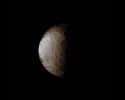
Japetus-V2-LXT.jpgJapetus (Natural Colors; credits: Lunar Explorer Italia)57 visitenessun commentoMareKromium
|
|

Saturn-W00051968-70-71.jpgThe North Pole of Saturn (Natural Colors; credits: Dr M. Faccin)57 visiteCon calma, abbiamo "rivelato" quelli che, se non altro a nostro parere (ed in accordo alla nostra tecnica di colorizzazione delle immagini RAW), erano e sono i "True" e "Natural" colors di Marte.
Adesso è la volta di Saturno e delle sue mutevoli lune. In questa elaborazione, un esempio (il primo, di fatto) di processing RGB per i Colori Naturali realizzato dal nostro ECCEZIONALE Dr Faccin.
Guardate e valutate Voi.MareKromium
|
|
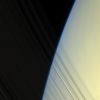
Saturn-PIA10598.jpgThe C-Ring (Natural Colors; credits: NASA/JPL/Space Science Institute)57 visiteCaption NASA:"The Cassini Spacecraft peers through Saturn's delicate, translucent inner C-Ring to see the diffuse blue limb of Saturn's Atmosphere.
This view looks toward the unilluminated side of the rings from about 20° above the Ring-Plane. Images taken using red, green and blue spectral filters were combined to create this Natural Color view. The images were obtained with the Cassini Spacecraft narrow-angle camera on April 25, 2008 at a distance of approx. 1,5 MKM (about 930.000 miles) from Saturn.
Image scale is roughly 8 Km (approx. 5 miles) per pixel".MareKromium
|
|

The_Rings-PIA11452.jpgSpokes in the B-Ring (Natural Colors; credits: Lunar Explorer Italia)57 visiteCaption NASA:"As Cassini sped around Saturn, the Spacecraft turned to snap this image of bright Spokes giving chase around the B-Ring.
These radial markings are appearing more often as Saturn approaches Equinox (August 2009) (see also PIA11144).
This view looks toward the sunlit side of the rings from about 31° below the Ring-Plane.
The image was taken in visible light with the Cassini Spacecraft wide-angle camera on Feb. 2, 2009. The view was acquired from a distance of approx. 578.000 Km (such as about 359.000 miles) from Saturn and at a Sun-Saturn-Spacecraft, or Phase, Angle of 144°.
Image scale is roughly 30 Km (about 20 miles) per pixel".MareKromium
|
|
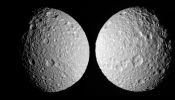
Mimas-Cs.jpgMimas, from Cassini57 visitenessun commentoMareKromium
|
|

Rhea-PIA11458.jpgRhea (Natural Colors; credits: Lunar Explorer Italia)57 visiteCaption NASA:"The Terminator between light and dark throws Rhea's cratered surface into stark relief while the Southern Hemisphere is scored by bright icy cliffs.
North on Rhea is up and rotated 42° to the right in this 2-tile mosaic. This view looks toward the Leading Hemisphere of Rhea (approx. 1528 Km, or about 949 miles across).
The image was taken in visible light with the Cassini spacecraft narrow-angle camera on Feb. 2, 2009. The view was acquired at a distance of approx. 181.000 Km (such as about 112.000 miles) from Rhea and at a Sun-Rhea-Spacecraft, or Phase, Angle of 91°.
Image scale is roughly 1 Km (about 3300 feet) per pixel".MareKromium
|
|
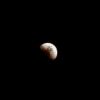
Japetus-PIA11460.jpgJapetus, from far away (Natural Colors; credits: Lunar Explorer Italia)57 visiteCaption NASA:"The Cassini Spacecraft casts its gaze across 4 MKM space for this snapshot of Japetus, Saturn's most distant Major Moon. Japetus — about 1471 Km (914 miles) across — is the 3rd largest moon, but its inclined orbit is much farther out from the other Major Moons, where Cassini spends most of its time. Nonetheless, the moon's distinctive two-tone surface is obvious.
This view looks toward the Leading Hemisphere of Japetus. North on Japetus is up and rotated 2° to the right. The image was taken in visible light with the Cassini Spacecraft narrow-angle camera on March 3, 2008.
The view was acquired at a distance of approx. 4 MKM (such as about 2,5 MMs) from Japetus and at a Sun-Japetus-Spacecraft, or Phase, Angle of 69°.
Image scale is roughly 24 Km (about 15 miles) per pixel".MareKromium
|
|
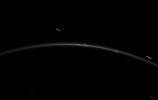
The_Rings-PIA11467.jpgMoonlet in the "G"-Ring57 visiteCaption NASA:"The faint "G"-Ring surrounding Saturn offers up a glimpse of its newfound tiny moonlet. The moonlet is near the center of this image.
A long exposure of 46" was required to capture the light from this tiny object and "G"-Ring, so the moonlet and a few stars have been smeared by motion, the stars showing up as short diagonal dashes.
The moonlet has also been smeared and appears to be a short vertical dash that is aligned with the Ring.
In August 2008 Cassini scientists spotted this moonlet, dubbed S/2008 S 1. It orbits in an arc, or partial ring, within the "G"-Ring. Imaging team scientists estimated the moonlet's diameter at about half a kilometer (one-third mile). For earlier images of this moonlet, see PIA11148.
This view looks toward the unilluminated side of the Rings from about 14° above the Ring-Plane. The image was taken in Visible Light with the Cassini Spacecraft narrow-angle camera on Feb. 20, 2009. The view was acquired at a distance of approx. 1,2 MKM (about 746.000 miles) from Saturn. Image scale is roughly 7 Km (a little more than 4 miles) per pixel".MareKromium
|
|
| 2245 immagini su 188 pagina(e) |
 |
|
|
|
|
93 | |
|
|
|
|





