| Piú viste - Saturn: the "Ringed Beauty" and His Moons |

SaturnSpaceN00115280-N00115290.gifThrough the "Eyes" of Cassini... (GIF-Movie; credits: Dr G. Barca)57 visiteSuggestivo, affascinante e, alla fine - semplicemente -, bello! (repetita iuvant)MareKromium
|
|

Sky-W00049978.jpgBizarre Reflection in the Space of Saturn...57 visiteCaption NASA:"W00049978.jpg was taken on October 09, 2008 and received on Earth October 09, 2008. The camera was pointing toward ENCELADUS that, at the time, was approx. 536.451 Km away. The image was taken using the CL1 and CL2 filters".MareKromium
|
|

UnusualObject-N00122114-1.jpgUnusually-looking "Object" in the Space of Saturn57 visiteSi tratta, senza dubbio (!), di una delle tantissime Lune Saturniane, ma quale? Scherzi ed ironie a parte, l'Oggetto Anomalo che Vi proponiamo appare solo in un frame, ottenuto dalla distanza di 433.941 Km dall'Anello "F" di Saturno.
Nel frame successivo (distanza 433.359 Km) e nel frame precedente (distanza 434.224 Km dal Main Target) nulla appare nella porzione alta dell'inquadratura.
L'Oggetto Anomalo, come l'edm ci mostra, possiede una forma piuttosto allungata ed irregolare (e attenzione: l'irregolarità del Corpo Celeste NON E' stata creata, ma solo ACCENTUATA dalla circostanza per cui il frame è leggermente "mosso") e la sua albedo ci sembra alquanto alta.
Non si distinguono (o almeno: noi non riusciamo a distinguere) rilievi superficiali idonei a consentirci l'identificazione dell'Oggetto, ma la nostra sensazione è che POTREBBE trattarsi della Luna Saturniana "Hyperion" (la quale, in determinate inquadrature, pare effettivamente assomigliare ad una sorta di "oliva" - un pà raggrinzita).
Ad ogni modo, questo frame è indubbiamente interessante e meriterebbe qualche approfondimento...MareKromium
|
|

Enceladus-PIA11123.jpgEnceladus Oct. 9, 2008 Flyby57 visiteCaption NASA:"The image was taken with the Cassini Spacecraft narrow-angle camera on Oct. 9, 2008, from a distance of approx. 47.000 Km (about 29.000 miles) from Enceladus.
Image scale is 279 meters (916 feet) per pixel".MareKromium
|
|

The_Rings-ERing-W00051101.jpgThe tenuous E-Ring of Saturn (RAW frame)57 visiteCaption NASA:"W00051101.jpg was taken on November 12, 2008 and received on Earth November 13, 2008. The camera was pointing toward SATURN's E-RING that, at the time, was approx. 1.234.847 Km away.
The image was taken using the CL1 and BL1 filters".
Nota Lunexit: in questo frame potete osservare una serie impressionante di image-artifacts (noise, per lo più, come spesso si vede nei frames CASSINI).MareKromium
|
|

Saturn-W00051225-MF.jpgThe colourful Upper Atmosphere of Saturn (True - but enhanced - Colors; credits: Dr M. Faccin)57 visiteUn frame bellissimo, ed incommentabile...MareKromium
|
|

The_RingsPIA11142.jpgSaturn's Rings: the whole System (natural colors; credits: NASA)57 visiteCaption NASA:"Details of Saturn's icy Rings are visible in this sweeping view from Cassini of the Planet's glorious Ring System.
This natural color mosaic, taken from 10° below the illuminated side of the Rings, shows, from left to right, radially outward from Saturn, the C-Ring (with its Colombo and Maxwell Gaps); the B-Ring and the Cassini Division beyond, with the intervening Huygens Gap; the A-Ring (with its Encke and Keeler Gaps); and, on the far right, the narrow F-Ring. The total span covers approx. 65.700 Km (such as about 40.800 miles).
Although it is too faint to be seen here, the D-Ring is located just to the left of the C-Ring.
It is interesting to compare this view with PIA08389, which shows the unilluminated side of the Rings. The difference in brightness of the B-Ring relative to the other Rings is striking. When illuminated directly by the Sun, the B-Ring appears brighter than the adjacent A and C-Rings; however, when viewing the unlit side of the B-Ring, the A and C-Rings appear brighter.
This phenomenon occurs because the density of the B-Ring is greater than that of the A or C-Rings.
The mosaic was constructed from 45 narrow-angle-camera images — 15 separate sets of red, green and blue images — taken over the course of about four hours, as Cassini scanned across the Rings. The images in this view were obtained by NASA's Cassini Spacecraft on Nov. 26, 2008, at a distance of approx. 1,1 MKM (such as about 700.000 miles) from Saturn and at a Phase Angle of 28°.
Image scale in the radial (horizontal) direction is about 7 Km (4,3 miles) per pixel".MareKromium
|
|

The_Rings-Shadow-N00127583.jpgEclipsing the Rings (4)57 visitenessun commentoMareKromium
|
|

The_Rings-Shadow-N00127582.jpgEclipsing the Rings (3)57 visitenessun commentoMareKromium
|
|
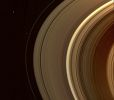
The_Rings-PIA10556.jpgFantastic View (possible True Colors; credits: Lunar Explorer Italia)57 visiteCaption NASA:"Three of Saturn's satellites are visible in this snapshot from the Cassini Spacecraft. Janus (approx. 179 Km, or about 111 miles across) is in the top left of the image. Pandora (approx. 81 Km, or about 50 miles across) is just outside the F-Ring and Pan (approx. 28 Km, or about 17 miles across) is the small moon that has cut a path inside the Rings below the center of the image.
This view looks toward the unilluminated side of the Rings from about 27° above the Ring-Plane. The image was taken in visible light with the Cassini Spacecraft wide-angle camera on Dec. 7, 2008 using clear filters: CL1 (635 nm) and CL2 (635 nm). It was obtained from a distance of approx. 1 MKM (such as about 641.000 miles) from Pan and at a Sun-Pan-Spacecraft, or Phase, Angle of 33°. Image scale is roughly 62 Km (about 38 miles) per pixel".MareKromium
|
|
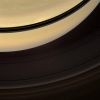
The_Rings-PIA10563.jpgThe Rings of Saturn (Natural Colors; credits: NASA/JPL/Space Science Institute)57 visiteCaption NASA:"Shadows cast onto Saturn by its Rings, visible here as dark bands, move steadily towards the Equator and grow thinner as Equinox approaches.
The Sun will cross Saturn's Ring-Plane on Aug. 10, 2009. Color variations between clouds in the Northern Hemisphere are more apparent than those in the Southern Hemisphere, which seems relatively bland, as Spring arrives in the North and Fall in the South.
Images taken using red, green and blue spectral filters were combined to create this natural color view. The images were acquired with the Cassini spacecraft wide-angle camera on Nov. 22, 2008 at a distance of approx. 859.000 Km (about 533.000 miles) from Saturn and at a Phase Angle of 56°.
Image scale is roughly 48 Km (about 30 miles) per pixel".MareKromium
|
|
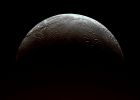
Enceladus-PIA10573.jpgCrescent Enceladus (Natural Colors; credits: Lunar Explorer Italia)57 visiteCaption NASA:"Sunrise uncovers both old and new Enceladus in this image from the Cassini Spacecraft. The lit side of the moon faces Saturn in this view of the Trailing Hemisphere. Old craters still pockmark the Northern Hemisphere while more recent geologic activity has swept them away in the South. North is on the right (Dx) in this image.
Mountain Ranges, a.k.a. "Dorsae", undulate across the moon's surface near the Equator.
From this high northern viewing angle, the South Pole's fascinating "Tiger Stripe Area" lies just out of view. Sulci, a.k.a. "furrows", in that area, are the sources of icy plumes being studied by Cassini scientists.
(See also PIA07800 and PIA09761).
Also near the Tiger Stripes are rift segments that resemble the zigzag patterns seen on Earth of sea-floor spreading from upwelling magma. See PIA11138 for a comparison of the phenomena.
Like outstretched fingers, the Samarkand Sulci reach from the West toward the North Pole, clearing their path of craters and slicing some in half.
This Natural Colors mosaic combines narrow-angle camera images obtained through UltraViolet, Green, and near-InfraRed camera filters. The images were acquired on Dec. 2, 2008 at a distance of approx. 124.000 Km (such as about 77.000 miles) from Enceladus and at a Sun-Enceladus-Spacecraft, or Phase, Angle of 116°.
Image scale is roughly 742 meters (2430 feet) per pixel".MareKromium
|
|
| 2245 immagini su 188 pagina(e) |
 |
|
|
|
|
92 | |
|
|
|
|





