| Piú viste - Saturn: the "Ringed Beauty" and His Moons |

Mimas-PIA10469.jpgShadowed Mimas (natural colors; credits: Lunexit)57 visiteCaption NASA:"The shadow of Saturn's Rings sits upon the Northern Hemisphere of Mimas like a dark cap. In this Cassini Spacecraft view, which looks toward high Northern Latitudes on Mimas, the moon is just grazing the shadow of the Rings. The two distinct shadow regions seen here are the penumbra and the much darker umbra. An observer within the penumbral region on Mimas would have their view of the Sun partly blocked by the Rings.
For a viewer within the umbral region, the Rings would completely cover the Sun. However, since the Rings are not opaque, the Sun would still be dimly visible.
The image was brightened to reveal faint details within the eclipsed region, illuminated dimly by sunlight filtering through the Rings. Another view, PIA10467, was acquired a few minutes prior to this image, and shows a nearly identical Mimas (about 396 Km, or approx. 246 miles across) before the Rings' shadow obscured the surface.
The image was taken in visible light with the Cassini Spacecraft narrow-angle camera on Aug. 4, 2008. The view was acquired at a distance of approx. 143.000 Km (89.000 miles) from Mimas and from about 67° above the moon's Equator. The Phase Angle in the image is 106°.
Image scale is 856 meters (2808 feet) per pixel".MareKromium
|
|

The_Rings-PIA10470.jpgGravitational Interactions or just Evidence of a recent Collision?57 visiteCaption NASA:"The three bright, finger-like jets of material seen here suggest that a small object has collided with the core of Saturn's F-Ring. Cassini Spacecraft imaging scientists have shown that the F-Ring shepherd moon Prometheus influences the structure of the Ring in 2 ways: 1) by creating streamer-channel features as it closely approaches (and partially passes into) the Ring (see PIA08397) and 2) by perturbing the orbits of small objects within the F-Ring Region which then exert their own influence on nearby Ring particles, as seen here.
These small, embedded objects could be temporary clumps of particles, but scientists think at least one of the objects could be a more permanent moonlet.
This view looks toward the sunlit side of the Rings from about 40° below the Ring-Plane. The image was taken in visible light with the Cassini Spacecraft narrow-angle camera on Aug. 20, 2008. The view was obtained at a distance of approx. 685.000 Km (such as about 426.000 miles) from Saturn and at a Phase Angle of 40°.
The image scale is about 5 Km per pixel".MareKromium
|
|

SaturnSpaceN00115280-N00115290.gifThrough the "Eyes" of Cassini... (GIF-Movie; credits: Dr G. Barca)57 visiteSuggestivo, affascinante e, alla fine - semplicemente -, bello! (repetita iuvant)MareKromium
|
|

Sky-W00049978.jpgBizarre Reflection in the Space of Saturn...57 visiteCaption NASA:"W00049978.jpg was taken on October 09, 2008 and received on Earth October 09, 2008. The camera was pointing toward ENCELADUS that, at the time, was approx. 536.451 Km away. The image was taken using the CL1 and CL2 filters".MareKromium
|
|

UnusualObject-N00122114-1.jpgUnusually-looking "Object" in the Space of Saturn57 visiteSi tratta, senza dubbio (!), di una delle tantissime Lune Saturniane, ma quale? Scherzi ed ironie a parte, l'Oggetto Anomalo che Vi proponiamo appare solo in un frame, ottenuto dalla distanza di 433.941 Km dall'Anello "F" di Saturno.
Nel frame successivo (distanza 433.359 Km) e nel frame precedente (distanza 434.224 Km dal Main Target) nulla appare nella porzione alta dell'inquadratura.
L'Oggetto Anomalo, come l'edm ci mostra, possiede una forma piuttosto allungata ed irregolare (e attenzione: l'irregolarità del Corpo Celeste NON E' stata creata, ma solo ACCENTUATA dalla circostanza per cui il frame è leggermente "mosso") e la sua albedo ci sembra alquanto alta.
Non si distinguono (o almeno: noi non riusciamo a distinguere) rilievi superficiali idonei a consentirci l'identificazione dell'Oggetto, ma la nostra sensazione è che POTREBBE trattarsi della Luna Saturniana "Hyperion" (la quale, in determinate inquadrature, pare effettivamente assomigliare ad una sorta di "oliva" - un pà raggrinzita).
Ad ogni modo, questo frame è indubbiamente interessante e meriterebbe qualche approfondimento...MareKromium
|
|

Enceladus-PIA11123.jpgEnceladus Oct. 9, 2008 Flyby57 visiteCaption NASA:"The image was taken with the Cassini Spacecraft narrow-angle camera on Oct. 9, 2008, from a distance of approx. 47.000 Km (about 29.000 miles) from Enceladus.
Image scale is 279 meters (916 feet) per pixel".MareKromium
|
|

The_Rings-ERing-W00051101.jpgThe tenuous E-Ring of Saturn (RAW frame)57 visiteCaption NASA:"W00051101.jpg was taken on November 12, 2008 and received on Earth November 13, 2008. The camera was pointing toward SATURN's E-RING that, at the time, was approx. 1.234.847 Km away.
The image was taken using the CL1 and BL1 filters".
Nota Lunexit: in questo frame potete osservare una serie impressionante di image-artifacts (noise, per lo più, come spesso si vede nei frames CASSINI).MareKromium
|
|

Saturn-W00051225-MF.jpgThe colourful Upper Atmosphere of Saturn (True - but enhanced - Colors; credits: Dr M. Faccin)57 visiteUn frame bellissimo, ed incommentabile...MareKromium
|
|

The_RingsPIA11142.jpgSaturn's Rings: the whole System (natural colors; credits: NASA)57 visiteCaption NASA:"Details of Saturn's icy Rings are visible in this sweeping view from Cassini of the Planet's glorious Ring System.
This natural color mosaic, taken from 10° below the illuminated side of the Rings, shows, from left to right, radially outward from Saturn, the C-Ring (with its Colombo and Maxwell Gaps); the B-Ring and the Cassini Division beyond, with the intervening Huygens Gap; the A-Ring (with its Encke and Keeler Gaps); and, on the far right, the narrow F-Ring. The total span covers approx. 65.700 Km (such as about 40.800 miles).
Although it is too faint to be seen here, the D-Ring is located just to the left of the C-Ring.
It is interesting to compare this view with PIA08389, which shows the unilluminated side of the Rings. The difference in brightness of the B-Ring relative to the other Rings is striking. When illuminated directly by the Sun, the B-Ring appears brighter than the adjacent A and C-Rings; however, when viewing the unlit side of the B-Ring, the A and C-Rings appear brighter.
This phenomenon occurs because the density of the B-Ring is greater than that of the A or C-Rings.
The mosaic was constructed from 45 narrow-angle-camera images — 15 separate sets of red, green and blue images — taken over the course of about four hours, as Cassini scanned across the Rings. The images in this view were obtained by NASA's Cassini Spacecraft on Nov. 26, 2008, at a distance of approx. 1,1 MKM (such as about 700.000 miles) from Saturn and at a Phase Angle of 28°.
Image scale in the radial (horizontal) direction is about 7 Km (4,3 miles) per pixel".MareKromium
|
|

The_Rings-Shadow-N00127583.jpgEclipsing the Rings (4)57 visitenessun commentoMareKromium
|
|

The_Rings-Shadow-N00127582.jpgEclipsing the Rings (3)57 visitenessun commentoMareKromium
|
|
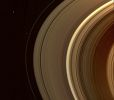
The_Rings-PIA10556.jpgFantastic View (possible True Colors; credits: Lunar Explorer Italia)57 visiteCaption NASA:"Three of Saturn's satellites are visible in this snapshot from the Cassini Spacecraft. Janus (approx. 179 Km, or about 111 miles across) is in the top left of the image. Pandora (approx. 81 Km, or about 50 miles across) is just outside the F-Ring and Pan (approx. 28 Km, or about 17 miles across) is the small moon that has cut a path inside the Rings below the center of the image.
This view looks toward the unilluminated side of the Rings from about 27° above the Ring-Plane. The image was taken in visible light with the Cassini Spacecraft wide-angle camera on Dec. 7, 2008 using clear filters: CL1 (635 nm) and CL2 (635 nm). It was obtained from a distance of approx. 1 MKM (such as about 641.000 miles) from Pan and at a Sun-Pan-Spacecraft, or Phase, Angle of 33°. Image scale is roughly 62 Km (about 38 miles) per pixel".MareKromium
|
|
| 2245 immagini su 188 pagina(e) |
 |
|
|
|
|
91 | |
|
|
|
|





