| Piú viste - Saturn: the "Ringed Beauty" and His Moons |

Japetus-PIA08375.jpgThe "Voyager" Mountains57 visiteCaption NASA:"Cassini zooms in, for the first time, on the patchy, bright and dark mountains originally identified in images from the NASA Voyager spacecraft taken more than 25 years earlier. The image was acquired during Cassini's only close flyby of Iapetus, a two-toned moon of Saturn.
The terrain seen here is located on the Equator of Japetus at approximately 199° West Longitude, in the Transition Region between the moon's bright and dark Hemispheres. North is up.
The image was taken on Sept. 10, 2007, with the Cassini spacecraft narrow-angle camera at a distance of approximately 9.240 Km (5.740 miles) from Japetus. Image scale is 55 meters (180 feet) per pixel".MareKromium
|
|
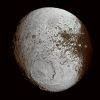
Japetus-PIA08384-2.jpgThe Other Side of Japetus (possible natural colors; elab. Lunexit)57 visitenessun commentoMareKromium
|
|

Japetus-PIA08381.jpgThe "Transition Region of Japetus" (possible natural colors - elab. Lunexit)57 visiteThe Transition Region from Saturn's moon Japetus' dark Leading Hemisphere to its bright Trailing Hemisphere is a complicated patchwork of craters and highlands, with low elevations filled in by dark material.
An explanation of the pattern visible here might be key to a full understanding of the bright/dark dichotomy on Japetus (about 1468 Km across).
The view is centered on the Equator and covers an area 711 Km wide by 417 Km tall (such as about 442 x 259 miles).
The giant Equatorial Ridge visible on the dark Leading Hemisphere is not present anymore in this Region. Instead, large, isolated mountains more than 10 Km tall are spread along the Equator. These mountains show bright western flanks, while the surrounding lowlands are generally dark.
This mosaic is an orthographic projection consisting of 21 image footprints across the surface of Japetus. The view is centered on terrain near 0,1° North Latitude and 199° West Longitude, in the quadrant of Japetus that faces away from Saturn. Image scale is approx. 83 meters (272 feet) per pixel. An orthographic view is most like the view seen by a distant observer looking through a telescope.
The clear spectral filter images in this mosaic were obtained with the Cassini spacecraft narrow- angle camera on Sept. 10, 2007, at distances ranging from 13.857 to 21.846 Km (such as about 8.610 to 13.574 miles) from Japetus.
MareKromium
|
|

Japetus-PIA08378.jpgSo close, and yet so far...57 visiteThis mosaic of Cassini images shows the smallest details ever observed on Saturn's moon Japetus.
Visible here are small craters as well as the base of a large mountain ridge located just South of the mosaic. At several places, bright spots about 20 to 50 meters (66 to 164 feet) across are visible. At these locations, more recent impactors have punched through the overlying blanket of dark material to reveal brighter, cleaner ice beneath.
Since the bright craters are relatively small and very shallow, it is likely that the dark blanket is rather thin in this area; it is assumed that its actual average thickness might be on the order of a foot.
The small crater at the upper left edge of the mosaic has a diameter of about 50 meters (164 feet) and shows a distinct ray pattern from excavated ice. This feature is so bright in comparison to the dark surrounding terrain that it had to be darkened manually so as not to look overexposed in this mosaic.
The mosaic consists of 8 image footprints across the surface of Japetus, presented here in simple cylindrical projection. The view is centered on terrain near 0° North Latitude, 164,9° West Longitude, within the dark Leading Hemisphere of Japetus. Image scale is approx. 10 meters (33 feet) per pixel.
The clear spectral filter images in this mosaic were obtained with the Cassini spacecraft narrow-angle camera on Sept. 10, 2007, at distances ranging from 1.627 to 2.040 Km (such as from about 1.011 to 1.268 miles) from Japetus.MareKromium
|
|

Enceladus-PIA08385.jpgThe sources of Enceladus' Fountains57 visiteCaption NASA:"This map of the South Polar Region of Enceladus shows the correlation between jet sources identified in Cassini imaging data and hot spots on the surface located by the Composite Infrared Spectrometer Instrument.
To identify jet source locations on the surface, imaging scientists carefully measured the locations and orientations of individual jets observed along the moon's limb in Cassini images taken from multiple viewing angles. For each jet measurement, the researchers then computed a curve, or ground track, on the surface of Enceladus along which that jet might lie. The ground tracks from all of the measurements made in the various images produced many intersections on this map. By considering the jet directions at every possible intersection, the researchers isolated 8 clusters of ground track intersections as jet sources.
The 8 identified jet source locations are labeled with yellow roman numerals. Composite Infrared Spectrometer hot spots are red boxes labeled with green capital letters.
The line-of-sight intersections indicating the measurements of each source in individual images are shown as colored diamonds.
White circles indicate the uncertainty in the locations of those sets of intersections.
The map is a polar stereographic projection of Cassini imaging data.
The 4 Tiger Stripe fractures, or sulci, are labeled here.
The South Pole is the dead center on the map.
Key longitudes are also labeled around the perimeter of the map".MareKromium
|
|

Dione-PIA09764.jpgThe "spiderweb like" streaks on Dione57 visiteCaption NASA:"Bright, wispy fractures streak across Dione's trailing side. Following the Voyager flybys of the early 80s, scientists considered the possibility that the streaks were bright material extruded by cryovolcanism. A quarter-century later, Cassini's close passes and sharp vision showed these features to be a system of braided canyons with bright walls.
North on Dione is up.
The image was taken in visible light with the Cassini spacecraft wide-angle camera on Sept. 30, 2007. The view was acquired at a distance of approx. 45.000 Km (such as about 28.000 miles) from Dione and at a Sun-Dione-spacecraft, or phase, angle of 36°.
Image scale is roughly 3 Km (about 2 miles) per pixel".MareKromium
|
|

The_Rings-PIA09782.jpgPrometheus' Trail57 visiteCaption NASA:"Seen here is the end result of the process that occurs every time the moon Prometheus closely approaches Saturn's F-Ring. The moon cuts a dark channel in the ring's inner edge that then shears out over successive orbits, giving the inner edge of the ring the grooved appearance seen here.
This process is described in detail, along with a movie of Prometheus creating one of the streamer/channel features, in Soft Collision.
The view is toward the sunlit side of the Rings from about 3° below the Ring-Plane.
The image was taken in visible light with the Cassini spacecraft narrow-angle camera on Oct. 25, 2007. The view was acquired at a distance of approx. 624.000 Km (such as about 388000 miles) from Saturn and at a Sun-Ring-Spacecraft, or phase, angle of 23°.
Image scale is roughly 3 Km (about 2 miles) per pixel".MareKromium
|
|

Atlas_Pan-PIA08405.jpgJust like Flying Saucers: Atlas and Pan57 visiteCaption NASA:"These HR images of Pan and Atlas reveal distinctive "flying saucer" shapes created by prominent Equatorial Ridges not seen on the other small moons of Saturn.
From left to right: a view of Atlas' Trailing Hemisphere, with North up, at a spatial scale of about 1 Km (0,6 mile) per pixel; Atlas seen at about 250 meters (820 feet) per pixel from Mid-Southern Latitudes, with the Sub-Saturn Hemisphere at the top and Leading Hemisphere to the left; Pan's Trailing Hemisphere seen at about 3 Km (about 2 miles) per pixel from low Southern Latitudes; an Equatorial view, with Saturn in the background, of Pan's Anti-Saturn Hemisphere at about 1 Km (0.6 mile) per pixel.
On Atlas, the ridge extends 20 to 30° in latitude on either side of the Equator; on Pan, its latitudinal extent is 15 to 20°. Atlas shows more asymmetry than Pan in having a more rounded ridge in the Leading and Sub-Saturn Quadrants.
The heights of the Ridges can be crudely estimated by assuming (ellipsoidal) shapes that lack ridges and vary smoothly cross the Equator. Heights of Atlas' Ridge range from about 3 Km (about 2 miles) at 270° West Long. to 5 Km (approx. 3 miles) at 180 and 0°. Pan's Ridge reaches about 4 Km (about 2,5 miles) at 0° West Long. and is about 1,5 Km (0,9 mile) high over most of the rest of the Equator.
The ridges represent about 27% of Atlas' volume and 10% of Pan's volume.
The images were acquired with the Cassini Spacecraft narrow-angle camera between 2005 and 2007. Pan is about 33 Km (apprx. 20,5 miles) across at its Equator and about 21 Km (approx. 13 miles) across at its Poles; Atlas is 39 Km (such as about 24 miles) across at its Equator and 18 Km (approx. 11 miles) across at its Poles".MareKromium
|
|

Rhea-N00098758.jpgGibbous Rhea (natural colors; credits: Lunexit)57 visiteCaption NASA (relativa al frame di Sx):"Bright, wispy markings cover the Trailing Hemisphere of Rhea. The features are thought to be similar in nature to the bright, icy canyons seen on Dione.
North on Rhea is up and rotated 17° to the left.
The image was taken in visible green light with the Cassini spacecraft narrow-angle camera on July 22, 2007. The view was acquired at a distance of approx. 1,2 MKM (about 700.000 miles) from Rhea and at a Sun-Rhea-spacecraft, or phase, angle of 42°.
Image scale is roughly 7 Km (approx. 4 miles) per pixel".MareKromium
|
|
W00041312.jpgReflections in the Space of Saturn57 visitenessun commentoMareKromium
|
|

Enceladus-5-CASSINI-big.jpgOver and Above... (natural colors; credits: Lunexit)57 visiteCaption NASA:"What does the surface of Saturn's ice-spewing moon Enceladus look like? To help find out, the robotic Cassini Spacecraft now orbiting Saturn was sent soaring past the cryovolcanic moon and even right through one of Enceladus' ice plumes.
Cassini closed to about 52 Km during its closest encounter to date. The above unprocessed image was taken looking down from the North, from about 30.000 Km away. Visible are at least two types of terrain.
The first type of terrain has more craters than occur near Enceladus' South Pole.
The other type of terrain has few craters but many ridges and grooves that may have been created by surface-shifting tectonic activity.
Exogeologists are currently poring over this and other Cassini images from last Wednesday's flyby to better understand the moon's patch-work surface, its unusual ice-geysers, and its potential to support life. Cassini is scheduled to fly by Enceladus at least 9 more times, including an even closer pass of just 25 Km in October 2008".MareKromium
|
|
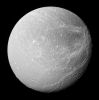
Dione-PIA09861.jpgDione57 visiteCaption NASA:"This southerly view of Dione shows enormous canyons extending from Mid-Latitudes on the Trailing Hemisphere, at right, to the moon's South Polar Region.
This view looks toward the Saturn-facing side of Dione (about 1126 Km, or 700 miles across) and is centered on 22° South Latitude, 359° West Longitude. North on Dione is up; the moon's south pole is seen at bottom.
The image was taken in visible light with the Cassini spacecraft narrow-angle camera on Feb. 8, 2008. The view was obtained at a distance of approx. 211.000 Km (such as about 131.000 miles) from Dione and at a Sun-Dione-Spacecraft, or phase, angle of 20°.
Image scale is roughly 1 Km (0,6 mile) per pixel".MareKromium
|
|
| 2245 immagini su 188 pagina(e) |
 |
|
|
|
|
90 | |
|
|
|
|





