| Piú viste - Saturn: the "Ringed Beauty" and His Moons |

Tethys_and_Rhea-N00147318-N00147337.gifSilent Running: Tethys and Rhea (GIF-Movie; credits: Elisabetta Bonora)58 visitenessun commentoMareKromium
|
|
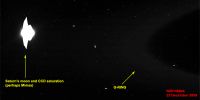
OverSaturation-N00148644.jpgOversaturation (by Elisabetta Bonora)58 visiteNon sempre la sovrasaturazione (o "sovraesposizione") - che è produttiva di una serie di image-artifacts tipici (su tutti, la cosiddetta "Light-Drop") - è il frutto di un errore: gli "oggetti a debole o debolissima luminosità", infatti, per essere evidenziati richiedono - come ben sapete - dei tempi di esposizione più lunghi del solito.
E quando poi, nel campo di ripresa, assieme all'"oggetto debole", vi è pure un "oggetto ad albedo elevata" - come in questo caso accade, rispettivamente, per l'Anello-G di Saturno e la sua luna Mimas -, ecco che l'immagine finale "sembra" venir fuori "sbagliata". Brutta e mossa, di regola (come vedete anche le stelle sono divenute, in questo frame, delle piccole "star-trails").
Ma la verità è che non si è trattato di un errore, ma di è una - oggettiva - necessità (come ben dimostra questa chiara elaborazione della nostra Elisabetta Bonora).MareKromium
|
|
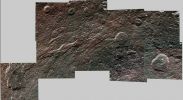
Rhea-Cracks-MF.jpgExtremely Long Tectonic Fracture on Rhea (possible True Colors; credits: Dr M. Faccin - Lunexit Team)58 visitenessun commentoMareKromium
|
|

Rhea-4229274308_c987cf73d9_o.jpgLarge Crater on Rhea (possible True Colors; credits: Dr M. Faccin - Lunexit Team)58 visitenessun commentoMareKromium
|
|

The_Sky_of_Saturn.gifIn the Sky of Saturn (GIF-Movie; credits: Dr M. Faccin)58 visiteLegenda: punti gialli ---> Stelle Fisse; punti blu: Lune Saturniane
MareKromium
|
|

Janus_Epimetheus-N00150026-45.gifSaturnian Runners (GIF-Movie; credits: Elisabetta Bonora)58 visitenessun commentoMareKromium
|
|

Dione-PIA12529.jpgCrescent Dione (possible Natural Colors; credits: Dr Paolo C. Fienga - Lunexit Team)58 visiteCaption NASA:"The tortured Terrain of Saturn's moon Dione is documented in this Cassini Spacecraft image.
The wispy fractures on the moon's Trailing Hemisphere can be seen on the left of the image, and Cratered Terrain on the moon's anti-Saturn side dominates the center of the image. North on Dione is up.
The image was taken in Visible Light with the Cassini Spacecraft narrow-angle camera on Nov. 23, 2009. The view was acquired at a distance of approx. 896.000 Km (such as about 557.000 miles) from Dione and at a Sun-Dione-Spacecraft, or Phase, Angle of 81°.
Image scale is roughly 5 Km (a little more than 3 miles) per pixel".MareKromium
|
|

Japetus-MF3.jpgUps and Downs on Japetus (Image-Mosaic; credits: Dr M. Faccin)58 visitenessun commentoMareKromium
|
|

Japetus-MF2.jpgJapetus' Skyline (possible Natural Colors; credits: Dr M. Faccin - Lunexit Team)58 visitenessun commentoMareKromium
|
|

SaturnianSpace-MF.gifStars, Streaks and (overexposed) Moons in the Space of Saturn (GIF-Movie; credits: Dr M. Faccin - Lunexit Team)58 visitenessun commentoMareKromium
|
|

SaturnianSpace-EB2.gifViews and Features of the Space of Saturn (GIF-Movie; credits: Elisabetta Bonora - Lunexit Team)58 visitenessun commentoMareKromium
|
|

Prometheus-4312264140_cd64e12a23_o.jpgPrometheus adrift... (possible Natural Colors; credits: Dr M. Faccin - Lunexit Team)58 visitenessun commentoMareKromium
|
|
| 2245 immagini su 188 pagina(e) |
 |
|
|
|
|
86 | |
|
|
|
|





