| Piú viste - Saturn: the "Ringed Beauty" and His Moons |
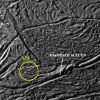
Enceladus-PIA11127.jpgBaghdad Sulcus58 visiteCaption NASA:"This Cassini image was the ninth 'skeet shoot' narrow-angle image captured during the Oct. 31, 2008 flyby of Saturn's moon Enceladus.
The source region for jet VII (see PIA08385) has been identified. The image was taken with the Cassini Spacecraft narrow-angle camera on Oct. 31, 2008, at a distance of approximately 6151 Km (about 3844 miles) from Enceladus and at a Sun-Enceladus-Spacecraft, or Phase, Angle of 75°.
Image scale is roughly 35 meters (115 feet) per pixel".MareKromium
|
|
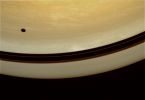
Saturn-PIA10512.jpgLonely Shadow... (possible True Colors; credits: Lunexit)58 visiteCaption NASA:"The shadow of Tethys drifts across the face of Saturn. Nearby, shadows of the Planet's Rings form a darkened band above the Equator. This view looks toward Saturn from a vantage point 63° North of the Equator.
The image was taken in visible green light with the Cassini Spacecraft wide-angle camera on Oct. 1, 2008. The view was acquired at a distance of approx 615.000 Km (about 382000 miles) from Saturn.
Image scale is roughly 37 Km (approx. 23 miles) per pixel".MareKromium
|
|
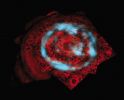
Saturn-PIA11396.jpgSouth Polar Aurora on Saturn58 visiteCaption NASA:"This image of the North Polar Regions of Saturn shows both the Aurora and underlying Atmosphere, seen at 2 different wavelengths of IR light as captured by NASA's Cassini spacecraft.
Energetic particles, crashing into the Upper Atmosphere cause the Aurora, shown in blue, to glow brightly at 4 microns (six times the wavelength visible to the human eye). The image shows both a bright ring, as seen from Earth, as well as an example of bright Auroral Emission within the Polar Cap that had been undetected until the advent of Cassini.
This Aurora, which defies past predictions of what was expected, has been observed to grow even brighter than is shown here. Silhouetted by the glow (cast here to the color red) of the hot interior of Saturn (clearly seen at a wavelength of 5 microns, or seven times the wavelength visible to the human eye) are the clouds and haze that underlie this Auroral Region. For a similar view of the Region beneath the Aurora see PIA09185.
This image is a composite captured with Cassini's Visual and Infrared Mapping Spectrometer. The aurora image was taken in the near-infrared on Nov. 10, 2006, from a distance of about 1 MKM (such as about 659.000 miles), with a phase angle of 157° and a sub-Spacecraft Planetocentric Latitude of 52° North.
The image of the clouds was obtained by Cassini on June 15, 2008, from a distance of approx. 602.000 Km (such as about 374.000 miles) and a sub-Spacecraft Planetocentric Latitude of 73° North".MareKromium
|
|
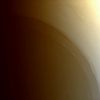
Saturn-PIA10513.jpgThe South Pole of Saturn (natural colors; credits: Lunexit)58 visiteCaption NASA:"Long streamers of cloud encircle the South Polar Region of Saturn. Farther poleward, or toward lower left, faint, deeper atmospheric structures lurk beneath the haze.
This image was acquired from a vantage point 74° South of the Planet's equator.
The view was taken with the Cassini spacecraft wide-angle camera on Oct. 2, 2008 using a spectral filter sensitive to wavelengths of IR light centered at 728 nanometers. The view was obtained at a distance of approx. 369.000 Km (such as about 229.000 miles) from Saturn.
Image scale is roughly 19 Km (about 12 miles) per pixel".MareKromium
|
|

The_Rings-PIA10518.jpgJust like a "Ribbon"...58 visiteCaption NASA:"The ever-changing F-Ring appears as wisps of smoke in this image taken downstream of the Shepherd Moon, Prometheus.
The image was taken in Visible Light with the Cassini Spacecraft narrow-angle camera on Oct. 23, 2008 at a distance of approx. 437.000 Km (about 272.000 miles) from Saturn and at a Sun-Saturn-Spacecraft Angle of 89°.
Image scale is roughly 2 Km (a little more than 1 mile) per pixel".
Nota Lunexit: un sincero Grazie alla NASA per aver pubblicato questa immagine la quale risolve - diremmo in via definitiva - il dubbio che era nato a proposito del possibile fenomeno di distorsione ottica imputabile ad un campo gravitazionale (e/o magnetico) di grande portata ed estremamente vicino a Cassini.MareKromium
|
|

Saturn-W00051225-MF.jpgThe colourful Upper Atmosphere of Saturn (True - but enhanced - Colors; credits: Dr M. Faccin)58 visiteUn frame bellissimo, ed incommentabile...MareKromium
|
|

Mimas-N00124650.jpgMimas and the Giant behind... (possible True Colors; credits: Lunar Explorer Italia)58 visiteCaption NASA:"N00124650.jpg was taken on November 26, 2008 and received on Earth November 27, 2008. The camera was pointing toward MIMAS that, at the time, was approx. 914.921 Km away
The image was taken using the CL1 and CL2 filters".MareKromium
|
|

The_Rings-Shadow-N00127583.jpgEclipsing the Rings (4)58 visitenessun commentoMareKromium
|
|
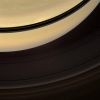
The_Rings-PIA10563.jpgThe Rings of Saturn (Natural Colors; credits: NASA/JPL/Space Science Institute)58 visiteCaption NASA:"Shadows cast onto Saturn by its Rings, visible here as dark bands, move steadily towards the Equator and grow thinner as Equinox approaches.
The Sun will cross Saturn's Ring-Plane on Aug. 10, 2009. Color variations between clouds in the Northern Hemisphere are more apparent than those in the Southern Hemisphere, which seems relatively bland, as Spring arrives in the North and Fall in the South.
Images taken using red, green and blue spectral filters were combined to create this natural color view. The images were acquired with the Cassini spacecraft wide-angle camera on Nov. 22, 2008 at a distance of approx. 859.000 Km (about 533.000 miles) from Saturn and at a Phase Angle of 56°.
Image scale is roughly 48 Km (about 30 miles) per pixel".MareKromium
|
|

The_Rings-PIA10571.jpgThe core of the F-Ring (Natural Colors; credits: Lunar Explorer Italia)58 visiteCaption NASA:"Structure in the tenuous F-Ring can be seen in this image of the ring's bright core.
Much of the structure in the F-Ring is created by its two shepherding moons: Prometheus (about 86 Km, or approx. 53 miles across) and Pandora (about 81 Km, or approx. 50 miles across).
The image was taken in Visible Light with the Cassini Spacecraft narrow-angle camera on Dec. 8, 2008.
The view, which looks down from about 70° above the Ring-Plane toward the unilluminated side of the Rings, was acquired at a distance of approx. 613.000 Km (about 381.000 miles) from Saturn and at a Sun-Saturn-Spacecraft, or Phase, Angle of 77°.
Image scale is roughly 3 Km (a little less than 2 miles) per pixel".MareKromium
|
|
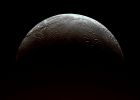
Enceladus-PIA10573.jpgCrescent Enceladus (Natural Colors; credits: Lunar Explorer Italia)58 visiteCaption NASA:"Sunrise uncovers both old and new Enceladus in this image from the Cassini Spacecraft. The lit side of the moon faces Saturn in this view of the Trailing Hemisphere. Old craters still pockmark the Northern Hemisphere while more recent geologic activity has swept them away in the South. North is on the right (Dx) in this image.
Mountain Ranges, a.k.a. "Dorsae", undulate across the moon's surface near the Equator.
From this high northern viewing angle, the South Pole's fascinating "Tiger Stripe Area" lies just out of view. Sulci, a.k.a. "furrows", in that area, are the sources of icy plumes being studied by Cassini scientists.
(See also PIA07800 and PIA09761).
Also near the Tiger Stripes are rift segments that resemble the zigzag patterns seen on Earth of sea-floor spreading from upwelling magma. See PIA11138 for a comparison of the phenomena.
Like outstretched fingers, the Samarkand Sulci reach from the West toward the North Pole, clearing their path of craters and slicing some in half.
This Natural Colors mosaic combines narrow-angle camera images obtained through UltraViolet, Green, and near-InfraRed camera filters. The images were acquired on Dec. 2, 2008 at a distance of approx. 124.000 Km (such as about 77.000 miles) from Enceladus and at a Sun-Enceladus-Spacecraft, or Phase, Angle of 116°.
Image scale is roughly 742 meters (2430 feet) per pixel".MareKromium
|
|

Saturn-PIA10580.jpgSouthern Atmosphere (Natural Colors; credits: Lunar Explorer Italia)58 visiteCaption NASA:"A Cassini Spacecraft image captures a bright, oblong storm swirling high through the Middle Latitudes of the Southern Hemisphere.
The image was taken through a spectral filter centered on wavelengths of light that are strongly absorbed by Methane gas. Hence, any light making it through this filter to the camera's detector has bounced off clouds that are high in the Atmosphere, making them visible, while light passing through the cloud-free surroundings gets absorbed by the Methane gas there before it reaches the lower clouds.
The image was taken with the Cassini Spacecraft wide-angle camera on Jan. 5, 2009 using a spectral filter sensitive to wavelengths of near-InfraRed Light centered at 890 nanometers. The view was acquired at a distance of approx. 711.000 Km (such as about 442.000 miles) from Saturn and at a Sun-Saturn-Spacecraft, or Phase, Angle of 106°.
Image scale is roughly 39 Km (about 24 miles) per pixel".MareKromium
|
|
| 2245 immagini su 188 pagina(e) |
 |
|
|
|
|
82 | |
|
|
|
|





