| Piú viste - Saturn: the "Ringed Beauty" and His Moons |

Star_Trails-N00099969.jpgStar-Trails...58 visitenessun commentoMareKromium
|
|

Dione-PIA10409.jpgDione (MULTISPECTRUM-2; credits: Lunexit)58 visiteCaption NASA:"The bright fractures on Dione's Trailing Side slice across terrain that is darker than the rest of the surface. Cassini scientists are working to understand the nature of the dark material that appears to coat the surfaces of several of Saturn's moons. Only after the Cassini Spacecraft began imaging Dione did they realize that the prominent "streaks" shown here are fractures on the surface.
Lit terrain seen here is on the Saturn-Facing Side of Dione. North is up.
The image was taken in visible light with the Cassini spacecraft narrow-angle camera on May 17, 2008. The view was acquired at a distance of approx. 873.000 Km (such as about 543.000 miles) from Dione and at a Phase Angle of 47°.
Image scale is roughly 5 Km (a little less than 3 miles) per pixel".MareKromium
|
|
Tethys-W00047018.jpgTethys and the Stars beyond...58 visitenessun commentoMareKromium
|
|

The_Rings-PIA10423.jpgSpooky Spokes! (MULTISPECTRUM; credits: Lunexit)58 visiteCaption NASA:"As they wheel about the Planet, Saturn's sunlit Rings often exhibit dark, radial markings called "spokes". Spokes are seen only in the broad B-Ring, and can also appear bright in certain viewing geometries.
This view looks toward the sunlit side of the Rings from about 11° below the Ring-Plane.
Pandora (about 81 kilometers, or approx. 50 miles across) is a speck above the Rings at left. The Planet's shadow darkens the Ring-Plane at lower right.
The image was taken in visible light with the Cassini Spacecraft wide-angle camera on June 3, 2008. The view was acquired at a distance of approx. 1 MKM (about 636.000 miles) from Saturn and at a Sun-Saturn-Spacecraft, or Phase, Angle of 19°.
Image scale is roughly 61 Km (approx. 38 miles) per pixel".MareKromium
|
|
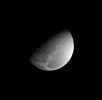
Dione-PIA10431.jpgDione58 visiteCaption NASA:"This Cassini Spacecraft view, taken from a vantage point 64° above Dione's Equator, looks down onto the bright fractures that cover the moon's Trailing Side. The fractures crisscross a region of terrain that is significantly darker than the rest of the moon's surface. Dione is approx. 1123 Km (about 698 miles) across.
The image was taken in visible light with the Cassini spacecraft narrow-angle camera on June 15, 2008. The view was obtained at a distance of approx. 601.000 Km (such as about 374.000 miles) from Dione and at a Sun-Dione-Spacecraft, or Phase, Angle of 76°. Image scale is roughly 4 Km (a little more than 2 miles) per pixel".MareKromium
|
|

The_Rings-PIA10442.jpgModern Art? (natural colors; credits: Lunexit)58 visiteCaption NASA:"This bizarre scene shows the cloud-streaked limb of Saturn in front of the Planet's B-Ring. The Ring's image is warped near the limb by the diffuse gas in Saturn's Upper Atmosphere.
For additional examples of this effect, see PIA09810, PIA07521 and PIA06656.
This view looks toward the sunlit side of the Rings, from about 31° below the Ring-Plane. North on Saturn is up.
The image was taken with the Cassini spacecraft narrow-angle camera on June 24, 2008 using a spectral filter sensitive to wavelengths of infrared light centered at 750 nanometers. The view was acquired at a distance of approx. 657.000 Km (about 408,000 miles) from Saturn.
Image scale is roughly 4 Km (about 2,5 miles) per pixel".MareKromium
|
|
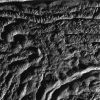
Enceladus-PIA11109.jpgCairo Sulcus58 visiteCaption NASA:"This image is the 4th skeet-shoot footprint taken during Cassini's very close flyby of Enceladus on Aug. 11, 2008. Cairo Sulcus is shown crossing the upper left portion of the image. An unnamed fracture curves around the lower right corner.
The image was taken with the Cassini Spacecraft narrow-angle camera on Aug. 11, 2008, a distance of approx. 3027 Km (such as about 1881 miles) above the surface of Enceladus.
Image scale is approximately 20 meters (66 feet) per pixel". MareKromium
|
|

Enceladus-PIA11107.jpgDamascus Sulcus58 visiteCaption NASA:"This image is the 7th skeet-shoot image taken during Cassini's very close flyby of Enceladus on Aug. 11, 2008. Damascus Sulcus is crossing the upper part of the image.
The image was taken with the Cassini Spacecraft narrow-angle camera on Aug. 11, 2008, a distance of approx. 4742 Km (such as about 2947 miles) above the surface of Enceladus.
Image scale is approximately 30 meters (98 feet) per pixel". MareKromium
|
|
Rhea-N00118975.jpgRhea's Eclipse58 visiteCaption NASA:"N00118981.jpg was taken on August 19, 2008 and received on Earth August 21, 2008. The camera was pointing toward RHEA that, at the time, was approx. 455.227 Km away; the image was taken using the CL1 and CL2 filters. This image has not been validated or calibrated".MareKromium
|
|

Tethys-PIA10462.jpgTethys, in full light (natural colors; credits: Lunexit)58 visiteCaption NASA:"Five hours after acquiring PIA10460, the Cassini Spacecraft turned its cameras back to Tethys for a more southerly view. The southern reaches of Ithaca Chasma are seen here, along with the large crater Telemus, just right of center.
Lit terrain seen here is on the Saturn-Facing Side of Tethys (approx. 1062 Km, or 660 miles across).
This view looks toward the Southern Hemisphere from a perspective 43° South of the moon's Equator. North is toward the top and rotated 30° to the right.
The image was taken in visible green light with the Cassini Spacecraft narrow-angle camera on July 28, 2008. The view was obtained at a distance of approx. 313.000 Km (such as about 194.000 miles) from Tethys and at a Sun-Tethys-Spacecraft, or Phase, Angle of 42°.
Image scale is roughly 2 Km (a little more than 1 mile) per pixel".MareKromium
|
|

Dione-N00119795.jpgCross-Worlds! (11)58 visitenessun commentoMareKromium
|
|

The_Rings-PIA10470.jpgGravitational Interactions or just Evidence of a recent Collision?58 visiteCaption NASA:"The three bright, finger-like jets of material seen here suggest that a small object has collided with the core of Saturn's F-Ring. Cassini Spacecraft imaging scientists have shown that the F-Ring shepherd moon Prometheus influences the structure of the Ring in 2 ways: 1) by creating streamer-channel features as it closely approaches (and partially passes into) the Ring (see PIA08397) and 2) by perturbing the orbits of small objects within the F-Ring Region which then exert their own influence on nearby Ring particles, as seen here.
These small, embedded objects could be temporary clumps of particles, but scientists think at least one of the objects could be a more permanent moonlet.
This view looks toward the sunlit side of the Rings from about 40° below the Ring-Plane. The image was taken in visible light with the Cassini Spacecraft narrow-angle camera on Aug. 20, 2008. The view was obtained at a distance of approx. 685.000 Km (such as about 426.000 miles) from Saturn and at a Phase Angle of 40°.
The image scale is about 5 Km per pixel".MareKromium
|
|
| 2245 immagini su 188 pagina(e) |
 |
|
|
|
|
81 | |
|
|
|
|





