| Piú viste - Saturn: the "Ringed Beauty" and His Moons |
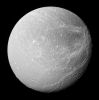
Dione-PIA09861.jpgDione58 visiteCaption NASA:"This southerly view of Dione shows enormous canyons extending from Mid-Latitudes on the Trailing Hemisphere, at right, to the moon's South Polar Region.
This view looks toward the Saturn-facing side of Dione (about 1126 Km, or 700 miles across) and is centered on 22° South Latitude, 359° West Longitude. North on Dione is up; the moon's south pole is seen at bottom.
The image was taken in visible light with the Cassini spacecraft narrow-angle camera on Feb. 8, 2008. The view was obtained at a distance of approx. 211.000 Km (such as about 131.000 miles) from Dione and at a Sun-Dione-Spacecraft, or phase, angle of 20°.
Image scale is roughly 1 Km (0,6 mile) per pixel".MareKromium
|
|
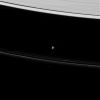
Daphnis-PIA09902.jpgDaphnis and a Little Star...58 visiteCaption NASA:"The Cassini Spacecraft captures a view showing two of Saturn's moons and their gravitational effects on nearby Rings.
At top, Daphnis (about 8 Km, or 5 miles across at its widest point) streaks through the Keeler Gap, with its ever-present edge waves. At center, Prometheus (about 86 Km, or 53 miles across at its widest point) pulls away from a recent encounter with the F-Rring. A bright background star is visible below the F-Ring.
This view looks toward the unilluminated side of the Rings from about 41° above the Ring-Plane. The image was taken in visible light with the Cassini spacecraft narrow-angle camera on April 8, 2008. The view was acquired at a distance of approx. 1,3 MKM (such as about 788.000 miles) from Prometheus and at a Sun-Prometheus-Spacecraft, or phase, angle of 53°.
Image scale is roughly 8 Km (about 5 miles) per pixel".
Nota Lunexit: noi vediamo Daphnis, la "Piccola Stella" in basso rispetto all'Anello "F" e la scia lasciata da Prometheus (sull'estrema Sx del frame) a seguito del suo transito ma, di Prometheus...nessuna traccia! E Voi? Lo vedete Prometheus?MareKromium
|
|

Pan-PIA09911.jpgAlmost invisible...58 visiteCaption NASA:"Pan coasts down its private highway within the Encke Gap.
The process by which Pan (about 28 Km, or 17 miles across) maintains the gap, clearing the neighborhood around its orbit, is believed to be similar to the way that planets clear gaps in debris disks around young stars. This view looks toward the unilluminated side of the Rings from about 11° above the Ring-Plane.
The limb of Saturn is seen through the Rings, at the upper left.
The image was taken in visible light with the Cassini Spacecraft narrow-angle camera on April 24, 2008. The view was obtained at a distance of approx. 1,3 MKM (such as about 784.000 miles) from Pan.
Image scale is roughly 8 Km (approx. 5 miles) per pixel".MareKromium
|
|

UnknownObject-N00111962-N00111966.gifAnother U.F.O. in the Space of Saturn! (GIF Movie - credits: Dr G. Barca)58 visiteUn altro "Filmato Didattico" il quale, stavolta, ci mostra il transito (con accelerazione quasi relativistica...) di un Oggetto Anomalo che, in accordo alla Filosofia Ispiratrice di Lunar Explorer Italia, non possiamo risolvere e dire "cosa sia", ma per il quale certo possiamo dire "che cosa NON è".
Non è un Raggio Cosmico; non è un Image-Artifact; non è "noise" nè "lack of signal" e non è una "luna saturniana in-transito".
Che cosa sarà mai?!? Questo GIF-Movie è dedicato a coloro (e sono TANTI...poverini) che credono che TUTTO sia spiegabile e risolvibile in accordo alla Umana Scienza e Conoscenza.
Ed un Complimento Grandissimo al Dr Barca per la pazienza e l'occhio!MareKromium
|
|

Star_Trails-N00099969.jpgStar-Trails...58 visitenessun commentoMareKromium
|
|

Dione-PIA10409.jpgDione (MULTISPECTRUM-2; credits: Lunexit)58 visiteCaption NASA:"The bright fractures on Dione's Trailing Side slice across terrain that is darker than the rest of the surface. Cassini scientists are working to understand the nature of the dark material that appears to coat the surfaces of several of Saturn's moons. Only after the Cassini Spacecraft began imaging Dione did they realize that the prominent "streaks" shown here are fractures on the surface.
Lit terrain seen here is on the Saturn-Facing Side of Dione. North is up.
The image was taken in visible light with the Cassini spacecraft narrow-angle camera on May 17, 2008. The view was acquired at a distance of approx. 873.000 Km (such as about 543.000 miles) from Dione and at a Phase Angle of 47°.
Image scale is roughly 5 Km (a little less than 3 miles) per pixel".MareKromium
|
|
Tethys-W00047018.jpgTethys and the Stars beyond...58 visitenessun commentoMareKromium
|
|

The_Rings-PIA10423.jpgSpooky Spokes! (MULTISPECTRUM; credits: Lunexit)58 visiteCaption NASA:"As they wheel about the Planet, Saturn's sunlit Rings often exhibit dark, radial markings called "spokes". Spokes are seen only in the broad B-Ring, and can also appear bright in certain viewing geometries.
This view looks toward the sunlit side of the Rings from about 11° below the Ring-Plane.
Pandora (about 81 kilometers, or approx. 50 miles across) is a speck above the Rings at left. The Planet's shadow darkens the Ring-Plane at lower right.
The image was taken in visible light with the Cassini Spacecraft wide-angle camera on June 3, 2008. The view was acquired at a distance of approx. 1 MKM (about 636.000 miles) from Saturn and at a Sun-Saturn-Spacecraft, or Phase, Angle of 19°.
Image scale is roughly 61 Km (approx. 38 miles) per pixel".MareKromium
|
|
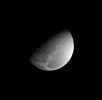
Dione-PIA10431.jpgDione58 visiteCaption NASA:"This Cassini Spacecraft view, taken from a vantage point 64° above Dione's Equator, looks down onto the bright fractures that cover the moon's Trailing Side. The fractures crisscross a region of terrain that is significantly darker than the rest of the moon's surface. Dione is approx. 1123 Km (about 698 miles) across.
The image was taken in visible light with the Cassini spacecraft narrow-angle camera on June 15, 2008. The view was obtained at a distance of approx. 601.000 Km (such as about 374.000 miles) from Dione and at a Sun-Dione-Spacecraft, or Phase, Angle of 76°. Image scale is roughly 4 Km (a little more than 2 miles) per pixel".MareKromium
|
|

The_Rings-PIA10442.jpgModern Art? (natural colors; credits: Lunexit)58 visiteCaption NASA:"This bizarre scene shows the cloud-streaked limb of Saturn in front of the Planet's B-Ring. The Ring's image is warped near the limb by the diffuse gas in Saturn's Upper Atmosphere.
For additional examples of this effect, see PIA09810, PIA07521 and PIA06656.
This view looks toward the sunlit side of the Rings, from about 31° below the Ring-Plane. North on Saturn is up.
The image was taken with the Cassini spacecraft narrow-angle camera on June 24, 2008 using a spectral filter sensitive to wavelengths of infrared light centered at 750 nanometers. The view was acquired at a distance of approx. 657.000 Km (about 408,000 miles) from Saturn.
Image scale is roughly 4 Km (about 2,5 miles) per pixel".MareKromium
|
|
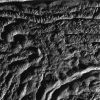
Enceladus-PIA11109.jpgCairo Sulcus58 visiteCaption NASA:"This image is the 4th skeet-shoot footprint taken during Cassini's very close flyby of Enceladus on Aug. 11, 2008. Cairo Sulcus is shown crossing the upper left portion of the image. An unnamed fracture curves around the lower right corner.
The image was taken with the Cassini Spacecraft narrow-angle camera on Aug. 11, 2008, a distance of approx. 3027 Km (such as about 1881 miles) above the surface of Enceladus.
Image scale is approximately 20 meters (66 feet) per pixel". MareKromium
|
|

Enceladus-PIA11107.jpgDamascus Sulcus58 visiteCaption NASA:"This image is the 7th skeet-shoot image taken during Cassini's very close flyby of Enceladus on Aug. 11, 2008. Damascus Sulcus is crossing the upper part of the image.
The image was taken with the Cassini Spacecraft narrow-angle camera on Aug. 11, 2008, a distance of approx. 4742 Km (such as about 2947 miles) above the surface of Enceladus.
Image scale is approximately 30 meters (98 feet) per pixel". MareKromium
|
|
| 2245 immagini su 188 pagina(e) |
 |
|
|
|
|
80 | |
|
|
|
|





