| Piú viste - Saturn: the "Ringed Beauty" and His Moons |

Enceladus-N00030103.jpgEnceladus, from approx. 6.000 Km57 visitenessun commento
|
|

Enceladus-N00030265.jpgEnceladus, from approx. 925.000 Km57 visitenessun commento
|
|

Epimetheus-PIA06605.jpgEpimetheus, from approx. 2,5 MKM57 visiteCaption NASA originale:"One of Saturn's strange co-orbital moons, Epimetheus, was captured by Cassini in this view. Irregularly shaped Epimetheus occasionally swaps orbits with nearby Janus and both moons play a role in maintaining the outer edge of Saturn's bright A-Ring. Epimetheus is 116 Km (approx. 72 miles) across.
The image was taken in visible light with the Cassini spacecraft narrow-angle camera on Jan. 22, 2005, at a distance of approximately 2,5 MKM (approx. 1,6 MMs) from Epimetheus and at a phase angle of 90°.
Resolution in the image is 15 Km (approx. 9 miles) per pixel.
The image has been contrast-enhanced to aid visibility".
|
|

Enceladus-PIA06206_modest.jpgEnceladus (close-up)57 visiteCaption NASA originale:"Fractures are nearly ubiquitous in this terrain, cutting across each other and across impact craters. Scientists can use the relationships between different features to determine the order in which they formed, thereby unraveling the moon's past. For example, almost all the craters in this mosaic have fractures running through their rims and floors, indicating that the craters formed first. This means that Enceladus has been geologically active relatively recently, especially compared to some of its neighbors in the Saturn system. There is an impressive variety of fractures visible here--from the wide east-west rifts near the upper left of the mosaic to the very fine north-south fractures in the center (which are approximately 100 to 400 meters). Due to the complexity of this terrain, the task of unraveling Enceladus' history promises to be a worthy challenge for planetary scientists".
|
|

Enceladus-PIA06208.jpgEnceladus (full-disk) - false colors57 visiteCaption NASA originale:"During its very close flyby on March 9, 2005, the Cassini spacecraft captured this false-color view of Saturn's moon Enceladus, which shows the wide variety of this icy moon's geology. Some geological regions on Enceladus are old and retain large numbers of impact craters; younger areas exhibit many generations of tectonic troughs and ridges. Subtle differences in color may indicate different ice properties, such as grain sizes, that will help unravel the sequence of geologic events leading to the current strange landscape. In the early 1980's, NASA's Voyager mission to the outer planets revealed a strikingly similar arrangement of terrains on Miranda, an icy moon of Uranus (see PIA 00141). Miranda is 470-Km-wide (290 miles), nearly as large as Enceladus (504 Km). The similarities in size and tectonic history on these objects may suggest that remarkably similar physical processes have controlled the separate geological evolutions of these bodies. The Sun illuminates Enceladus from the left, leaving part of it in shadow and blocking out part of the view of Saturn. This view shows the anti-Saturn hemisphere, centered nearly on the equator".
|
|

Enceladus-PIA06209.jpgEnceladus' "crispy & fractured" surface (false colors)57 visiteExtending through the center of this image is a system of rifts 3 Km wide and lanes of grooved terrain 20 Km wide, which separate 2 distinct geological provinces. To the right of the boundary is older, cratered terrain - a region peppered with craters ranging from 10 Km in diameter, down to craters near the limit of resolution. The region is believed to be old because it has accumulated a relatively high density of impact craters over time and the topography is soft and muted, suggesting that it is covered by a layer of particulate materials. The cratered terrain is cut crosswise by numerous faults and fractures ranging in width from hundreds of meters to a few Km. On the left side of the scene are grooved, icy plains. This broad, relatively flat region is scored by an extensive band of parallel grooves that appear to subdivide the surface into narrow lanes approx. 1 Km wide. The low abundance of impact craters and crisp relief on topographic features here imply that this region is geologically much younger than the cratered terrain at the right.
|
|

Enceladus-PIA06210.jpgEnceladus' "crispy & fractured" surface (false colors)57 visiteTo human eyes, Enceladus appears almost completely white, but false color reveals intriguing details. This view is a composite of images taken using filters sensitive to ultraviolet (centered at 338 nnmts), green (centered at 568 nnmts), and near-infrared (centered at 930 nnmts) light and has been processed to accentuate subtle color differences. The uppermost surface of these terrains appears uniformly grey in this picture, suggesting that they are covered with materials of homogeneous composition and grain size. However, the walls of many of the fractures appear to be somewhat bluer than typical surface materials. It is possible that the difference in color identifies outcrops of solid ice on the walls of fractures, or ice with different grain-sizes, compared to powdery surface materials. It is also possible that the color identifies some compositional difference between buried ice and ice at the surface. The surface is peppered with craters of all sizes, from the 21-Km diameter crater at the top of the image, down to tiny craters near the limit of resolution. The prominent crater at the top contains a central, domelike structure more than 11 kilometers (7 miles) in diameter. The dome, the crater -- and indeed the entire scene -- is sliced by a complex network of fractures ranging in width from hundreds of meters in some places, to over three kilometers (2 miles) in others.
|
|

Telesto.jpgTelesto57 visiteCaption NASA originale:"Saturn's moon Telesto is visible below and to the left of center in this image from the Cassini spacecraft.
Telesto (only 24 Km across) shares the orbit of Saturn's moon Tethys (1.071 Km across), leading the larger moon in its path by 60°. Similarly sized Calypso (22 Km across) trails Tethys by the same amount. These positions, called Lagrange points, are dynamically stable. In being co-orbital moons of Tethys, Telesto and Calypso are like the Trojan moons of Jupiter, which occupy Lagrange points and orbit 60° ahead and behind of Jupiter. The Saturnian moon Dione also has companion moons: Helene, which leads Dione in its orbit and the Cassini-discovered trailing Lagrange moon, Polydeuces. This image was taken in visible light with the Cassini spacecraft narrow angle camera on Jan. 18, 2005, at a distance of approximately 3,7 MKM from Telesto. Resolution in the image is 7 Km per pixel. Telesto has been brightened by a factor of two to aid visibility".
|
|

Saturn-tilted.jpgTilted Saturn57 visiteCaption NASA originale:"Saturn's whirling vortices and feathery cloud bands are the signs of a restless world. Cassini captured this arresting view of the giant planet scored by bold shadows cast by the rings. The rings are seen edge-on in this dramatic, artfully tilted scene.
The image was taken with the Cassini spacecraft wide-angle camera on March 6, 2005, at a distance of approx. 1,7 MKM (1 MMs) from Saturn through a filter sensitive to wavelengths of infrared light centered at 750 nnmts. The image scale is 10 Km per pixel".
|
|

Janus-PIA06612.jpgJanus rides the Rings57 visiteCaption NASA originale:"Cassini was nearly in the plane of Saturn's Rings when it took this image of Janus. The nearly edge-on rings appear almost ribbon-like in this view and some surface detail is visible on the small moon. The image was taken in visible light with the Cassini spacecraft narrow-angle camera on Feb. 18, 2005, at a distance of approximately 911.000 Km from Janus and at a phase angle of 101°. The image scale is 5 Km per pixel".
|
|
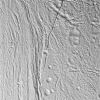
Enceladus-PIA06215.jpgCracks on Enceladus (and possible Anomaly)57 visiteCaption NASA originale:"This view of Enceladus shows an area that has undergone a very intriguing sequence of events. The craters here are subdued, as seen elsewhere on Enceladus and most, but not all, are older than the fractures. Fracturing has occurred at a wide variety of scales, from the wide rift running through the center of the image to much narrower sets of shorter fractures that crosscut the craters (and each other) to the left. This region is a transition from cratered to wrinkled terrain. Westward (left) of the central rift that divides the 2 regions are relatively parallel grooves and ridges that are reminiscent of terrain on Jupiter's large moon Ganymede. Very few craters are seen in this area of Enceladus. Right of the large rift the terrain becomes more cratered, although the craters are quite degraded. A prominent fracture runs North-South to the center of the image".
Nota: guardate bene che cosa c'è all'interno di questo crepaccio, in alto, proprio a ridosso del bordo superiore del frame!
|
|
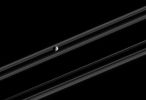
Epimetheus-PIA06615.jpgEpimetheus, from approx. 990.000 Km57 visiteCaption NASA originale:"Saturn's small, irregularly-shaped moon Epimetheus orbits against the backdrop of the planet's rings, which are nearly edge-on in this view. Some of the moon's larger geological features can be seen here. The image was taken in visible light with the Cassini spacecraft narrow-angle camera on Feb. 18, 2005, at a distance of approximately 990.000 Km (approx. 615.000 miles) from Epimetheus and at a phase angle of 99°. Resolution in the original image was 6 Km per pixel. The image has been contrast-enhanced and magnified by a factor of two to aid visibility".
|
|
| 2245 immagini su 188 pagina(e) |
 |
|
|
|
|
79 | |
|
|
|
|





