| Piú viste - Saturn: the "Ringed Beauty" and His Moons |

Mimas-PIA06176.jpgBlue Saturn and Mimas57 visiteCaption NASA originale:"Mimas drifts along in its orbit against the azure backdrop of Saturn's northern latitudes in this true color view. The long, dark lines on the atmosphere are shadows cast by the planet's rings.
Saturn's northern hemisphere is presently relatively cloud-free, and rays of sunlight take a long path through the atmosphere. This results in sunlight being scattered at shorter (bluer) wavelengths, thus giving the northernmost latitudes their bluish appearance at visible wavelengths.
At the bottom, craters on icy Mimas (398 Km or 247 miles across) give the moon a dimpled appearance.
Images taken using infrared (930 nanometers), green (568 nanometers) and ultraviolet (338 nanometers) spectral filters were combined. The colors have been adjusted to match closely what the scene would look like in natural color. The images were obtained using the Cassini spacecraft narrow angle camera on Jan. 18, 2005, at a distance of approx. 1,4 MKM from Saturn".
|
|

Mimas-PIA06582.jpgMimas's "Eye": the "Herschel Crater"57 visiteCaption NASA originale:"Saturn's moon Mimas has many large craters, but its Herschel Crater dwarfs all the rest. This large crater 130 Km wide (80 miles) has a prominent central peak, seen here almost exactly on the terminator. This crater is the moon's most prominent feature, and the impact that formed it probably nearly destroyed Mimas. Mimas is 398 Km (247 miles) across. This image was taken with the Cassini spacecraft narrow angle camera on Jan. 16, 2005, at a distance of approximately 213.000 Km (132.000 miles) from Mimas and at a phase angle of 84°. Resolution in the original image was about 1,3 Km (0,8 mi.s) per pixel. A combination of spectral filters sensitive to ultraviolet and polarized light was used to obtain this view. Contrast was enhanced and the image was magnified by a factor of two to aid visibility".
|
|

Epimetheus-N00027756.jpgEpimetheus at the boundaries of the "Ringed Kingdom"57 visitenessun commento
|
|

Enceladus-PIA06188.jpgEnceladus "tormented" surface57 visiteCaption NASA originale:"This HR image from Cassini shows a region of "smooth plains" terrain on the surface of Saturn's moon Enceladus, located slightly north of the equator on the moon's Saturn-facing hemisphere. The area is about 70 by 84 Km.
The image shows a variety of tectonic features that attest to Enceladus' dynamic geological history. At the top of the image is a relatively fresh-looking crevasse system with individual fractures more than a kilometer wide. The crevasse system cross-cuts a complex NE-to-SW-trending system of older faults. A 12-Km-wide band of crudely aligned, chevron-shaped features runs down the center of the image. Among the most intriguing features in this view are a series of dark, small spots, 125 to 750 meters in diameter.
The "dark spots" often seem to be aligned in chains parallel to narrow fractures. The contrast of the dark features with the surrounding bright terrain suggests that they may be compositionally distinct, but their origin is a new mystery".
|
|

Enceladus-PIA06189.jpgStereo-Enceladus: ridges, trough, cracks, faults and much more!57 visiteCaption NASA originale:"Images from different directions allow construction of stereo views such as this, which are helpful in interpreting the complex topography.
This view of an area about 60 Km across shows several different kinds of ridge-and-trough topography, indicative of a variety of horizontal forces near the surface of this 505-Km diameter satellite.
Several different kinds of deformation are visible and a small population of impact craters shows that this is some of the younger terrain on Enceladus. Sunlight illuminates the scene from the bottom. Interestingly, the topographic relief is only about one kilometer, which is quite low for a small, low-gravity satellite. However, this is consistent with other evidence that points to interior melting and resurfacing in Enceladus' history. The images for this anaglyph were taken in visible light with the narrow angle camera, from distances ranging from 10.750 Km - red image) to 24.861 Km - blue image) from Enceladus".
|
|

Enceladus-P-IMG001391-br500.jpgEnceladus, here and there!57 visiteEncelado: la piccola "Luna di Ghiaccio" ci mostra per intero il suo luminoso volto nell'immagine centrale (ripresa da una distanza di circa 180.000 Km) e poi alcune delle sue incredibili caratteristiche superficiali (canyons, crepacci, fratture, canali etc.), nei 2 frames di Dx e di Sx - ripresi da una distanza media di circa 24.000 Km (Sx) e 12.000 Km (Dx).
|
|

Rings-PIA06588.jpgThe "rings" and a "string" of Moons...57 visiteCaption NASA originale:"Moons visible in this image: Mimas (398 Km, or 247 miles across) at right, Pandora (84 Km, or 52 miles across) near center and Janus (181 Km, or 113 miles across) in the lower left corner. Mimas' orbit inclination of 1,6° relative to Saturn's equator is enough to make it appear as if it orbits just beyond the F-Ring when viewed from this vantage point of 5° below the Rings. In fact, it is 34.000 Km (such as approx. 21.000 miles) more distant than Janus".
|
|

F-Enceladus-N00028770.jpgEnceladus from approx. 1.784.000 Km57 visiteUn'immagine davvero spettacolare di Encelado e (supponiamo...) Epimeteo, apparentemente "divisi" dagli Anelli di Saturno: una sorta di 'pentagramma spaziale" fatto di sottili filamenti luminosi i quali sembrano 'tagliare' il Cielo circostante.
|
|

Dione-N00028517.jpgDione, Epimetheus and the Rings57 visitenessun commento
|
|

Saturnian Aurora.jpgSaturnian Aurora - HST57 visiteDa "NASA - Picture of the Day" del 22 Febbraio 2005:
"Are Saturn's auroras like Earth's? To help answer this question, the Hubble Space Telescope and the Cassini spacecraft monitored Saturn's South Pole simultaneously as Cassini closed in on the gas giant in January 2004. Hubble snapped images in ultraviolet light, while Cassini recorded radio emissions and monitored the solar wind. Like on Earth, Saturn's auroras make total or partial rings around magnetic poles. Unlike on Earth, however, Saturn's auroras persist for days, as opposed to only minutes on Earth. Although surely created by charged particles entering the atmosphere, Saturn's auroras also appear to be more closely modulated by the solar wind than either Earth's or Jupiter's auroras. The above sequence shows 3 Hubble images of Saturn each taken two days apart".
|
|

Dione-N00028850.jpgDione and Rhea (4)57 visitenessun commento
|
|
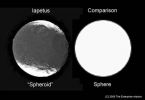
Japetus-A-Sphere-Comparison.jpgIs Japetus a "sphere" or a "spheroid"?57 visiteUn bellissimo lavoro svolto da Richard Hoagland (pubblicato sul Sito "The Enterprise Mission") ci permette di aprire un nuovo capitolo nella saga dei "Misteri di Giapeto", una luna Saturniana - se ci passate la battuta - "un pò troppo trascurata (dalla NASA) per non essere estremamente interessante"...
Vi consigliamo, se siete familiari con l'Inglese e se Vi interessa un parere davvero autorevole, di leggerVi l'articolo "A Moon With A View" (Luna con vista) di Richard Hoagland.
Noi abbiamo letto il pezzo dell'Amico Richard e, come sempre, pur apprezzandone i contenuti (davvero "immaginifici") e le tecniche (molto evolute) usate per renderli ancora più verosimili, dobbiamo dire che - ancora una volta - non riusciamo a condividerne le conclusioni (come sempre un poco esagerate).
Ma procediamo con calma: Giapeto è una "sfera" o uno "sferoide" (ossìa una "sfera mancata" o, se volete, "fatta molto male")? Guardate Voi stessi e decidete!
|
|
| 2245 immagini su 188 pagina(e) |
 |
|
|
|
|
78 | |
|
|
|
|





