| Piú viste - Saturn: the "Ringed Beauty" and His Moons |
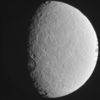
Rhea-N00047219.jpgRhea58 visiteOriginal caption:"N00047219.jpg was taken on December 24, 2005 and received on Earth December 24, 2005. The camera was pointing toward RHEA that, at the time, was approximately 255.628 Km away.
The image was taken using the CL1 and CL2 filters".
|
|

Rhea-N00047136.jpgRhea58 visiteOriginal caption:"N00047136.jpg was taken on December 23, 2005 and received on Earth December 24, 2005. The camera was pointing toward RHEA that, at the time, was approximately 283.082 Km away.
The image was taken using the CL1 and IR3 filters".
|
|

Japetus-PIA07660.jpgLand of the Day, Land of the Night58 visiteAlthough it is no longer "Uncharted Land", the origin of the dark territory of Cassini Regio on Iapetus remains a mystery.
Also puzzling is the equatorial ridge that bisects this terrain, and how it fits into the story of the moon's strange brightness dichotomy. The ridge is seen here, curving along the lower left edge of Iapetus.
The view looks down onto the Northern Hemisphere of Iapetus, and shows terrain on the moon's Leading Hemisphere.
The image was taken in polarized green light with the Cassini spacecraft narrow-angle camera on Nov. 12, 2005 at a distance of approx. 417.000 Km (such as about 259.000 miles) from Iapetus and at a Sun-Iapetus-spacecraft, or phase, angle of 95°. Image scale is about 2 Km (about 1 mile) per pixel.
|
|

Telesto-N00047273.jpgTelesto58 visiteOriginal caption:"N00047273.jpg was taken on December 25, 2005 and received on Earth December 26, 2005. The camera was pointing toward TELESTO that, at the time, was approximately 21.404 kilometers away, and the image was taken using the CL1 and CL2 filters".
Nota: secondo Voi è il movimento della Sonda rispetto a Cassini che ha determinato il repentino cambio di posizione di Telesto in questi due frames, oppure Telesto è un'altra - vera, questa volta! - "Tumbling Moon" (al pari - presunto - di Hyperion)?!?
|
|

Saturn-PIA07672.jpgSaturn's limb (enhanced - and yet natural - colors)58 visiteOriginal caption:"Twice as far from the Sun as Jupiter, Saturn's colder temperatures mean that clouds form lower in its atmosphere. As a result, the visible cloud patterns - so striking on Jupiter - occur deeper inside Saturn, reducing their visibility in natural color views.
This enhanced-color view uses exaggerated contrast and intensity in order to make Saturn's cloud bands easy to see.
The Latitude seen at the image center is approximately 60° South of the Equator.
Images taken in blue (BL2), green and red (CB1) polarized spectral filters were combined to create this enhanced-color view. The images were taken with the Cassini spacecraft narrow-angle camera on Dec. 7, 2005, at a distance of approximately 3,1 MKM (1,9 MMs) from Saturn. The image scale is about 36 Km (app.x 22 miles) per pixel".
|
|

Mimas-N00048622.jpgOver the clouds of Saturn: Mimas (2)58 visiteOriginal caption:"N00048613.jpg was taken on January 19, 2006 and received on Earth January 19, 2006. The camera was pointing toward Mimas that, at the time, was approximately 1.011.360 kilometers away, and the image was taken using the CL1 and CL2 filters.
This image has not been validated or calibrated".
|
|

Saturn~0.jpgSaturn...from France58 visitePresently at opposition in planet Earth's sky, Saturn is well placed for telescopic observations. On Wednesday (Jan., 25, 2006) two Amateur Astronomers took full advantage of the situation from Melun, near Paris, France. With a 12" diameter telescope and web cam they recorded this sharp image of the ringed gas giant and made an exciting discovery: a new storm on Saturn. The storm appears as the white spot visible here in Saturn's Southern Hemisphere (bottom of the picture). In particular, the storm seems to correspond with an outburst of radio noise detected by the Cassini spacecraft. The phenomenon is likely similar to the Dragon Storm recorded by Cassini's instruments early last year. That storm is thought to be analogous to a terrestrial thunderstorm, with radio noise produced in high-voltage lightning discharges.
|
|

Tehys-PIA07693.jpgOdysseus58 visiteOriginal caption:"Plunging cliffs and towering mountains characterize the gigantic impact structure called Odysseus on Saturn's moon Tethys. The great impact basin lies before the Cassini spacecraft in one of the best views yet obtained.
Quite a few small craters are visible inside Odysseus (450 Km - or 280 miles across), making it clear that this is not a very young structure. However, a comparison of cratering density between the interior of Odysseus and the surrounding terrain should show whether the large basin is at least relatively young.
Odysseus lies on the Leading Hemisphere of Tethys; North is up and rotated 18° to the right.
The image was taken in polarized ultraviolet light with the Cassini spacecraft narrow-angle camera on Dec. 24, 2005 at a distance of approx. 196.000 Km (about 122.000 miles) from Tethys and at a Sun-Tethys-spacecraft, or phase, angle of 85°. Resolution in the original image was about 1 Km (3,831 feet) per pixel. The image has been magnified by a factor of two and contrast-enhanced to aid visibility".
|
|

Saturn-PIA07695.jpgDark Saturn, Bright Rings58 visiteCaption originale:"The Cassini spacecraft looked toward the darkened night side of Saturn to capture the eerie glow of the Rings, which, not being blocked by the Planet's bulk, remained brilliant in full Sunlight.
The image was taken in visible light with the Cassini spacecraft wide-angle camera on Dec. 24, 2005, at a distance of approx. 286.000 Km (roughly 178.000 miles) from Saturn.
The image scale is about 13 Km (approx. 8 miles) per pixel".
|
|

Telesto-PIA07696.jpgTelesto58 visiteThese views show surface features and color variation on the Trojan moon Telesto. The smooth surface of this moon suggests that, like Pandora, it is covered with a mantle of fine, dust-sized icy material.
This monochrome image was taken in visible light. To create the false-color view (see PIA07697), ultraviolet, green and infrared images were combined into a single black and white picture that isolates and maps regional color differences.
The "color map" was then superposed over a clear-filter image. The origin of the color differences is not yet understood, but may be caused by subtle differences in the surface composition or the sizes of grains making up the icy soil.
Tiny Telesto is a mere 24 Km (about 15 miles) wide.
The image was acquired with the Cassini spacecraft narrow-angle camera on Dec. 25, 2005 at a distance of approx. 20.000 Km (about 12.000 miles) from Telesto and at a Sun-Telesto-spacecraft, or phase, angle of 58°. Image scale is 118 meters (387 feet) per pixel.
|
|

Janus&Epimetheus-PIA07699.jpgHigh-Phase in the Darkness: Janus and Epimetheus58 visiteThis close pairing of Janus and Epimetheus shows the 2 moons at "high phase," meaning that only a thin sliver of sunlit terrain is visible on each moon. Portions of each are also lit feebly by reflected light from Saturn.
Janus (181 Km, or about 113 miles across) is at top and Epimetheus (116 Km, or about 72 miles across) is below.
The image was taken in visible light with the Cassini spacecraft narrow-angle camera on Dec. 25, 2005, at a distance of approx. 479.000 Km(roughly 298.000 miles) from Janus and about 455,000 Km (roughly 283.000 miles) from Epimetheus. The image scale is about 3 Km (approx 2 miles) per pixel on both moons.
|
|
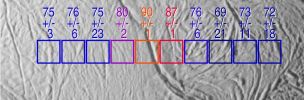
Enceladus-PIA07794.jpgEnceladus' surface temperatures (2)58 visiteEnhanced thermal emission is seen in the vicinity of the prominent "Tiger Stripe" fissures discovered by the imaging cameras.
In these images, the excess emission is most strongly seen in the left-most composite Infrared Spectrometer field of view, which includes a fissure near the end of one of the Tiger Stripes. The peak temperatures, 86 and 90 Kelvin (such as about -305 and -298 Fahrenheit) respectively, are averages over the Composite Infrared Spectrometer field of view, and other composite Infrared Spectrometer data suggest that much higher temperatures, up to at least 145 Kelvin (such as -199 Fahrenheit), occur in narrow zones a few hundred meters wide along the Tiger Stripe fissures.
The 1st image is centered near long. 135° W. and lat. 65° S. and each square from the composite infrared spectrometer field of view is about 17,5 Km (approx. 10,9 miles) across.
The 2nd image was taken nearly 3 times closer to Enceladus and is centered near long. 120° W, lat. 82° S.
|
|
| 2245 immagini su 188 pagina(e) |
 |
|
|
|
|
77 | |
|
|
|
|





