| Piú viste - Saturn: the "Ringed Beauty" and His Moons |

Japetus-N00022199.jpgJapetus from approx. 1.218.000 Km57 visiteLa Sonda Cassini-Huygens si è sensibilmente avvicinata non solo a Saturno, ma anche ad alcune delle sue Lune interne. Questa immagine (una delle tantissime) di Giapeto, è stata ripresa da una distanza di poco superiore al milione di Km e ci fa già vedere molti dettagli della superficie di questo mondo ghiacciato e ricoperto di crateri da impatto. Il gioco di luci ed ombre che sembra caratterizzare la "faccia" di Giapeto rende l'immagine ancora più "aliena" ed affascinante.
|
|

Saturn-South Pole~0.jpgThe South Pole of Saturn57 visiteQuesta immagine, pubblicata sul Sito "NASA Picture of the Day" del 18.10.2004 ci sembra interessante perchè presenta - a nostro parere - una Anomalia. Innanzitutto eccoVi la caption originale:"...Visible in the above image of Saturn are bright bands, dark belts and a dark spot right over the South Pole. The above image in infrared light spans over 30.000 Km and was taken early last month (Sept.) by the Cassini spacecraft. Saturn's atmosphere is about 75% H, 25% He and small amounts of heavier compounds including water vapor, methane, and ammonia. The relatively low gravity at Saturn's cloud tops result in a thicker haze layer, which in turn makes atmospheric features blurrier than Jupiter". I dati sull'atmosfera di Saturno sono interessanti e le indicazioni relative ad alcune surface features corrette. Ma che cosa possiamo dire di quell'area circolare, luminescente, biancastra, ben visibile, perpendicolare al Polo Sud, a circa centro immagine?!? E' un difetto di processo? Un artifact? Una nuvola sferica?
|
|

Saturn-N00023938.jpgSaturn is not alone... (1)57 visiteGuardate questa recentissima immagine proveniente dalla Sonda Cassini-Huygens con attenzione, e poi provate a riflettere sulle conseguenze che una simile (FANTASTICA!) visione potrebbe avere su degli occhi umani.
Non si tratta di una domanda oziosa nè di una sciocca questione retorica: Vi stiamo semplicemente chiedendo di immaginare - se Voi foste "là", in un'ipotetica astronave, a gurdare da un oblò - che cosa provereste osservando "dal vivo", in tempo reale, uno spettacolo del genere.
Noi crediamo che la vista sia, in generale, il senso che supporta in maggior misura lo "sviluppo globale" dell'Uomo. E quindi, in altre parole, una visione diretta dello Spazio, nelle sue multiformi manifestazioni, potrebbe aiutarci - forse - a "diventare qualcosa di più" (e di meglio).
Si tratta solo di un'opinione, come ovvio, e ci piacerebbe davvero sentire una Vostra voce in proposito...
|
|

Tethys-PIA06140-N-HD.jpgTethys in natural colors (HD)57 visiteCommento NASA originale estratto da "NASA - Picture of the Day" del 29 Novembre 2004:"Tethys is one of the larger and closer moons of Saturn. The Cassini spacecraft now orbiting Saturn passed near the frozen moon at the end of October, capturing the most detailed images since the Voyager spacecrafts in the early 1980s. Tethys is composed almost completely of water ice and shows a large impact crater that nearly circles the planet. Because this crater did not disrupt the moon, Tethys is hypothesized to be at least partly liquid in its past. Two smaller moons, Telesto and Calypso, orbit Saturn just ahead of and behind Tethys. Giovanni Cassini discovered Tethys in 1684. The Cassini spacecraft is scheduled for a close fly-by of Tethys in September 2005".
|
|

Saturn-the Encke Gap-PIA06534_modest.jpgThe "Encke Gap" of Saturn's Rings57 visiteCaption NASA originale:"An intriguing knotted ringlet within the Encke Gap is the main attraction in this Cassini image. The Encke Gap is a small division near the outer edge of Saturn's rings that is about 300 Km wide. The tiny moon Pan (20 Km across) orbits within the gap and maintains it.
Many waves produced by orbiting moons are also visible.
The image was taken in visible light with the Cassini spacecraft narrow angle camera on Oct. 29, 2004, at a distance of about 807,000 Km from Saturn. The image scale is 4,5 Km per pixel".
|
|

Japetus in the darkness-PIA06146_modest.jpgThe night-side of Japetus (from 1,6 MKMs)57 visiteCaption NASA originale:"Japetus, as it has been already said, is mainly famous for some dramatic contrasts in brightness on its surface: the leading hemisphere is as dark as a freshly-tarred street while the trailing hemisphere and poles are almost as bright as fresh snow. Many impact craters can be seen in the bright terrain and in the transition zone between bright and dark and for the first time in parts of the dark terrain. Also visible is a line of mountains that appear as a string of bright dots (see the color images "Sharp views of Japetus"). These mountains were originally detected in Voyager images and might compete in height with the tallest mountains on Earth, Jupiter's moon Io and possibly even Mars. Further observations will be required to precisely determine their heights. Interestingly, the line of peaks is aligned remarkably close to the equator of Japetus".
|
|

Japetus-N00026243.jpgJapetus (and the "Pentagon") from about 180.000 Km (3)57 visitenessun commento
|
|

Japetus-PIA06170_modest.jpgJapetus in HR57 visiteCaption NASA originale:"This oblique view of Saturn's moon Japetus from high latitude shows how the dark, heavily cratered terrain of Cassini Regio transitions to a bright, icy terrain at high latitudes. In this mosaic of 2 HR images taken during Cassini's New Year's Eve 2004 flyby of Japetus, the direction toward the north pole is approximately 15° below the horizontal on the right. At the equator terrains are uniformly covered with a dark mantle of material that has a reflectivity of about 4%. At latitudes toward the pole of about 40°, the dark deposits become patchy and diffuse as the surface transitions to a much brighter, icy terrain near the pole. The brightest icy materials exhibit visual reflectivity over 60%. Superimposed on the bright terrain is a subtle, ghostly pattern of crudely parallel, north-south trending wispy streaks. The streaks, which were discovered during this flyby of Iapetus, are typically a few kilometers wide and sometimes tens of kilometers long. Their appearance and orientation may be connected with the emplacement of dark materials that cover Cassini Regio. The dark materials might represent the gradual accumulation of dark debris falling from space, or alternatively, may represent fallout from plume-style eruptions that may have accompanied the formation of Iapetus's enigmatic equatorial ridge (see PIA 06166)".
|
|

Japetus-PIA06171_modest.jpgLandslide on Japetus57 visiteCaption NASA originale:"A spectacular landslide within the low-brightness region of Japetus's surface known as Cassini Regio. The landslide material appears to have collapsed from a scarp 15 Km high that forms the rim of an ancient 600 Km impact basin. Unconsolidated rubble from the landslide extends halfway across a conspicuous, 120-Km diameter flat-floored impact crater that lies just inside the basin scarp. Landslides are common geological phenomena on many planetary bodies, including Earth and Mars. The appearance of this landslide on an icy satellite with low-brightness cratered terrain is reminiscent of landslide features that were observed during NASA's Galileo mission on the Jovian satellite Callisto. The fact that the Japetus landslide traveled many kilometers from the basin scarp could indicate that the surface material is very fine-grained and perhaps was fluffed by mechanical forces that allowed the landslide debris to flow extended distances".
|
|

Japetus-temp.1-PIA07006_modest.jpgJapetus Temperature Variation Map57 visiteCaption NASA originale:"This plot shows how daytime temp.s at low latitudes on the Dark Material on Japetus vary with time of day from about 130 Kelvin (-226 F) at noon to about 70 Kelvin (-334 F) at sunset. The observations are compared to a "forecast" model (green line) which predicts temperatures based on an assumed value of a parameter called the "thermal inertia. Rock or solid ice has a high thermal inertia (approx. 2.000.000 as measured in the obscure units used for thermal inertia), meaning that it is good at storing heat and cools down or heats up relatively slowly. On Japetus, in contrast, temperatures drop precipitously in the afternoon as the Sun sinks towards the horizon and a very small value of the thermal inertia (30.000 units) is needed in the model to match the data. This means that Japetus's surface is extremely bad at storing heat and is thus extremely fluffy, probably due to the pulverizing effect of billions of years of meteorite impacts (...)".
|
|

Mimas-N00026588.jpgOne half of Mimas57 visitenessun commento
|
|
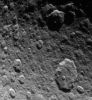
Rhea-N00026670.jpgRhea's craters (HD) - detail mgnf57 visiteGuardate con attenzione all'interno dei 4 crateri contenuti in questo dettaglio del frame precedente.
Troverete un picco centrale illuminato dal Sole calante (nel cratere posto in posizione superiore, a ridosso del terminatore); una struttare conica con qualcosa di circolare sulla sommità (il cratere alla Vostra Sn); getti di polvere o antiche cascate di materiale fangoso (dentro il cratere maggiore situato alla Vostra Dx) ed un qualcosa di indefinibile (dalla forma irregolare e confusa) dentro al cratere posto all'interno del triangolo disegnato dai primi tre, quasi sulla linea che congiunge il cratere posto sul terminatore a quello che vedete alla Vostra Sn.
Si tratta di strutture artificiali "Aliene"? O forse di configurazioni rocciose naturali?
Secondo noi, fra le 4 "anomalie", quella posta all'interno del cratere più grande (alla Vostra Dx) ci sembra la più meritevole di indagini: i due "getti" chiari che vediamo sul bordo del cratere, infatti, sono davvero difficili da interpretare e spiegare...
|
|
| 2245 immagini su 188 pagina(e) |
 |
|
|
|
|
76 | |
|
|
|
|





