| Piú viste - Saturn: the "Ringed Beauty" and His Moons |

Saturn-PIA07559.jpgRings in the Rings, both cut by the darkness...58 visiteCaption NASA originale:"This view shows the unlit face of Saturn's Rings, visible via scattered and transmitted light. In these views, dark regions represent gaps and areas of higher particle densities, while brighter regions are filled with less dense concentrations of ring particles.
The dim right side of the image contains nearly the entire C-Ring. The brighter region in the middle is the inner B-Ring, while the darkest part represents the dense outer B-Ring. The Cassini Division and the innermost part of the A-Ring are at the upper-left.
Saturn's shadow carves a dark triangle out of the lower right corner of this image.
The image was taken in visible light with the Cassini spacecraft wide-angle camera on June 8, 2005, at a distance of approximately 433.000 Km (about 269.000 miles) from Saturn. The image scale is 22 Km (about 14 miles) per pixel".
|
|
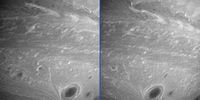
Saturn-PIA07562.jpgThe "anti-hurricanes" of Saturn58 visiteVortices mingle amidst other turbulent motions in Saturn's atmosphere in these two comparison images. The image on the right was taken about two Saturn rotations after the image on the left.
Both views show latitudes from -23° to -42°. The region below center in these images (at -35°) has seen regular storm activity since Cassini first approached Saturn in early 2004.
Cassini investigations of the atmosphere from February to October 2004 showed that most of the oval-shaped storms in the latitude region near -35° rotate in a counter-clockwise direction, with smaller storms occasionally merging into larger ones.
On Earth, hurricanes in the Southern Hemisphere rotate clockwise. Thus, the storms in these images of Saturn's southern latitudes could be called "anti-hurricanes."
This backwards spiraling (compared to Earth) is common on the giant planets.
|
|

Hyperion-N00038106.jpgHyperion, from about 868.000 Km58 visiteUn'immagine molto bella e che ci spinge a considerare molto seriamente l'ipotesi che la Luna conosciuta come "Hyperion" non sia altro che una cometa mancata, ovvero un astro composto prevalentemente da ghiaccio d'acqua, il cui cammino verso il Sole venne interrotto (repentinamente e per sempre) dall'abbraccio gravitazionale di Saturno. A proposito: se osservate Hyperion con una certa attenzione, dovreste notare una certa (e forte) somiglianza con un altro corpo celeste "vagante", recentemente salito agli onori delle Cronache Spaziali.
Quale?
|
|

Saturn-PIA07568.jpgThe "dusty" D-Ring of Saturn58 visiteOriginal caption:"This close-up view is Cassini's best look yet at Saturn's tenuous innermost D-Ring. The narrow ringlet visible here is named D68 and is the innermost discrete feature in the D-Ring.
This image also clearly shows how the diffuse component of the D-Ring tapers off as it approaches the Planet.
The view is looking down on the dark side of the Rings, with the Planet's lower half being illuminated by reflected light from the Rings. The upper half of the Planet is also dark. The image was taken at a high phase angle - such as the Sun-Saturn-spacecraft angle - such as 177°. Viewing the Rings at high phase angle makes the finest dusty particles visible.
The inner edge of the C-Ring enters the scene at the lower left and Saturn's shadow cuts off the view of the Rings. Several background stars can also be seen here.
The image was taken in visible light with the Cassini spacecraft wide-angle camera on July 15, 2005, at a distance of approx. 293.000 Km from Saturn".
|
|

Mimas-HerschelCrater.jpgHerschel Crater on Mimas58 visitenessun commento
|
|

Rings-PIA03556.jpg"Clumps" in the A-Ring58 visiteOriginal NASA caption:"The left image is a false-color view of Saturn's A-Ring from the Ultraviolet Imaging Spectrograph aboard Cassini.
The A-Ring is the bluest in the center, where the gravitational clumps are the largest. The thickest black band in the Ring is the "Encke-Gap" while the thin black band further to the right is the "Keeler-Gap".
The right image is a computer simulation about 150 mt (about 490 feet) across illustrating a "clumpy region" of particles in the A-Ring. And, there and that is the 'real surprise'...The particles are moving counterclockwise, from bottom to top!".
|
|

Rings-PIA07579.jpgPandora, Prometheus and the F-Ring58 visiteOriginal NASA caption:"From just outside the faint edge of Saturn's F-Ring, the moon Pandora keeps watch over her fine-grained flock.
The outer flanks of the F-Ring region are populated by ice particles approaching the size of the particles comprising smoke!
As a shepherd moon, Pandora helps her cohort Prometheus confine and shape the main F-Ring (Pandora is 84 Km (such as 52 miles) across while Prometheus is 102 Km (such as 63 miles) wide and orbits interior to the F-Ring.
The small knot seen attached to the core is one of several that Cassini scientists are eyeing as they attempt to distinguish "embedded moons" from "transient clumps of material".
The image was taken with the Cassini spacecraft narrow-angle camera on Aug. 2, 2005, using a filter sensitive to wavelengths of infrared light centered at 930 nnmts at a distance of approx. 610.000 Km (such as about 379.000 miles) from Pandora and at a Sun-Pandora-spacecraft, or phase, angle of 146°. Image scale is 4 Km per pixel".
|
|

Saturn-PIA03559.jpgSaturn's clouds in 3D58 visiteSaturn's clouds and hazes at three different levels in the atmosphere are depicted in the image on the right, as observed by the visual infrared mapping spectrometer on the Cassini spacecraft.
In the image, red represents the deepest clouds yet found on Saturn. They are at an altitude where pressure is nearly double Earth's sea-level air pressure. The spectrometer saw these clouds using a 5.1 micron wavelength. Brightness levels in the original image were inverted to show cloud as bright features. Green is an image taken simultaneously at 1.6 micron wavelength, showing upper-level clouds near and above the altitude where atmospheric pressure equals Earth's sea-level air pressure, a pressure expressed as 1 bar. Blue is an image taken at 2.05 micron, a wavelength which is limited to showing only higher cloud level due to absorption of light by the hydrogen gas comprising the bulk of Saturn's atmosphere. Blue indicated clouds of an altitude where atmospheric pressure is only about 70 percent of Earth's sea-level air pressure. Thus, the aqua-colored feature over the equator is high-altitude haze residing 10 kilometers (6 miles) altitude above the typical zonal features seen in reflected sunlight over the planet (green).
The image on the left shows only the upperatmosphere above the 1-bar level, and is the view seen in reflected sunlight as observed by cameras not capable of seeing the thermal radiation of Saturn. Red in this image was taken at 2.79 micron, a wavelength that absorbs ammonia. The greenish appearance of the south pole indicates that ammonia gas is enhanced there.
As opposed to the uniform bands of hazes and clouds seen over the planet at pressures near and less than 1 bar, clouds at the 2-bar level (red, in right-hand image) are distinct, and come in a variety of shapes and sizes.
|
|

Saturn-PIA07731-1.jpgSpokes (1)58 visiteAfter much anticipation, Cassini has finally spotted the elusive "spokes" in Saturn's Rings.
"Spokes" are the ghostly Radial Markings discovered in the Rings by NASA's Voyager spacecraft 25 years ago. Since that time, Spokes had been seen in images taken by NASA's Hubble Space Telescope but had not, until now, been seen by Cassini.
These three images, taken over a span of 27', show a few faint, narrow Spokes in the outer B-Ring. The Spokes are about 3500 Km (2200 miles) long and about 100 Km wide (60 miles). The motion of the Spokes here is from left to right.
They are seen just prior to disappearing into the Planet's shadow on the Rings.
|
|
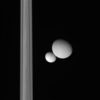
Tethys-N00039923.jpgTethys, Dione anf the Rings58 visiteN00039923.jpg was taken on September 22, 2005 and received on Earth September 23, 2005. The camera was pointing toward TETHYS and Dione at approximately 1.495.033 Km away and the image was taken using the CL1 and CL2 filters.
|
|

Calypso-N00040025.jpgCalypso in the darkness58 visitePerduta nell'oscurità incombente dello Spazio, così come una minuscola isola - dimenticata dalle mappe dei Naviganti - è persa nell'Oceano: questa è Calypso, una piccola luna di Saturno la quale, se la osservate con attenzione, denuncia la sua natura di "scheggia vagante", catturata dalle braccia gravitazionali di Saturno e sottratta, in epoche (presumiamo) assai remote, al suo peregrinare senza mèta nei recessi del Sistema Solare.
Valutazioni romantiche a parte, in questo bellissimo frame, Calypso è a poco più di 100.000 Km di distanza da Cassini, ma qualche suo rilievo superficiale - oltre alla forma, decisamene peculiare... - si può già intuire: un grande bacino (da impatto?) marca il Polo Sud di Calypso, mentre un altro cratere, più vasto e meno profondo, sembra segnare il Polo Nord di questo piccolo mondo la cui forma - attenzione! - ricorda in maniera davvero impressionante quella dell'asteroide 433 Eros.
Identità di natura, coincidenza o un segnale di ripetitività?
|
|
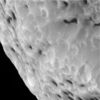
Hyperion-N00040349.jpgHyperion (17)58 visiteDa 11.600 Km di distanza da Hyperion e grazie a questo frame, possiamo definitivamente escludere che le zone "scure" sul fondo di innumerevoli crateri (e non solo quelli della specie che abbiamo battezzato "conica") sìano ombre.
Ma proseguiamo: le immagini migliori devono ancora arrivare...
|
|
| 2245 immagini su 188 pagina(e) |
 |
|
|
|
|
74 | |
|
|
|
|





