| Piú viste - Saturn: the "Ringed Beauty" and His Moons |

Janus-PIA07529.jpgJanus from 357.000 Km58 visiteThis close-up look at Saturn's moon Janus reveals spots on the moon's surface which may be dark material, maybe exposed by impacts. If the dark markings within bright terrain are indeed impact features, then Janus' surface represents a contrast with that of Saturn's moon Phoebe, where impacts have uncovered bright material beneath a darker overlying layer. Recent theories say also that Janus may be a porous body, composed mostly of water ice.
This image was taken in visible light with the Cassini spacecraft narrow-angle camera on May 20, 2005, at a distance of approx. 357.000 Km (about 222.000 miles) from Janus and at a Sun-Janus-spacecraft, or phase, angle of 6°. Resolution in the original image was 2 Km (about 1,3 miles) per pixel. The view was magnified by a factor of two and contrast-enhanced to aid visibility of the moon's surface".
|
|

Tethys-IMG001589-br500.jpgItaca Chasma on Tethys58 visiteCaption NASA originale:"Saturn's icy moon Tethys displays a very old impact basin here, just South-East of its giant canyon system, Ithaca Chasma. The large crater has been degraded, or softened, by time and a more recent impact has formed a smaller crater near its southern edge. This large basin was first seen in images from the NASA Voyager mission. A sharper, presumably younger crater called Penelope lies near the eastern limb, at the 3 o'clock position. This view shows principally the trailing hemisphere on Tethys and North is directly up.
The image was taken in visible light with the Cassini spacecraft narrow-angle camera on May 20, 2005, at a distance of approx. 1 MKM (approx. 600.000 miles) from Tethys and at a Sun-Tethys-spacecraft, or phase, angle of 31°. Resolution in the original image was 6 Km (about 4 miles) per pixel. The image has been contrast-enhanced and magnified by a factor of two to aid visibility".
|
|

Mimas-PIA07534.jpgRound? Not really...58 visiteCaption NASA originale:"Saturn's moon Mimas, whose low density suggests that it is primarily composed of ice, has a flattened or oblate shape reminiscent of Saturn's. The moon's equatorial dimension is nearly 10% larger than the polar one due to the satellite's rapid rotation. This view shows principally the leading hemisphere on Mimas. Mimas' largest crater, Herschel (130 Km, or 80 miles wide), is centered roughly on the equator and can be seen here. North on Mimas is toward upper left.
The moon's oblateness is exaggerated by Cassini's viewing angle here -- the Sun-Mimas-spacecraft, or phase, angle was only 5° leaving a sliver of the moon's disk in shadow on the northwest limb.
The image was taken in visible light with the Cassini spacecraft narrow-angle camera on May 20, 2005, at a distance of approx. 916.000 Km (about 569.000 miles) from Mimas. Resolution in the original image was 5 Km (about 3 miles) per pixel".
|
|

Enceladus-N00037062.jpgEnceladus fly-by (18) - from approx. 11.000 Km58 visiteOra, a circa 11.000 Km di distanza dalla superficie, incominciamo a vedere che i bordi (limbs) di tutti i canali e crepacci che ricoprono la quasi totalità di Encelado, presentano curiosi rilievi la cui albedo sembra molto elevata.
Da questa, ancora gradissima, distanza, sembra che ai bordi e sui fianchi dei canyons di Encelado vi sia qualcosa di simile a quanto abbiamo già visto su Marte (sebbene, nel caso del Pianeta Rosso, Regione di Melas Chasma, eravamo a soli 370 Km di altitudine!).
Forse ci sono delle "cascate di ghiaccio" anche su Encelado?
|
|
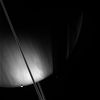
Saturn-W00009484.jpgHow many moons around Saturn? (2) - frame W0000948458 visiteUna delle due lune (diciamo) "maggiori" sembra allungarsi e sdoppiarsi, ma si tratta - a nostro parere - di un mero effetto ottico derivante dalla ripresa non buona. Se così non fosse, invece, potremmo supporre che il corpo celeste "allungato" (e minore) sia una delle "Lune Pastore": nella fattispecie, ipotizzeremmo Prometheus.
I due punti luminosi che vedete sulla Dx del frame sono inspiegabili, ma si potrebbe ragionevolmente trattare di photo-artifacts.
|
|

Hyperion.jpgHyperion: the "sponge-like" moon58 visiteDa "NASA - Picture of the Day" del 26 Luglio 2005:"Recent HR images from the Cassini spacecraft orbiting Saturn show Hyperion to be an even stranger place than thought before. Previously, it was known that the length of a day on Hyperion is unpredictable. The moon's highly elliptical orbit around Saturn, its highly non-spherical shape and its locked 4:3 orbital resonance with Titan torque Hyperion around so much it is hard to predict when the Sun will rise next. The newly imaged craters on the unusually coarse surface are surely the result of impacts, but for some reason have dark centers. The low density of Hyperion indicates it might even be a spelunker's paradise, riddled with tremendous caverns".
Nota: è la prima volta che la NASA dice espressamente che i crateri visibili sono "surely the result of impacts". A parte l'ovvia assurdità di una simile certezza (irraggiungibile per definizione), molti Ricercatori credono che gli impatti ebbero un ruolo MARGINALE nella definizione di questo ed altri mondi...
|
|

Mimas-N00037581.jpgMimas, from approx. 183.583 Km58 visiteL'impressionante "Occhio di Mimas" non sembra essere rivolto nella nostra direzione e quindi, memori delle avventure di Ulisse, possiamo tentare di passare inosservati nelle sue vicinanze...
Mitologia a parte, l'immenso cratere che domina questa - tutto sommato - minuscola luna di Saturno dovrebbe farci riflettere sulle sue origini e, più in generale, sulla - sempre presunta - "origine da impatto" della quasi totalità delle formazioni crateriche che vediamo sui diversi corpi celesti. Abbiamo già accennato a questa complessa e controversa problematica in altri momenti, ma sono immagini come questa che devono spingerci a non "accettare acriticamente ed aprioristicamente come valide" tutte le Teoria Esplicative delle Fenomenologie Complesse (TEFC) allorchè l'acquisizione di nuovi dati ed informazioni le mette, se non in crisi, quantomeno in grandissima difficoltà.
|
|

Mimas-N00037611.jpgMimas, from approx. 104.424Km58 visiteLa maggior parte di questi elementi - se non la totalità - in difetto di osservazioni dirette dell'impatto, dovrà essere dedotta da elementi circostanziali quali, ad esempio: 1) le dimensioni del cratere; 2) la forma del cratere; 3) la composizione della superficie impattata all'interno del cratere e nei suoi dintorni, sia quelli immediati, sia quelli più lontani (a tal riguardo è corretta l'analisi chimico-fisica degli ejecta; 4) la composizione del bolide (sempre ammesso che sia possibile trovarne qualche "pezzo" - non è da escludere, infatti, l'ipotesi di una totale annichilazione del corpo impattante al momento dell'impatto) e così via.
Ora, semplificando questa modesta trattazione il più possibile, ciò che possiamo dedurre - guardando un cratere come lo "Stickney Crater" di Phobos, oppure il "Copernicus Crater" della Luna e poi, naturalmente, il cratere che stiamo osservando ora e che chiamiamo "Occhio di Mimas" (ma il cui vero nome è "Herschel") - è che, in epoche remote, alcuni corpi celesti...
|
|

Rhea-N00037566.jpgRhea, from about 211.000 Km58 visitenessun commento
|
|

Saturn-PIA07559.jpgRings in the Rings, both cut by the darkness...58 visiteCaption NASA originale:"This view shows the unlit face of Saturn's Rings, visible via scattered and transmitted light. In these views, dark regions represent gaps and areas of higher particle densities, while brighter regions are filled with less dense concentrations of ring particles.
The dim right side of the image contains nearly the entire C-Ring. The brighter region in the middle is the inner B-Ring, while the darkest part represents the dense outer B-Ring. The Cassini Division and the innermost part of the A-Ring are at the upper-left.
Saturn's shadow carves a dark triangle out of the lower right corner of this image.
The image was taken in visible light with the Cassini spacecraft wide-angle camera on June 8, 2005, at a distance of approximately 433.000 Km (about 269.000 miles) from Saturn. The image scale is 22 Km (about 14 miles) per pixel".
|
|
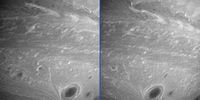
Saturn-PIA07562.jpgThe "anti-hurricanes" of Saturn58 visiteVortices mingle amidst other turbulent motions in Saturn's atmosphere in these two comparison images. The image on the right was taken about two Saturn rotations after the image on the left.
Both views show latitudes from -23° to -42°. The region below center in these images (at -35°) has seen regular storm activity since Cassini first approached Saturn in early 2004.
Cassini investigations of the atmosphere from February to October 2004 showed that most of the oval-shaped storms in the latitude region near -35° rotate in a counter-clockwise direction, with smaller storms occasionally merging into larger ones.
On Earth, hurricanes in the Southern Hemisphere rotate clockwise. Thus, the storms in these images of Saturn's southern latitudes could be called "anti-hurricanes."
This backwards spiraling (compared to Earth) is common on the giant planets.
|
|

Hyperion-N00038106.jpgHyperion, from about 868.000 Km58 visiteUn'immagine molto bella e che ci spinge a considerare molto seriamente l'ipotesi che la Luna conosciuta come "Hyperion" non sia altro che una cometa mancata, ovvero un astro composto prevalentemente da ghiaccio d'acqua, il cui cammino verso il Sole venne interrotto (repentinamente e per sempre) dall'abbraccio gravitazionale di Saturno. A proposito: se osservate Hyperion con una certa attenzione, dovreste notare una certa (e forte) somiglianza con un altro corpo celeste "vagante", recentemente salito agli onori delle Cronache Spaziali.
Quale?
|
|
| 2245 immagini su 188 pagina(e) |
 |
|
|
|
|
73 | |
|
|
|
|





