| Piú viste - Saturn: the "Ringed Beauty" and His Moons |

Japetus-PIA06171_modest.jpgLandslide on Japetus58 visiteCaption NASA originale:"A spectacular landslide within the low-brightness region of Japetus's surface known as Cassini Regio. The landslide material appears to have collapsed from a scarp 15 Km high that forms the rim of an ancient 600 Km impact basin. Unconsolidated rubble from the landslide extends halfway across a conspicuous, 120-Km diameter flat-floored impact crater that lies just inside the basin scarp. Landslides are common geological phenomena on many planetary bodies, including Earth and Mars. The appearance of this landslide on an icy satellite with low-brightness cratered terrain is reminiscent of landslide features that were observed during NASA's Galileo mission on the Jovian satellite Callisto. The fact that the Japetus landslide traveled many kilometers from the basin scarp could indicate that the surface material is very fine-grained and perhaps was fluffed by mechanical forces that allowed the landslide debris to flow extended distances".
|
|
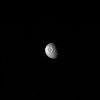
Mimas-N00026522.jpgMimas: the Ring-Master58 visitenessun commento
|
|
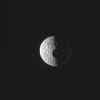
Mimas-N00026566.jpgThe "Eye" of Mimas58 visiteCaption NASA originale:"Whatever hit Mimas nearly destroyed it. What remains is one of the largest impact craters on one of Saturn's smallest moons. The crater, named Herschel after its discoverer, spans about 130 Km and is pictured above in the dramatic light of its terminator. Mimas' low mass produces a surface gravity just strong enough to create a spherical body but weak enough to allow such relatively large surface features. Mimas is made of mostly water ice with a smattering of rock - so it is accurately described as a big dirty snowball".
Una descrizione accurata ed interessante, in linea con le più recenti correnti di pensiero scientifico relative alla struttura ed alla composizione di Mimas.
Tuttavia, assumendo come vere queste informazioni, ci chiediamo come abbia fatto una "palla di neve sporca" a resistere senza disintegrarsi del tutto a seguito dell'impatto che generò il cratere Herschel.
Deduzione: forse Mimas non è solo ghiaccio d'acqua ed un pò di roccia, come ci stanno insegnando...
|
|

Mimas-N00026588.jpgOne half of Mimas58 visitenessun commento
|
|

Saturn-N00027022.jpgSomething is moving: is it a moon or a spaceship? (1)58 visiteAncora un enigma e, ancora una volta l'immagine è - secondo noi -davvero difficile da interpretare. Vi offriamo 3 frames ripresi dalla Sonda Cassini i quali ci mostrano la porzione più esterna degli Anelli di Saturno (per altro leggermente sovraesposti) e, in alto, proprio alla Vostra estrema Sn, un oggetto che emana una notevole luce e che, nell'arco dei tre frames, si sposta visibilmente dall'angolo alto a Sn sin quasi al centro del riquadro (ma sempre restando sul margine superiore dell'immagine). Abbiamo subito pensato che si trattasse di una delle lune di Saturno che, come è accaduto altre volte, è rimasta "mossa" (e così ci sembra, effettivamente). Ma è la rapidità di movimento dell'oggetto che ci ha lasciati perplessi. Certo è, però, che non sappiamo (grazie alla pochezza di dati utili rilasciati dalla NASA) l'intervallo di tempo intercorrente fra i vari scatti. Secondi, minuti oppure ore? Ma è proprio da questa informazione che dipende la risposta all'interrogativo che intitola le immagini!
|
|

Enceladus-PIA06579.jpgCrescent Enceladus, the brightest gem of Saturn's System58 visiteCaption NASA originale:"In the dim light of the outer Solar System, Cassini gazed back at Saturn's brightest gem: the moon Enceladus. The icy little world presents only a slim crescent in this natural color view. Cassini has now matched the best spatial resolution on Enceladus achieved by NASA's Voyager spacecraft, and will soon have excellent coverage of the moon (at more than 10 times the resolution in this image), following a flyby planned for February 17.
When seen from its day side, Enceladus (499 Km across) has one of the brightest and whitest surfaces in the Solar System. Since it reflects most of the sunlight that strikes it, the temperature there remains at a chilly -200°C (-330° Fahrenheit).
In this view, Cassini was pointed at the leading hemisphere of Enceladus, which was in darkness at the time. The image has been rotated so that north on Enceladus is up".
|
|

Mimas-PIA06176.jpgBlue Saturn and Mimas58 visiteCaption NASA originale:"Mimas drifts along in its orbit against the azure backdrop of Saturn's northern latitudes in this true color view. The long, dark lines on the atmosphere are shadows cast by the planet's rings.
Saturn's northern hemisphere is presently relatively cloud-free, and rays of sunlight take a long path through the atmosphere. This results in sunlight being scattered at shorter (bluer) wavelengths, thus giving the northernmost latitudes their bluish appearance at visible wavelengths.
At the bottom, craters on icy Mimas (398 Km or 247 miles across) give the moon a dimpled appearance.
Images taken using infrared (930 nanometers), green (568 nanometers) and ultraviolet (338 nanometers) spectral filters were combined. The colors have been adjusted to match closely what the scene would look like in natural color. The images were obtained using the Cassini spacecraft narrow angle camera on Jan. 18, 2005, at a distance of approx. 1,4 MKM from Saturn".
|
|

Mimas-PIA06582.jpgMimas's "Eye": the "Herschel Crater"58 visiteCaption NASA originale:"Saturn's moon Mimas has many large craters, but its Herschel Crater dwarfs all the rest. This large crater 130 Km wide (80 miles) has a prominent central peak, seen here almost exactly on the terminator. This crater is the moon's most prominent feature, and the impact that formed it probably nearly destroyed Mimas. Mimas is 398 Km (247 miles) across. This image was taken with the Cassini spacecraft narrow angle camera on Jan. 16, 2005, at a distance of approximately 213.000 Km (132.000 miles) from Mimas and at a phase angle of 84°. Resolution in the original image was about 1,3 Km (0,8 mi.s) per pixel. A combination of spectral filters sensitive to ultraviolet and polarized light was used to obtain this view. Contrast was enhanced and the image was magnified by a factor of two to aid visibility".
|
|

Epimetheus-N00027756.jpgEpimetheus at the boundaries of the "Ringed Kingdom"58 visitenessun commento
|
|

Enceladus-N00028181.jpgEnceladus: from VERY close! (1)58 visiteUna serie di 4 immagini ravvicinate (riprese da una distanza media di circa 1200 Km dalla superficie di questa "Luna di ghiaccio" la quale - a detta degli Scienziati - riflette la luce come se fosse "neve fresca") che ci mostrano lo stupefacente volto di Encelado.
In tutte le 4 immagini che Vi proponiamo sono chiaramente visibili delle lunghissime (ed intricate!) reti di crepacci ("cracks" e/o "chasmas") i quali, nel caratterizzare questa piccola Luna, la rendono, in qualche maniera, piuttosto simile - visivamente - alla Luna Gioviana "Europa".
In questo primissimo frame, inoltre, si può notare una sostanziale mancanza di crateri; una mancanza che, talvolta, può essere indice di una (relativa) 'gioventù geologica' della superficie!
|
|

Enceladus-PIA06191.jpgEnceladus: photomosaic58 visiteCaption NASA originale:"The view is about 300 Km across and shows the myriad of faults, fractures, folds, troughs and craters that make this Saturnian Satellite especially intriguing to planetary scientists. More than 20 years ago, NASA's Voyager spacecraft gave hints of a surface cut by tectonic features and subsequent images of other icy moons have revealed many different ways that stresses have acted on icy moon crusts. The new close-up images of Enceladus, which has a diameter of 505 Km, show some familiar-looking features and others that are brand new. Extending downward from the top center of the mosaic for hundreds of kilometers is a broad belt of complex, interwoven fractures. A huge rift 5 Km-wide dissects this belt and extends into several older-looking, distinct regions or "cells" of terrain that themselves exhibit distinct fracture patterns. The work required to unravel their origins, their formation sequence, and the implications for the evolution of icy Solar System bodies is just beginning...".
|
|
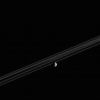
Mimas-N00028766.jpgMimas and the Rings, from approx. 1.378.000 Km58 visiteUna splendida immagine, che non serve commentare.
|
|
| 2245 immagini su 188 pagina(e) |
 |
|
|
|
|
72 | |
|
|
|
|





