| Piú viste - Saturn: the "Ringed Beauty" and His Moons |
Rhea-N00047219.jpgRhea59 visiteOriginal caption:"N00047219.jpg was taken on December 24, 2005 and received on Earth December 24, 2005. The camera was pointing toward RHEA that, at the time, was approximately 255.628 Km away.
The image was taken using the CL1 and CL2 filters".
|
|

Rhea-N00047136.jpgRhea59 visiteOriginal caption:"N00047136.jpg was taken on December 23, 2005 and received on Earth December 24, 2005. The camera was pointing toward RHEA that, at the time, was approximately 283.082 Km away.
The image was taken using the CL1 and IR3 filters".
|
|
Saturn-N00047653.jpgWhite ice-clouds on Saturn's upper atmosphere (1)59 visiteOriginal caption:"N00047653.jpg was taken on January 02, 2006 and received on Earth January 03, 2006. The camera was pointing toward Saturn that, at the time, was approximately 2.732.201 Km away, and the image was taken using the CL1 and CL2 filters. This image has not been validated or calibrated".
|
|

Janus&Epimetheus-PIA07699.jpgHigh-Phase in the Darkness: Janus and Epimetheus59 visiteThis close pairing of Janus and Epimetheus shows the 2 moons at "high phase," meaning that only a thin sliver of sunlit terrain is visible on each moon. Portions of each are also lit feebly by reflected light from Saturn.
Janus (181 Km, or about 113 miles across) is at top and Epimetheus (116 Km, or about 72 miles across) is below.
The image was taken in visible light with the Cassini spacecraft narrow-angle camera on Dec. 25, 2005, at a distance of approx. 479.000 Km(roughly 298.000 miles) from Janus and about 455,000 Km (roughly 283.000 miles) from Epimetheus. The image scale is about 3 Km (approx 2 miles) per pixel on both moons.
|
|

Telesto-PIA07702.jpgTelesto59 visiteThe Cassini spacecraft passed within a cosmic stone's throw of Telesto in October, 2005 capturing this shot of the tiny Trojan moon. Telesto (24 Km, or 15 miles across) appears to be mantled in fine, icy material, although a few craters and some outcrops and/or large boulders are visible. Its smooth surface does not appear to retain the record of intense cratering that most of Saturn's other moons possess.
The image was taken in polarized green light with the Cassini spacecraft narrow-angle camera on Oct. 11, 2005, at a distance of approx. 14.500 Km (9.000 miles) from Telesto. The image scale is 86 mt (about 283 feet) per pixel.
|
|
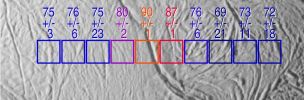
Enceladus-PIA07794.jpgEnceladus' surface temperatures (2)59 visiteEnhanced thermal emission is seen in the vicinity of the prominent "Tiger Stripe" fissures discovered by the imaging cameras.
In these images, the excess emission is most strongly seen in the left-most composite Infrared Spectrometer field of view, which includes a fissure near the end of one of the Tiger Stripes. The peak temperatures, 86 and 90 Kelvin (such as about -305 and -298 Fahrenheit) respectively, are averages over the Composite Infrared Spectrometer field of view, and other composite Infrared Spectrometer data suggest that much higher temperatures, up to at least 145 Kelvin (such as -199 Fahrenheit), occur in narrow zones a few hundred meters wide along the Tiger Stripe fissures.
The 1st image is centered near long. 135° W. and lat. 65° S. and each square from the composite infrared spectrometer field of view is about 17,5 Km (approx. 10,9 miles) across.
The 2nd image was taken nearly 3 times closer to Enceladus and is centered near long. 120° W, lat. 82° S.
|
|
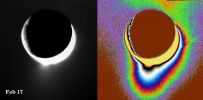
Enceladus-PIA07798.jpgEnceladus' active South Pole (1)59 visitePlumes of icy material extend above the Southern Polar Region of Enceladus, as imaged by the Cassini spacecraft in February 2005. The monochrome view is presented along with a color-coded version on the right. The latter reveals a fainter and much more extended plume component.
Images like these are being analyzed by scientists as they seek to explain the processes that could be producing such incredible features. As reported in the journal Science on March 10, 2006, imaging scientists believe that the plumes are geysers erupting from pressurized subsurface reservoirs of liquid water above 273 degrees Kelvin (0° C.).
Another plume view was taken 1 month earlier and looks broadside at the moon's prominent "Tiger Stripe" fractures. In the January view, the plume appears to have a single component. The February view looks along the Tiger Stripe fractures and reveals both a large and a small component to the plume; the smaller, fainter component is separated from the main plume by about 100 Km.
|
|

Tethys-PIA08149.jpgPenelope is always waiting...59 visiteCaption NASA originale:"This dramatic close-up of Tethys shows the large crater Penelope lying near center, overprinted by many smaller, younger impact sites. Three smaller impact features of roughly similar size make a line left of Penelope that runs North-South: (from bottom) Ajax, Polyphemus and Phemius.
Features on Tethys are named for characters and places from "The Iliad" and "The Odyssey". The largest impact structure on Tethys is named Odysseus.
This view is toward the Saturn-facing Hemisphere on Tethys and North is up.
This image was taken in polarized ultraviolet light with the Cassini spacecraft narrow-angle camera on Feb. 25, 2006 at a distance of approximately 165.000 Km (about 103.000 miles) from Tethys and at a Sun-Tethys-spacecraft, or phase, angle of 23°.
Image scale is about 984 meters (approx. 3.227 feet) per pixel".
|
|

Saturn-PIA08159.jpgCrescent Moons (1)59 visiteCaption NASA originale:"The tilted crescent of Saturn displays lacy cloud bands here along with a bright Equatorial Region and threadlike ring shadows on the Northern Hemisphere. Three moons are visible here: Mimas (397 Km, or about 247 miles across) at left and faint, is aligned with the Ring-Plane. At right are Rhea (1.528 Km, or about 949 miles across, at top) and Tethys (1.071 Km, or 665 miles across, below Rhea).
The image was taken in polarized infrared light with the Cassini spacecraft wide-angle camera on March 11, 2006, at a distance of approximately 2,8 MKM (approx. 1,8 MMs) from Saturn.
The image scale is roughly 166 Km (about 103 miles) per pixel".
|
|

Saturn-PIA08166.jpgRomantic inhospitality...59 visiteCaption originale:"Dreamy colors ranging from pale rose to butterscotch to sapphire give this utterly inhospitable gas planet a romantic appeal. Shadows of the rings caress the Northern Latitudes whose blue color is presumed to be a seasonal effect.
Enceladus hugs the Ring-Plane right of center.
Images taken using red, green and blue spectral filters were combined to create this color view, which approximates what the human eye would see. The image was taken with the Cassini spacecraft wide-angle camera on March 16, 2006 at a distance of approximately 2,1 MKM (such as about 1,3 MMs) from Saturn and at a Sun-Saturn-spacecraft, or phase, angle of 102°. Image scale is about 120 Km (approx. 75 miles) per pixel on Saturn".
|
|

Japetus-PIA08164.jpgThe unusual colors of Japetus59 visiteThese two views of Iapetus primarily show terrain in the Southern part of the moon's dark Leading Hemisphere - the side of Iapetus that is coated with dark material. The bright South Pole of Iapetus is visible, along with some terrain (at the bottom) that lies on the bright Trailing Hemisphere.
The dark terrain known as Cassini Regio is uniformly dark between the equator and about 30° South Lat. From there down to about 50 to 60° South Lat., the dark material looks "patchy" because south-facing crater walls are bright (being largely devoid of the dark material). South of this Region, only some northward-facing crater walls are still dark, while the bright terrain has a somewhat reddish color.
Beyond 90° South, the reddish color becomes white. The Region at the bottom of the color view presented here shows this "color boundary" in the bright terrain, which also marks the boundary between the Leading and Trailing Hemispheres.
The monochrome image on the left was taken using a filter sensitive to wavelengths of infrared light centered at 930 nanometers. The image was obtained with the Cassini spacecraft narrow-angle camera on April 8, 2006, at a distance of approximately 866,000 kilometers (538,000 miles) from Iapetus and at a Sun-Iapetus-spacecraft, or phase, angle of 88 degrees. The image scale is 5 kilometers (3 miles) per pixel.
The color view on the right was created by combining images taken in ultraviolet, green and infrared spectral filters. The images were acquired with the Cassini spacecraft narrow-angle camera on April 9, 2006, at a distance of approximately 692,000 kilometers (430,000 miles) from Iapetus and at a Sun-Iapetus-spacecraft, or phase, angle of 101 degrees. The image scale is 4 kilometers (2.5 miles) per pixel.
|
|

Rhea-N00063370.jpgRhea and the Rings59 visiteCaption originale:"N00063370.jpg was taken on July 01, 2006 and received on Earth July 01, 2006. The camera was pointing toward Rhea that, at the time, was approximately 1.170.687 Km away.
The image was taken using the RED and CL2 filters".
|
|
| 2245 immagini su 188 pagina(e) |
 |
|
|
|
|
70 | |
|
|
|
|





