| Piú viste - Saturn: the "Ringed Beauty" and His Moons |

Telesto-N00041282.jpgTelesto59 visiteOriginal caption:"N00041282.jpg was taken on October 11, 2005 and received on Earth October 12, 2005. The camera was pointing toward TELESTO at approx. 15.409 Km away; this image was taken using the P0 and GRN filters. This image has not been validated or calibrated".
|
|

Saturn-W00011753.jpgSaturn's limb59 visiteOriginal caption:"W00011753.jpg was taken on October 30, 2005 and received on Earth October 30, 2005. The camera was pointing toward SATURN at approximately 345.545 Km away, and the image was taken using the CL1 and BL1 filters. This image has not been validated or calibrated".
|
|

Dione&Co.-PIA07628.jpgDione, Tethys and Pandora59 visiteOriginal caption:"This excellent grouping of 3 moons - Dione, Tethys and Pandora - near the Rings, provides a sampling of the diversity of worlds that exists in Saturn's Realm. A 330-Km-wide (about 205 miles) impact basin can be seen near the bottom right on Dione (at left). Ithaca Chasma and the Region imaged during the Cassini spacecraft¿s Sept. 24, 2005, flyby can be seen on Tethys (middle). Little Pandora makes a good showing here as well, displaying a hint of surface detail. Tethys is on the far side of the Rings in this view; Dione and Pandora are much nearer to the Cassini spacecraft.
Rememeber that Dione is approx. 1.126 Km (about 700 miles) across. Tethys is approx. 1.071 Km (about 665 miles) across and Pandora is 84 Km (roughly 52 miles) across.
This image was taken in visible blue light with the Cassini spacecraft narrow-angle camera on Sept. 22, 2005, at a distance of approx. 1,2 MKM (about 800.000 miles) from Saturn. The image scale is about 5 Km (approx. 3 miles) per pixel on Dione and Pandora and 9 kilometers (6 miles) per pixel on Tethys".
|
|

Rhea-N00043395.jpgLittle "White Rayed Splat"59 visiteN00043395.jpg was taken on November 26, 2005 and received on Earth November 27, 2005. The camera was pointing toward Rhea that, at the time, was approximately 65.528 Km away.
The image was taken using the CL1 and CL2 filters.
|
|

Saturn-PIA07646.jpgThe limb of Saturn59 visiteOriginal caption:"This brooding portrait shows the South-Western limb of the cold gas giant and the thread-like cloud features lurking there. The limb appears smooth, but at the terminator (such as the boundary between light and dark) and at higher resolution, variations in cloud height can cause shadows that are visible to Cassini.
The image was taken in visible, red light with the Cassini spacecraft wide-angle camera on Oct. 30, 2005, at a distance of approx. 401.000 Km(such as about 249.000 miles) from Saturn and at a phase angle of 155°. Image scale is 20 Km (13 miles) per pixel. The image was contrast enhanced to improve visibility of features in the atmosphere".
|
|

Rings-PIA07654.jpgCrescent Enceladus and Crescent Rings59 visiteSunlight reflects off the bright, frozen surfaces of the billions and billions of particles comprising Saturn's Rings to brighten the Planet's Southern Skies.
The particles in Saturn's Rings are each too small to be seen by Cassini in this image but, if they could, each would look like the bright reflective crescent of Enceladus seen here, with each reflecting sunlight onto the Southern Hemisphere of the Planet.
The image was taken in polarized infrared light with Cassini's wide-angle camera on Nov. 2, 2005, at a distance of approx. 1,7 MKM (1,1 MMs) from Saturn and at a phase angle of 119°. The image scale is roughly 104 Km (about 65 miles) per pixel.
|
|

Enceladus-PIA06443.jpgThe biggest "Geyser" in the Solar System: the Enceladus' Fountain59 visiteDuring a non-targeted flyby by the Cassini spacecraft of Enceladus on Nov. 26, 2005, the Cassini's Visual and Infrared Mapping Spectrometer (VIMS) measured the spectrum of the plumes originating from the South Pole of the icy moon. The instrument captured a very clear signature of small ice particles in the plume data, at the 2,9 micron wavelength. This image of Enceladus, taken with the VIMS, shows not only the plume over the South Pole, but also the dark side of the moon, silhouetted against a foggy background of light from the E-Ring.
The bottom graph shows the measurements of the spectrum, of this background light. It shows a very similar signature of small ice particles to that in the plumes, confirming earlier expectations that Enceladus is indeed the source of the E-Ring.
Preliminary analyses suggest that the average size of the particles in the plume is about 10 microns (or 1/100.000 of a meter). The particles in the E-Ring are about 3 times smaller.
The sunlit surface of Enceladus itself, visible as a thin crescent at the bottom of the image, is also composed of water ice, but with a much larger grain size than the plume.
|
|

Dione-PIA07771.jpgBlack&White&Colors: Dione and Saturn59 visiteCool and icy Dione floats in front of giant Saturn bedecked in a dazzling array of colors.
The surface of Dione, which exhibits contrasting bright and dark areas when viewed up close, appears pale in this image. It is Saturn's multi-hued cloud bands that boldly steal the show. Discrete clouds and eddies in Saturn's Northern Hemisphere can be seen within the faint shadows of the Rings on the Planet. Cassini is in a phase of its mission in which its orbit will be nearly equatorial for some time. This view was obtained from about 1/3ed of 1° out of the Ring-Plane.
Images taken with red, green and blue filters were used to create this natural-color view.
The images were obtained with the wide-angle camera on Sept. 22, 2005, from a distance of approx. 803.000 Km (roughly 499.000 miles) from Dione and at a phase angle of about 43°.
The image scale is about 48 Km (30 miles) per pixel.
|
|

Janus-N00047102.jpgJanus and...?59 visiteOriginal caption:"N00047102.jpg was taken on December 23, 2005 and received on Earth December 23, 2005. The camera was pointing toward JANUS that, at the time, was approximately 1.111.348 Km away.
The image was taken using the CL1 and CL2 filters".
|
|

Hyperion-N00047027.jpgHyperion? (1)59 visiteOriginal caption:"N00047027.jpg was taken on December 23, 2005 and received on Earth December 23, 2005. The camera was pointing toward HYPERION that, at the time, was approx. 227.969 Km away.
The image was taken using the CL1 and CL2 filters".
Saranno scherzi della luce, dell'angolo di fase (o di quello di ripresa), della distanza...Chissà. L'unica cosa che a noi sembra evidente è che Hyperion, in questo frame (e nel successivo) non assomiglia per nulla al corpo celeste che avevamo già visto in passato ed ammirato durante l'ultimo fly-by di Cassini.
Diremmo che assomiglia ad Epimetheus e, comunque, ricorderete anche Voi un altro "face-change" che rilevammo qualche mese fa analizzando alcune immagini MGS di Phobos (un "cambio-faccia" del quale Vi abbiamo già parlato in passato, nella Sezione "Mars and His Moons").
Le possibili cause di questi (apparenti?) "cambi-faccia"? Ripetiamo: la luce, l'angolo di ripresa, l'angolo di fase...senza dimenticare le "sviste": nostre e non solo!
|
|

Hyperion-N00047056.jpgHyperion? (2)59 visiteOriginal caption:"N00047056.jpg was taken on December 23, 2005 and received on Earth December 23, 2005. The camera was pointing toward HYPERION that, at the time, was approximately 235.195 Km away.
The image was taken using the CL1 and CL2 filters".
|
|
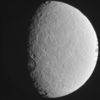
Rhea-N00047219.jpgRhea59 visiteOriginal caption:"N00047219.jpg was taken on December 24, 2005 and received on Earth December 24, 2005. The camera was pointing toward RHEA that, at the time, was approximately 255.628 Km away.
The image was taken using the CL1 and CL2 filters".
|
|
| 2245 immagini su 188 pagina(e) |
 |
|
|
|
|
69 | |
|
|
|
|





