| Piú viste - Saturn: the "Ringed Beauty" and His Moons |
Enceladus-PIA10498.jpgNorthern Craters of Enceladus (natural colors; credits: Lunexit)59 visiteCaption NASA:"This image is part of an observation designed to view the moon's plume of icy particles at a moderately High Phase Angle.
The "Phase Angle" is the angle formed between the Sun, the target being imaged, and the Spacecraft, and it ranges from 0 to 180°. Tiny particles, like those in the plume, brighten substantially at high phase angles.
This view was taken from a vantage point 37° above the Equator of Enceladus (about 504 Km, or approx. 313 miles across). Reflected light from Saturn dimly illuminates the moon's dark side.
The image was taken in visible light with the Cassini Spacecraft narrow-angle camera on Sept. 17, 2008. The view was acquired at a distance of approx. 262.000 Km (such as about 163.000 miles) from Enceladus and at a Phase Angle of 140°.
Image scale is roughly 2 Km (5137 feet) per pixel".MareKromium
|
|

Enceladus-PIA11124.jpgThe Enceladus' "Tiger Stripes"59 visiteCaption NASA:"This Cassini image was the first and highest resolution 'skeet shoot' narrow-angle image captured during the Oct. 31, 2008, flyby of Saturn's moon Enceladus.
The image was taken with the Cassini Spacecraft narrow-angle camera on Oct. 31, 2008, at a distance of approximately 1691 Km (about 1056 miles) from Enceladus and at a Sun-Enceladus-Spacecraft, or Phase, Angle of 78°.
Image scale is roghly 9 meters (29 feet) per pixel.MareKromium
|
|

Unusual_Reflection-W00050623.jpgUnusual Reflection in the Space of Saturn59 visiteIn questo caso, probabilmente, si tratta solo di un frame "venuto male": e cioè mosso e sovraesposto.
Ma qual'è la "fonte" della sovraesposizione? Una Luna Saturniana (e, se SI, quale)? O forse si tratta di Saturno stesso?
Oppure è un'altra Anomalìa, tanto eclatante, quanto indecifrabile?...MareKromium
|
|

The_Rings-PIA10518.jpgJust like a "Ribbon"...59 visiteCaption NASA:"The ever-changing F-Ring appears as wisps of smoke in this image taken downstream of the Shepherd Moon, Prometheus.
The image was taken in Visible Light with the Cassini Spacecraft narrow-angle camera on Oct. 23, 2008 at a distance of approx. 437.000 Km (about 272.000 miles) from Saturn and at a Sun-Saturn-Spacecraft Angle of 89°.
Image scale is roughly 2 Km (a little more than 1 mile) per pixel".
Nota Lunexit: un sincero Grazie alla NASA per aver pubblicato questa immagine la quale risolve - diremmo in via definitiva - il dubbio che era nato a proposito del possibile fenomeno di distorsione ottica imputabile ad un campo gravitazionale (e/o magnetico) di grande portata ed estremamente vicino a Cassini.MareKromium
|
|

Saturn-W00052086.jpgUnusual Saturn Image59 visiteSapreste spiegare, in un massimo di tre righe, il contenuto visivo di questo frame?... Provateci, se volete, utilizzando la funzione "commenti"!MareKromium
|
|

The_Rings-Shadow-N00127583.jpgEclipsing the Rings (4)59 visitenessun commentoMareKromium
|
|

The_Rings-Shadow-N00127580.jpgEclipsing the Rings (1)59 visiteL'impressione iniziale? C'è un (gigantesco!) UFO nei pressi dell'Anello "B" di Saturno!
La realtà? Si tratta dell'ombra, affusolata, di una delle tante lune del Gigante Anellato (onestamente non abbiamo idea di quale sia, ma ci sembra logico pensare ad una Luna Pastore e, vista la forma dell'ombra, a Prometeo od Epimeteo) che, con il suo passaggio davanti al Sole, sta creando e provocando una splendida eclissi su una modestissima porzione degli Anelli di Saturno.
Insomma: "la Natura al lavoro"!MareKromium
|
|

The_Rings-PIA10561.jpgSpokes in the Rings of Saturn (Natural Colors; credits: Lunar Explorer Italia)59 visiteCaption NASA:"On November 2008 Cassini snapshot showcases a classic view of the triangular shape typical of many of the spokes in Saturn's outer B-Ring. Small particles in the Ring compose the Spokes and these wedge-shaped patterns seem to be appearing more often as Saturn approaches Equinox.
The moons Pan, Pandora and Janus are also visible. Janus is the farthest outside the Rings. Pandora orbits outside the faint F-Ring. Pan is near the top right of the image and can be seen as a faint sphere cutting a path in the thin black strip of the Encke Gap in the A-Ring.
This view looks toward the sunlit side of the rings from about 12° below the Ring-Plane.The image was taken in visible light with the Cassini Spacecraft wide-angle camera on Nov. 10, 2008 at a distance of approx. 1 MKM (about 639.000 miles) from Saturn and at a Phase Angle of 29°.
Image scale is roughly 58 Km (about 36 miles) per pixel".MareKromium
|
|
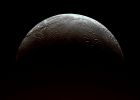
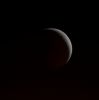
Enceladus-PIA10573.jpgCrescent Enceladus (Natural Colors; credits: Lunar Explorer Italia)59 visiteCaption NASA:"Sunrise uncovers both old and new Enceladus in this image from the Cassini Spacecraft. The lit side of the moon faces Saturn in this view of the Trailing Hemisphere. Old craters still pockmark the Northern Hemisphere while more recent geologic activity has swept them away in the South. North is on the right (Dx) in this image.
Mountain Ranges, a.k.a. "Dorsae", undulate across the moon's surface near the Equator.
From this high northern viewing angle, the South Pole's fascinating "Tiger Stripe Area" lies just out of view. Sulci, a.k.a. "furrows", in that area, are the sources of icy plumes being studied by Cassini scientists.
(See also PIA07800 and PIA09761).
Also near the Tiger Stripes are rift segments that resemble the zigzag patterns seen on Earth of sea-floor spreading from upwelling magma. See PIA11138 for a comparison of the phenomena.
Like outstretched fingers, the Samarkand Sulci reach from the West toward the North Pole, clearing their path of craters and slicing some in half.
This Natural Colors mosaic combines narrow-angle camera images obtained through UltraViolet, Green, and near-InfraRed camera filters. The images were acquired on Dec. 2, 2008 at a distance of approx. 124.000 Km (such as about 77.000 miles) from Enceladus and at a Sun-Enceladus-Spacecraft, or Phase, Angle of 116°.
Image scale is roughly 742 meters (2430 feet) per pixel".MareKromium
|
|
Japetus-V2-LXT.jpgJapetus (Natural Colors; credits: Lunar Explorer Italia)59 visitenessun commentoMareKromium
|
|
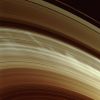
The_Rings-PIA11452.jpgSpokes in the B-Ring (Natural Colors; credits: Lunar Explorer Italia)59 visiteCaption NASA:"As Cassini sped around Saturn, the Spacecraft turned to snap this image of bright Spokes giving chase around the B-Ring.
These radial markings are appearing more often as Saturn approaches Equinox (August 2009) (see also PIA11144).
This view looks toward the sunlit side of the rings from about 31° below the Ring-Plane.
The image was taken in visible light with the Cassini Spacecraft wide-angle camera on Feb. 2, 2009. The view was acquired from a distance of approx. 578.000 Km (such as about 359.000 miles) from Saturn and at a Sun-Saturn-Spacecraft, or Phase, Angle of 144°.
Image scale is roughly 30 Km (about 20 miles) per pixel".MareKromium
|
|
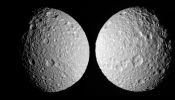
Mimas-Cs.jpgMimas, from Cassini59 visitenessun commentoMareKromium
|
|
| 2245 immagini su 188 pagina(e) |
 |
|
|
|
|
67 | |
|
|
|
|





