| Piú viste - Saturn: the "Ringed Beauty" and His Moons |

Saturn-HST-Oct1996-PIA03158_modest.jpgSaturn from Hubble Space Telescope (Oct. 1996)58 visitenessun commento
|
|

Saturn_s Clouds-V1-PIA00027_modest.jpgSaturn's Clouds from Voyager 158 visitecaption NASA originale:"This image was obtained on November 10, 1980 when Voyager 1 was at a distance of 3,500,000 kilometers (2,200,000 miles) from Saturn. The smallest resolved features in this photograph are 65 kilometers (40 miles) in diameter. Images with similar resolution indicate that Saturn's circulation is somewhat different from Jupiter's. The maximum westward velocities seen on Saturn are located in the middle of the darker regions, while on Jupiter they are located at the poleward interface between belts and zones".
|
|

Saturn-V2-PIA00030_modest.jpgSaturn from approx. 33.900.000 Km - Voyager 258 visiteCaption NASA originale:"NASA's Voyager 2 took this 'true color' photograph of Saturn on July 21, 1981, when the spacecraft was 33.900.000 Km from the planet. Two bright, presumably convective cloud patterns are visible in the mid-northern hemisphere and several dark spoke-like features can be seen in the broad B-ring (left of planet). The moons Rhea and Dione appear as blue dots to the south and southeast of Saturn, respectively. Voyager 2 made its closest approach to Saturn on Aug. 25, 1981".
|
|

Phoebe (3D).jpgThree-dimensional Phoebe58 visiteCaption NASA originale:"The Sun is coming from the left, illuminating craters and bumps on the surface, along with a prominent ridge-like feature in the middle. Bright material, likely to be ice, is exposed atop this ridge-like feature as well as around small craters and down the slopes of large craters. There are also bright streaks on steep slopes, perhaps where loose material slid downhill during the seismic shaking of impact events".
|
|

Saturn-N00016178.jpgSaturn: clouds and rings from about 8.400.000 Km58 visitenessun commento
|
|

Saturn and Prometheus-PIA06481_modest.jpgSaturn and Prometheus58 visiteCaption NASA originale:"Saturn's moon Prometheus is seen shepherding the inner edge of Saturn's "F-Ring". Prometheus is 102 Km across and was captured in a close-up view by the Cassini spacecraft near the time of orbital insertion at Saturn (see PIA06098). A number of clumps are visible here along the arcing "F-Ring".
The image was taken with the Cassini spacecraft narrow angle camera on Aug. 5, 2004, at a distance of 8.2 MKM from Saturn through a filter sensitive to visible green light. The image scale is 49 Km per pixel. Contrast was slightly enhanced to aid visibility".
|
|

Saturn + 1-N00019307.jpgSaturn and one little Moon N 0001930758 visiteVi proponiamo due immagini da guarddare in stretta correlazione. In questo primo frame, Saturno è accompagnato da una delle sue tante Lune. Non sapremmo dire di quale si tratti, ma questo non è un dato - in questa sede - di importanza fondamentale. EccoVi il commento NASA al frame:"N00019307.jpg was taken on September 24, 2004 and received on Earth September 25, 2004. The camera was pointing toward SATURN at approximately 7.752.936 Km away and the image was taken using the BL1 and CL2 filters".
Accanto alla Luna di Saturno si può intuire - espandendo il frame sino a full-size - una leggera ombratura chiara. Noi abbiamo pensato che fosse un difetto dell'immagine. Ma ora andate a guardare il frame successivo...
|
|
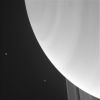
Saturn + 2-N00019308.jpgSatrun, one little Moon and "something else" - N 0001930758 visiteInnanzitutto il commento NASA originale: "N00019308.jpg was taken on September 24, 2004 and received on Earth September 25, 2004. The camera was pointing toward SATURN at approx. 7.752.875 Km away and the image was taken using the CL1 and UV3 filters".
Si vede subito che c'è un altro oggetto luminoso, accanto a Saturno, oltre alla Luna che avevamo già notato nel frame precedente. Se ingrandite l'immagine, poi, ecco la sorpresa: l'oggetto "nuovo" sembra essere il centro (o la causa?) di una sorta di "esplosione". Se osservate attentamente nell'area centrale dell'esplosione (!) vedrete qualcosa di simile ad un triangolino bianco: un effetto della possibile eccessiva luminosità dell'epicentro del fenomeno. Dunque, di che cosa si tratta?
Ancora un errore/difetto nella/della trasmisione dati? Una cometa che si disintegra?
E' purtroppo probabile che non lo sapremo mai, tuttavia il fenomeno immortalato (crediamo in maniera del tutto casuale) dalla Sonda potrebbe anche essere di valore storico. Potrebbe...
|
|
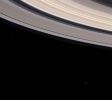
Saturn-PIA06485_modest.jpgSaturn, Janus and Mimas (in natural colors)58 visiteCaption NASA originale:"Looking something like the fibrous bow of a violin, Saturn's colorful rings sweep through this spectacular natural color view while two small moons look on.
From left, the moons visible here are Janus (181 Km across) and Mimas (398 Km across). Cassini's view in this image is from beneath the ring plane; the moons are on the far side of Saturn. Janus leads Mimas as the two moons orbit the planet. Nearly the entire ring system can be seen in this view. The diaphanous C-Ring appears at the upper right, followed by the multi-hued B-Ring. Next, the famous Cassini division (4.800 Km wide) separates the A and B rings. The outer edge of the B-Ring which forms the inner boundary of the Cassini division is maintained by a gravitational resonance with Mimas. Near the outer edge of the A-Ring are the Encke Gap (325 Km wide) and the barely visible Keeler Gap (35 Km wide). The faint, thread-like F-Ring is slightly discernible just beyond the main rings".
|
|

Saturn_s sky-N00020366.jpgThe Sky of Saturn58 visiteIl cielo di Saturno, visto da Cassini/Huygens. Queste immagini, purtroppo, non vengono molto pubblicizzate, nè dalla NASA nè da altri organi di informazione (scientifica o meramente divulgativa). Il motivo è abbastanza chiaro: frame come questo - si dice - non mostrano "nulla di particolare", se non qualche stella e qualche satellite di Saturno. Secondo noi, frame come questo possiedono una grandissima magia ed un enorme fascino: lo Spazio visto DALLO Spazio! Qualcuno ha detto che "...Se non c'è bellezza, non ci può essere curiosità; e se non c'è curiosità, non ci può essere scienza alcuna...".
Noi siamo d'accordo.
|
|

Saturn-N00021000.jpgSaturn and his Rings58 visitenessun commento
|
|

Rings and Moons-PIA06501_modest.jpgRings and Moons (detail - x4 mgnf)58 visiteCaption NASA originale:"This image captures several important targets of the Cassini mission: icy moons, rings and the gaps in the rings that may contain small undiscovered moons. Mimas (398 Km across) is easily seen near lower right. Epimetheus (116 Km across) is visible left of center. The 4.800 Km wide Cassini division is the dark swath at upper left. The Encke Gap (325 Km wide) is visible as a dark curve near the edge of the A-Ring. The thin F-Ring is seen here, exterior to the main rings.
The image was taken in visible light with the Cassini spacecraft narrow angle camera on Sept. 10, 2004, at a distance of 8.9 MKm(5.5 million miles) from Mimas and at a Sun-Mimas-spacecraft (or "phase") angle of 84°. The image scale is 53 Km per pixel.
The image was magnified by a factor of four to aid visibility".
|
|
| 2245 immagini su 188 pagina(e) |
 |
|
|
|
|
60 | |
|
|
|
|





