| |

| Piú viste - Saturn: the "Ringed Beauty" and His Moons |
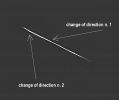
Streak-N00065622-2.jpgWhat is that? (detail mgnf n. 1)131 visiteSi tratta allora di una "Stella Cadente", un "bolide", insomma?
A sensazione potremmo anche dire di si (a "cambio di direzione, se osservate attentamente, noterete che corrisponde anche un cambio di luminosità e di tessitura dell'oggetto), ma questa "Shooting Star" in "che cosa" sta "bruciando e consumandosi"?
Nel vuoto? Ovviamente questo è impossibile, a meno che Cassini non stesse inquadrando gli strati superiori dell'atmosfera di Saturno, immersi nella notte del Pianeta e quindi non visibili...
Ma è la NASA stessa, tuttavia, a dire che Cassini stava fotografando "SKY" e cioè lo Spazio di Saturno e NON Saturno!
E allora?...
|
|

The_Rings-N00123872.jpgAnother UFO in the Space of Saturn (natural colors; credits: Lunexit)131 visiteL'Oggetto Volante Non Identificato, come vedete, conserva la sua forma e luminosità (e mantiene anche l'effetto di doppia riflessione), ma CAMBIA la sua posizione sia rispetto all'Orbiter Cassini, sia rispetto alla sezione inquadrata degli Anelli di Saturno.
Curiosamente, nei suoi pressi appare una lunga traccia luminosa che, come ovvio, NON E' un Raggio Cosmico, NON è una "feature" tipica degli Anelli di Saturno e NON è nemmeno un image-artifact.
La conclusione, interlocutoria - ma ovvia - non cambia: stiamo osservando un Oggetto Volante Non Identificato (di origine ignota).MareKromium
|
|

Enceladus-N00165592-165603-MF-LXTT.gifHuge "Spurt" from Enceladus (a GIF-Movie by Dr Marco Faccin - Lunexit Team)131 visiteSolo una nota: questo GIF-Movie è stato pubblicato IERI, 21 Dicembre 2010, sulle Pagine Flickr dei nostri Partner Marco FACCIN ed Elisabetta BONORA.
La NASA, con tutte le sue "menti" ed i suoi "immensi mezzi", ha evidenziato il fenomeno solamente oggi, dopo aver visitato le pagine Flickr di cui sopra.
Ogni ulteriore commento ci sembra superfluo...MareKromium
|
|

Rhea-PIA14574-PCF-LXTT-IPF.jpgIn the Saturnshine (Absolute Natural Colors; credits for the additional process. and color.: Dr Paolo C. Fienga - Lunar Explorer Italia/Italian Planetary Foundation)131 visiteSome Southern Terrain on the Gas-Giant Planet Saturn's moon Rhea is dimly illuminated by the Saturnshine (---> the Saturnian equivalent, on Rhea, of the Moonshine, on Earth) in this NASA - Cassini Spacecraft's view of the dark side of the moon. The camera of Cassini is looking toward the night side of Rhea (which is approx. 1530 Km - such as about 950 miles - across), but the Sunlight reflected off the day side of the immense Saturn is bright enough to illuminate the Surface - with all its Impact Craters - seen here. This view is centered on Terrain located at 23° South Latitude and 315° West Longitude. If you look carefully beyond the Limb of Rhea, you will notice that 4 (four) background Stars are visible.
The image was taken in Visible Light with the NASA - Cassini Spacecraft Wide-Angle Camera on August, 1st, 2011. The view was obtained at a distance of approximately 6000 Km (such as about 3726 miles) from Rhea and at a Sun-Rhea-Cassini Spacecraft, or Phase, Angle of 113°. Scale in the original image was 800 meters (such as 2600 feet) per pixel.
This frame (which is an Original NASA - Cassini Spacecraft image published on the NASA - Planetary Photojournal with the ID n. PIA 14574) has been additionally processed, contrast enhanced, and then colorized in Absolute Natural Colors (such as the colors that a human eye would actually perceive if someone were onboard the NASA - Cassini Spacecraft and then looked outside, towards the Saturnian moon Rhea), by using an original technique created - and, in time, dramatically improved - by the Lunar Explorer Italia Team. Different colors, as well as different shades of the same color, mean, among others, the existence of different Elements present on the Surface of Rhea, each having a different Albedo (---> Reflectivity) and Chemical Composition.MareKromium
|
|

Rhea-PIA12648.jpgGibbous Rhea (Natural Colors; credits for the additional process. and color.: Dr Paolo C. Fienga - Lunexit Team)129 visiteCaption NASA:"The Cassini Spacecraft looks toward the cratered plains of the Trailing Hemisphere of Rhea.
Some of the moon's fractures, appearing like wispy bright lines, can be seen on the left of the image. Rhea's North Pole is up and rotated 3° to the right.
This Celestial Body is about 1528 Km (approx. 949 miles) across.
The image was taken in Visible Light with the Cassini Spacecraft wide-angle camera on Nov. 21, 2009. The view was obtained at a distance of approx. 30.000 Km (about 19.000 miles) from Rhea and at a Sun-Rhea-Spacecraft, or Phase, Angle of 27°.
Image scale is roughly 2 Km (a little more than 1 mile) per pixel.
MareKromium
|
|

Dione-NVL-MF-PCF-LXTT.jpgDione (an Image-Mosaic in Absolute Natural Colors by Marco Faccin and Paolo C. Fienga - Lunexit Team)128 visitenessun commentoMareKromium
|
|

Phoebe-PIA07775.jpgPhoebe's Global Digital Map128 visiteCaption NASA:"This Global Digital Map of Saturn's moon Phoebe was created using data taken during the Cassini Spacecraft's close Fly-By of the small moon that occurred in June 2004. The Map is an "Equidistant Projection" and has a scale of 233 meters (764 feet) per pixel.
The Mean Radius of Phoebe used for projection of this Map is approx. 107 Km (such as 66,447 miles). The resolution of the Map is 8 pixels per degree".MareKromium
|
|
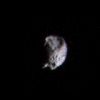
Phoebe-PIA06065.gifRevolving Phoebe (a GIF-Movie by NASA/JPL/Space Science Institute)127 visiteCaption NASA:"Phoebe rotates through nearly one full rotation in this GIF sequence of 9 frames, taken on Cassini's approach to the small Celestial Body on June, 10, 2004. Phoebe rotates on its axis once every 9 hours and 16 minutes; this sequence spans 8 hours and 14 minutes; all 360° of Longitude on Phoebe are visible in the sequence.
The Surface is clearly covered by impact craters of a wide range of sizes, up to 40% of the diameter of the moon, creating rugged topography, illustrated dramatically along the Terminator and Limb.
The images that make up this sequence were obtained at a Sun-Phoebe-Spacecraft angle of 87° and from distances ranging from 877.453 Km (544.898 miles) to 688.924 Km (427,822 miles). The image scale in this sequence ranges from 5,3 to 4,1 Km per pixel. To aid visibility, the images were magnified three times via linear interpolation; no contrast enhancement was performed".MareKromium
|
|

Dione-N00165585-89-EB-LXTT.jpgCrescent Dione (an Image-Mosaic by Elisabetta Bonora - Lunexit Team)126 visitenessun commentoMareKromium
|
|

Unusual_Event_on_The_Rings-EB-N00164273.jpgPossible Collision inside the "F"-Ring (Credits for the additional process: Elisabetta Bonora - Lunexit Team)125 visiteN00164273.jpg was taken on October 16, 2010, and received on Earth on October 17, 2010. The camera was pointing toward MIMAS which, at the time, was approximately 195.976 Km away.
The image was taken using the CL1 and CL2 filters.
Nota Lunexit: l'Evento ripreso da Cassini non siamo in grado di spiegarlo compiutamente. Ad una prima (e molto superficiale) occhiata, avevamo pensato che si trattasse di un - consueto, si fa per dire... - Disturbo Gravitazionale derivato dal transito, attraverso l'Anello "F" del Gigante Gassoso, di una Luna Pastore (e l'Evento, in tal caso, sarebbe stato un cosiddetto "Streamer-Channel", tanto per essere chiari).
Tuttavia, la sua assai particolare configurazione esteriore (sembra un "flash") ci dice che potrebbe trattarsi anche di una collisione fra detriti di una certa dimensione oppure fra alcune "Particelle Maggiori" dell'Anello "F" ed un Corpo Estraneo. Una collisione ripresa davvero al momento in cui essa si stava verificando (alla NASA direbbero "caught in the act").
Purtroppo non siamo in grado di dire di più. Complimentissimi alla nostra Elisabetta Bonora per lo splendido Lavoro svolto (ancora una volta e come sempre).MareKromium
|
|
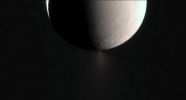
Enceladus-PIA18328-PCF-LXTT-IPF.jpgIn the Saturnshine... (Absolute Natural Colors; credits for the additional process. and color.: Dr Paolo C. Fienga/Lunar Explorer Italia/Italian Planetary Foundation)125 visiteThe Saturnian moon Enceladus looks as if it is half lit by Sunlight in this view from the NASA - Cassini Spacecraft; but looks, as you know, can be (as they often are) deceiving.
In fact, the kind of pinkish area of Enceladus visible on the right (Dx) of the frame, where MANY Surface Features can be made out (---> seen/identified), is actually illuminated by the light reflected off of Saturn (such as the so-called "Saturnshine"). On the other hand, a sliver of the Enceladian Surface that is actually illuminated by direct Sunlight is visible - and also highly overexposed! - on the left (Sx) of the picture. Images like this one are designed to capture the extended Plumes of Icy Materials spraying from huge cracks located the moon's South Polar Region. Such images need to be taken with the NASA - Cassini Spacecraft looking toward the Icy moon's Night Side, since the small particles that form the Plumes (however, just barely visible in this picture) are most easily seen when backlit by the Sun.
This view looks toward the Leading Hemisphere of Enceladus; North is up. The image was taken in Visible Light with the NASA - Cassini Spacecraft's Narrow-Angle Camera on May 10, 2015. Enceladus is roughly 313 miles (such as about 503,72 Km) across. The view was acquired at a distance of approximately 226.000 miles (such as approx. 363.7210,84 Km) from Enceladus and at a Sun-Enceladus-Cassini Spacecraft, or Phase, Angle of 152°. Image scale is roughly 1,4 miles (about 2,2530 Km) per pixel.
This frame (which is an Original NASA - CASSINI Spacecraft's b/w and NON Map-Projected image published on the NASA - Planetary Photojournal with the ID n. PIA 18328) has been additionally processed, contrast enhanced, magnified, in order to allow the vision of the slightest details of the Surface, Gamma corrected and then re-colorized - according to an educated guess (or, if you wish, an informed speculation) carried out by Dr Paolo C. Fienga - in Absolute Natural Colors (such as the colors that a human eye would actually perceive if someone were onboard the NASA - Cassini Spacecraft and then looked outside, toward the Saturnian moon "Enceladus"), by using an original technique created - and, in time, dramatically improved - by the Lunar Explorer Italia Team. Different colors, as well as different shades of the same color, mean, among other things, the existence of different Elements (Minerals) present on the Surface of Enceladus, each having a different Albedo (---> Reflectivity) and Chemical Composition.
Note: it is possible (but we, as IPF, have no way to be one-hundred-percent sure of such a circumstance), that the actual luminosity of Enceladus - as it is in this frame - would appear, to an average human eye, a little bit lower than it has been shown (or, better yet: interpreted) here.MareKromium
|
|

Enceladus-PIA20522enceladusC.jpgCrescent Enceladus (Credits: NASA/JPL/Cassini Imaging Team)124 visitePeering from the shadows, the Saturn-facing hemisphere of tantalizing inner moon Enceladus poses in this Cassini spacecraft image. North is up in the dramatic scene captured during November 2016 as Cassini's camera was pointed in a nearly sunward direction about 130,000 kilometers from the moon's bright crescent. In fact, the distant world reflects over 90 percent of the sunlight it receives, giving its surface about the same reflectivity as fresh snow. A mere 500 kilometers in diameter, Enceladus is a surprisingly active moon. Data and images collected during Cassini's flybys have revealed water vapor and ice grains spewing from south polar geysers and evidence of an ocean of liquid water hidden beneath the moon's icy crust.MareKromium
|
|
| 2245 immagini su 188 pagina(e) |
|
|
|
|
6 | |
|
|
|
|
|
|
|





