| Piú viste - Saturn: the "Ringed Beauty" and His Moons |

Saturn-N00027024.jpgSomething is moving: is it a moon or a spaceship? (3)59 visitevedi i commenti ai frames che precedono
|
|

Saturn-W00004086.jpgA look at the Saturn's System59 visiteSaturno in compagnia di 4 Lune Maggiori (siamo abbastanza certi che 3 delle 4 lune visibili siano Rhea, Mimas e Dione) ed almeno altre 5 o 6 Lune Minori (non crediamo che i piccoli punti luminosi che circondano gli Anelli di Saturno in questo frame siano degli artefatti fotografici).
Un'immagine sovraesposta ma splendida: da collezione!
|
|

Saturn-N00027083.jpgHiding behind the Rings!59 visiteRhea - o almeno così ci sembra, ma potremmo anche sbagliare - "gioca" a nascondersi dietro gli Anelli di Saturno.
Un'immagine incredibile che fissa il momento in cui questa luna si accinge a scomparire dalla visuale della Sonda Cassini, attratta e quindi "assorbita" - si fa per dire... dai maestosi Anelli del Gigante.
|
|

Mimas and Saturn-PIA06574.jpgMimas and Saturn59 visiteCaption NASA originale:"In a dazzling and dramatic portrait painted by the Sun, the long thin shadows of Saturn's rings sweep across the planet's northern latitudes. Within the shadows, bright bands represent areas where the ring material is less dense, while dark strips and wave patterns reveal areas of denser material. The shadow darkens sharply near upper right, corresponding to the boundary of the thin C-Ring with the denser B-Ring. A wide-field, natural color view of these shadows can be seen in PIA06164.
The globe of Saturn's moon Mimas (398 Km or 247 miles across) has wandered into view near the bottom of the frame. A few of the large craters on this small moon are visible. The image was taken with the Cassini spacecraft narrow angle camera on Jan. 18, 2005, at a distance of 1,4 MKM (889.000 miles) from Saturn using a filter sensitive to wavelengths of infrared light centered at 752 nanometers. The image scale is 9 Km (approx 5,5 miles) per pixel".
|
|
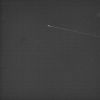
Unexplainable-N00027253.jpgSomething's moving in the Space of Saturn59 visiteImmagine ripresa dalla Sonda Cassini il 31 Gennaio 2005 e ricevuta a Terra il 1mo Febbraio.
Che cosa mostra? Si tratta, evidentemente, di un fenomeno - per noi - "unexplainable", come molti altri.
Le ipotesi sono le solite: 1) immagine "mossa" di una stella o di un piccolo satellite di Saturno (ipotesi più probabile); 2) oggetto in movimento "di passaggio" accanto alla Sonda - un UFO? - (ipotesi leggermente meno probabile); 3) artefatto fotografico (ipotesi decisamente improbabile). Noi saremmo propensi, per una molteplicità di fattori, a considerare l'ipotesi 1) come la più probabile (almeno in questo frangente).
|
|

Saturn-PIA07008.jpgSaturn's temperature emissions (upper troposphere)59 visiteCaption NASA originale:"This is the sharpest image of Saturn's temperature emissions taken from the ground; it is a mosaic of 35 individual exposures made at the W.M. Keck I Observatory, Mauna Kea, Hawaii on Feb. 4, 2004.
The images to create this mosaic were taken with infrared radiation. The mosaic was taken at a wavelength near 17,65 microns and is sensitive to temperatures in Saturn's upper troposphere. The prominent hot spot at the bottom of the image is right at Saturn's South Pole. The warming of the Southern Hemisphere was expected, as Saturn was just past Southern Summer Solstice, but the abrupt changes in temperature with latitude were NOT expected. The tropospheric temperature increases toward the pole abruptly near 70° latitude from 88° to 89° Kelvin (-301° to -299° Fahrenheit) and then to 91° Kelvin (-296° degrees Fahrenheit) right at the Pole. Ring particles are not at a uniform temperature: they are obviously coldest just after having cooled down in Saturn's shadow (lower left)".
|
|

RHEA~0.jpgRhea: a Moon made of "frozen water"! (possible ANOMALY)59 visiteDa "NASA - Picture of the Day" del 15 Febbraio 2005:"Rhea, Saturn's second largest moon behind Titan, shows unusual wisps (wisp---> piccola striscia), visible above as light colored streaks. HR images of the wisps show them to be made of long braided fractures. Rhea is composed mostly of water ice, but likely has a small rocky core. Rhea's rotation and orbit are locked together, just like Earth's Moon, so that one side always faces Saturn; a consequence of this is that one side always leads the other. Rhea's leading surface is much more heavily cratered than the above pictured trailing surface".
Vi segnaliamo inoltre una possibile "Anomalia" (e non crediamo che si tratti di un photo-artifact o di un difetto del frame derivante da un'incompleta trasmissione dei dati): se osservate il lato Sn di Rhea, in prossimità del bordo e circa ad ore 8, vedrete un "disco scuro" stagliarsi contro il grigio della sua superficie. Noi crediamo che sia un "corpo in transito" (magari una "luna di Rhea!).
|
|

Enceladus-PIA06188.jpgEnceladus "tormented" surface59 visiteCaption NASA originale:"This HR image from Cassini shows a region of "smooth plains" terrain on the surface of Saturn's moon Enceladus, located slightly north of the equator on the moon's Saturn-facing hemisphere. The area is about 70 by 84 Km.
The image shows a variety of tectonic features that attest to Enceladus' dynamic geological history. At the top of the image is a relatively fresh-looking crevasse system with individual fractures more than a kilometer wide. The crevasse system cross-cuts a complex NE-to-SW-trending system of older faults. A 12-Km-wide band of crudely aligned, chevron-shaped features runs down the center of the image. Among the most intriguing features in this view are a series of dark, small spots, 125 to 750 meters in diameter.
The "dark spots" often seem to be aligned in chains parallel to narrow fractures. The contrast of the dark features with the surrounding bright terrain suggests that they may be compositionally distinct, but their origin is a new mystery".
|
|

Rings-PIA06588.jpgThe "rings" and a "string" of Moons...59 visiteCaption NASA originale:"Moons visible in this image: Mimas (398 Km, or 247 miles across) at right, Pandora (84 Km, or 52 miles across) near center and Janus (181 Km, or 113 miles across) in the lower left corner. Mimas' orbit inclination of 1,6° relative to Saturn's equator is enough to make it appear as if it orbits just beyond the F-Ring when viewed from this vantage point of 5° below the Rings. In fact, it is 34.000 Km (such as approx. 21.000 miles) more distant than Janus".
|
|

Janus-N00028725.jpgJanus and the "Lord of the Rings"59 visitenessun commento
|
|

Saturn-W00005056.jpgSaturn, from approx. 1.130.000 Km59 visitenessun commento
|
|
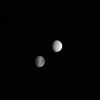
Tethys and Dione-N00029831.jpgTethys and Dione59 visiteUno dei tanti "incroci" fra le lune di Saturno, al quale la Sonda Cassini ha avuto l'onore di assistere da una distanza - per così dire... - ragionevole: in fondo, fra Cassini e Tethys, ci sono solo un milione e mezzo di km...
|
|
| 2245 immagini su 188 pagina(e) |
 |
|
|
|
|
57 | |
|
|
|
|





