| |

| Piú viste - Saturn: the "Ringed Beauty" and His Moons |

Prometheus-PIA08947~0.jpgCosmic "Through-and-Through"!60 visiteCaption NASA:"Prometheus pulls away from an encounter with Saturn's F-Ring, leaving behind a reminder of its passage.
Prometheus (about 102 Km, or 63 miles across) approaches closely to the F-Ring once during each circuit around Saturn, disturbing the orbits of the small particles in the Ring and creating a streamer of material that then shears out, following the moon as it speeds off.
This view looks toward the unilluminated side of the Rings from about 37° above the Ring-Plane. Prometheus is brightly lit by the Sun on one side and lit more modestly by Saturn's reflected light on the other side.
The image was taken in visible light with the Cassini spacecraft narrow-angle camera on April 18, 2007 at a distance of approx. 2 MKM (about 1,2 MMs) from Prometheus and at a Sun-Prometheus-spacecraft, or phase angle of 87°. Image scale is roughly 12 Km (about 7 miles) per pixel".
MareKromium
|
|

Mimas-PIA10467.jpgHol(e)y Mimas! (natural colors; credits: Lunexit)60 visiteCaption NASA:"The sun's low angle near the Terminator throws the craters of Mimas into stark relief.
This view looks toward high Northern Latitudes on Mimas (approx. 396 Km, or about 246 miles across) from a position 72° North of the moon's Equator. The North Pole is in darkness at center.
The image was taken in visible green light with the Cassini Spacecraft narrow-angle camera on Aug. 4, 2008. The view was obtained at a distance of approx. 153.000 Km (such as about 95.000 miles) from Mimas and at a Phase Angle of 106°.
Image scale is 918 meters (3011 feet) per pixel".MareKromium
|
|
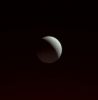
Enceladus-PIA10471.jpgDouble "Space-Lights" on Enceladus! (natural colors; credits: Lunexit)60 visiteCaption NASA:"As the Cassini Spacecraft began its August 2008 flyby of Enceladus, the spacecraft approached over the moon's cratered North Pole. Cassini acquired this view as the icy moon grew ever larger in its field of view.
In addition to the sunlit crescent at upper right, the faint glow at bottom indicates a secondary source of illumination: reflected sunlight from Saturn (a.k.a.: "Saturnshine").
The view looks toward high Northern Latitudes on Enceladus from a perspective of 71° North of the moon's Equator.
The North Pole is in shadow at center.
The image was taken in visible light with the Cassini Spacecraft narrow-angle camera on Aug. 11, 2008. The view was obtained at a distance of approx. 448.000 Km (such as about 278.000 miles) from Enceladus and at a Phase Angle of 113°.
Image scale at maximum resolution is approx. 3 Km (a little less than 2 miles) per pixel".MareKromium
|
|

Mimas-intransit-N00119952-N00119954.gifQuick Transit! (GIF-Movie; credits: Dr G. Barca)60 visite...Sembra un UFO...Ma non lo è! Si tratta, a nostro avviso, della luna Saturniana Mimas, ben riconoscibile a causa della sua forma oblunga e del suo "occhio" (!) che appare - relativamente chiaro - a ridosso del Terminatore.
Un intrigante - e MOLTO ISTRUTTIVO! - GIF-Movie, del sempre puntualissimo Dr Barca!MareKromium
|
|

Sky-W00049978.jpgBizarre Reflection in the Space of Saturn...60 visiteCaption NASA:"W00049978.jpg was taken on October 09, 2008 and received on Earth October 09, 2008. The camera was pointing toward ENCELADUS that, at the time, was approx. 536.451 Km away. The image was taken using the CL1 and CL2 filters".MareKromium
|
|

UnusualObject-N00122114-5.jpgUnusually-looking "Object" in the Space of Saturn (GIF-Movie; credits: Dr G. Barca)60 visiteUn fantastico GIF-Movie realizzato dal bravissimo Dr Barca, che "dedichiamo" alla NASA (con ironia, certo, ma sempre con ammirazione), in attesa che ci "dica" qualcosa al riguardo...MareKromium
|
|

Enceladus-PIA11133.jpgCrescent Enceladus (possible True Colors; credits: Lunar Explorer Italia)60 visiteCaption NASA:"On Oct. 5, 2008, just after coming within 25 kilometers (15.6 miles) of the surface of Enceladus, NASA's Cassini captured this stunning mosaic as the Spacecraft sped away from this geologically active moon of Saturn.
Craters and cratered terrains are rare in this view of the Southern Region of the moon's Saturn-facing Hemisphere. Instead, the surface is replete with fractures, folds, and ridges — all hallmarks of remarkable tectonic activity for a relatively small world. In this True Colors view, regions that appear blueish are thought to be coated with larger grains than those that appear white or gray.
Portions of the Tiger Stripe Fractures, or Sulci, are visible along the Terminator at lower right, surrounded by a circumpolar belt of mountains. The icy moon's famed jets emanate from at least 8 distinct Source Regions, which lie on or near the Tiger Stripes. However, in this view, the most prominent feature is Labtayt Sulci, the approximately one-kilometer (such as 0,6 miles) deep Northward-trending chasm located just above the center of the mosaic.
Near the top, the conspicuous ridges are Ebony and Cufa Dorsae. This mosaic was created from 28 images obtained at seven footprints, or pointing positions, by Cassini's narrow-angle camera. At each footprint, 4 images using filters sensitive to UltraViolet (UV), Visible (V) and InfraRed light (IR) - spanning wavelengths from 338 to 930 nanometers) were combined to create the individual frames. The mosaic is an orthographic projection centered at 64,49° South Lat. and 283,87° West Long., and it has an image scale of 196 Km (about 122,5 miles) per pixel. The original images ranged in resolution from 180 meters (594 feet) to 288 meters (950 feet) per pixel and were acquired at distances ranging from 30.000 to 48.000 Km (such as from about 18.750 to 30.000 miles) as the Spacecraft receded from Enceladus.
The view was acquired at a Sun-Enceladus-spacecraft, or phase, angle of 73°".MareKromium
|
|

Saturn-PIA10596.jpgSouthern Turbulence (Natural Colors; credits: Lunar Explorer Italia)60 visiteCaption NASA:"Through the Atmosphere of the Southern Hemisphere of Saturn rolls a large storm, seen here as a tight dark circle in the lower left of this image. Horizontal strands of other atmospheric formations give the image the fibrous look of travertine stone.
Prometheus (about 86 Km, or 53 miles across) is a small dark dot in the top left part of the image.
The image was taken with the Cassini spacecraft wide-angle camera on Dec. 30, 2008 using a combination of polarized and spectral filters sensitive to wavelengths of near-InfraRed Light centered at 752 nanometers.
The view was acquired at a distance of approx. 1,2 MKM (about 750.000 miles) from Saturn and at a Sun-Saturn-Spacecraft, or Phase, Angle of 27°.
Image scale is roughly 68 Km (approx. 42 miles) per pixel".MareKromium
|
|

The_Rings-PIA11665.jpgSmall Object in the "B"-Ring60 visiteCaption NASA:"The Cassini Spacecraft captured this image of a small object in the outer portion of Saturn's "B"-Ring casting a shadow on the Rings as Saturn approaches its August 2009 Equinox.
This new moonlet, situated about 300 miles (approx. 480 Km), inward from the outer edge of the "B"-Ring, was found by detection of its shadow which stretches 25 miles, or about 41 Km, across the Rings.
The shadow length implies the moonlet is protruding about 660 feet, or 200 meters, above the Ring-Plane.
If the moonlet is orbiting in the same plane as the ring material surrounding it, which is likely, it must be about 1300 feet, or 400 meters, across.
This object is not attended by a Propeller feature, unlike the band of moonlets discovered in Saturn's "A"-Ring earlier by Cassini (see PIA07792 and PIA06196). The "A"-Ring moonlets, which have not been directly imaged, were found because of the propeller-like narrow gaps on either side of them that they create as they orbit within the Rings. The lack of a propeller feature surrounding the new moonlet is likely because the "B"-Ring is dense, and the ring material in a dense ring would be expected to fill in any gaps around the moonlet more quickly than in a less dense region like the mid-"A"-Ring. Also, it may simply be harder in the first place for a moonlet to create propeller-like gaps in a dense ring.
Straw-like patterns of clumping ring material are also visible along the edge of the outer "B"-Ring near the right of this image. See PIA09855 to learn more about these features.
This image and others like it (see PIA11656 and PIA11659) are only possible around the time of Saturn's Equinox which occurs every half-Saturn-year (equivalent to about 15 Earth years). The illumination geometry that accompanies Equinox lowers the Sun's angle to the Ring-Plane and causes out-of-plane structures to cast long shadows across the Rings.
This view looks toward the sunlit side of the Rings from about 42° below the Ring-Plane. Background stars are visible on the right of the image. They appear elongated by the camera's exposure time.
The image was taken in Visible Light with the Cassini Spacecraft narrow-angle camera on July 26, 2009. The view was obtained at a distance of approx. 296.000 Km (such as about 184.000 miles) from Saturn and at a Sun-Saturn-Spacecraft, or Phase, Angle of 120°.
Image scale is roughly 1 Km (4680 feet) per pixel".MareKromium
|
|

The_Rings-PIA11663.jpgShadow of a "Vertical Structure" in the "F"-Ring60 visiteCaption NASA:"Cassini spies a shadow cast by a vertically extended structure or object in the F-Ring in this image taken as Saturn approaches its August 2009 Equinox.
The structure can be seen as a bulge near the bright core of the Ring on the right of the image. Imaging scientists are working to understand the origin of structures such as this one, but they think this image shows the shadow of what appears to be a vertically extended object in the core of the "F"-Ring.
The second (bottom) version of the image has been brightened to enhance the visibility of the Ring and shadow. Background stars appear elongated in the image because of the camera's exposure time.
This view looks toward the sunlit side of the Rings, from about 54° below the Ring-Plane.
The image was taken in Visible Light with the Cassini Spacecraft narrow-angle camera on June 9, 2009. The view was obtained at a distance of approx. 592.000 Km (about 368.000 miles) from Saturn and at a Sun-Saturn-Spacecraft, or Phase, Angle of 97°. Image scale is roughly 3 Km (a little less than 2 miles) per pixel".MareKromium
|
|

Propeller-PIA11672-a.jpgGiant "Propeller" in the A-Ring (CTX Frame)60 visiteAn unusually large "Propeller" feature is detected just beyond the Encke Gap in this Cassini image of Saturn’s outer A-Ring taken a couple days after the Planet’s August 2009 Equinox.
The unique geometry of Equinox has thrown into relief small moonlets within the Rings and the structures they create around them. Propeller-like features, a few kilometers long, centered on and created by the action of small embedded moonlets only about 100 meters across, were discovered early in the mission (see also PIA07792 and PIA07790).
These previous findings constituted the first recognition of the presence in Saturn’s Rings of bodies bigger than the largest ring particles (about 10 meters, or 30 feet, across) but smaller than the 8-Km-wide (about 5-mile-wide) ring moon, Daphnis, in the outer A-Ring.
From the 350-Km (about 220-mile) length of the shadow cast by this 130-Km-long (about 80-mile-long) Propeller, the heights of these features above the Ring-Plane have been measured to reach about 200 meters (650 feet), indicating the moonlet responsible for the Propeller in this image is likely to be 400 meters (1300 feet) across.
A previously released early-Equinox image also had revealed a moonlet in the outer B-Ring about 400 meters (1300 feet) across (see PIA11665).MareKromium
|
|
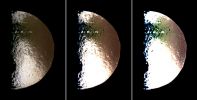
Japetus-PIA11689.jpgColor-Dichotomy on Japetus (False Colors; credits: NASA/JPL/Space Science Institute)60 visiteCaption NASA:"Three different false-color views of Saturn's moon Japetus show the boundary of the so-called global "Color Dichotomy" on the Hemisphere of this moon facing away from Saturn.
Such a "Color Dichotomy", which has been detected in images from the Cassini Imaging Team, is a second global pattern found on Japetus besides the well-known global "Brightness Dichotomy".
This image consists of three panels, each of which was contrast-enhanced in different ways to bring out Surface Features. Minimal enhancement was applied to the image on the left panel while those on the middle and right panels were enhanced more (with contrast increased by factors of two and four, respectively), making them appear brighter and overexposed.
In the case of Japetus' Brightness Dichotomy, the Dark Terrain extends towards its Trailing Side at Equatorial Regions, while the Bright Terrain extends towards Japetus' Leading Side in the Polar Regions (see PIA11116).
In the case of the Color Dichotomy seen here, its boundary is quite well correlated with the boundary between Japetus' Leading and Trailing Hemispheres. At Near-InfraRed wavelengths, the Bright Terrain on the Leading Side is redder than the one visible on the Trailing Side. This pattern is visible in the panel on the left, which uses normal contrast enhancement. The characteristic reddish distribution also appears on the dark material, as seen in the middle and right-hand panels that have been adjusted with even higher contrast.
Indeed, the otherwise uniformly dark material shows different color hues, depending on whether the viewer looks at the Leading vs. the Trailing Side.
Cassini scientists think this effect is caused by material falling onto Japetus from the outer irregular moons of Saturn. (see PIA06145 to learn more)
Images obtained with InfraRed, Green and UltraViolet Spectral Filters (centered at 953, 563 and 338 nanometers, respectively) were combined to create these False Color views. The color seen here is similar to that produced in (red, green and blue) Natural Color views.
North on Japetus is approx. up in these images. The images were taken with the Cassini Spacecraft narrow-angle camera on Oct. 15, 2004. The view was obtained at a distance of approx. 1,2 MKM (such as about 746.000 miles) from Japetus and at a Sun-Japetus-Spacecraft, or Phase, Angle of 88°.
Image scale is roughly 7 Km (a little more than 4 miles) per pixel".MareKromium
|
|
| 2245 immagini su 188 pagina(e) |
|
|
|
|
|
52 | |
|
|
|
|
|
|





