| Piú viste - Saturn: the "Ringed Beauty" and His Moons |

SaturnandCompanions-PIA07538.jpgSaturn's Space Panorama60 visiteCaption NASA originale:"Three of Saturn's icy moons are seen here, along with the magnificent water-ice rings and the cold gaseous envelope of the Planet's atmosphere. Saturn's dark shadow stretches completely across the rings.
At nine and a half times farther from the Sun than Earth, Saturn inhabits the deep cold of the outer Solar System. The Sun appears only 1% as bright there as it appears at Earth, creating an environment where ice dominates over rock.
The icy Moons visible here, from left to right are: Janus (181 kilometers, or 113 miles, across), Enceladus (505 kilometers, or 314 miles, across), and Epimetheus (116 kilometers, or 72 miles, across).
The image was taken in visible green light with the Cassini spacecraft wide-angle camera on June 1, 2005, at a distance of approximately 2,4 MKM from Saturn. The image scale is 139 Km per pixel".
|
|

Dione-N00041005.jpgDione and Rhea (2)60 visiteOriginal caption:"The Cassini spacecraft successfully completed its only flyby of Saturn's moon Dione on Oct. 11, 2005. In the process, Cassini captured Dione eclipsing Saturn's moon Rhea. In the picture above, the distance between Dione and Rhea was roughly 330.000 Km (about 205.000 miles). Cassini will swoop by Rhea on Nov. 26, 2005".
|
|

Saturn-N00044404~0.jpgPhotographic Defect, Photo-Artifact or UFO in-transit? (2)60 visiteQuesto frame (dal seriale N. 00044404) contiene un piccolo enigma che, presumibilmente, susciterà una nuova, modesta (e fuggevole) vampata di interesse per la Missione Cassini. Che cosa c'è di così "curioso"? Una striscia (un "bright streak") che taglia - letteralmente - l'immagine e che può ricordare le tracce lasciate da un oggetto in movimento rapido (tipo un satellite o un aereo) quando scattiamo una fotografia del cielo usando un'esposizione non brevissima (ma neppure - necessariamente - lunga). Ci sono elementi per ritenere che questa "linea bianca" sia solo un mero difetto dell'immagine (causato, p.e., da una perdita di dati durante la trasmissione da Saturno), e ci sono elementi - diremmo evidenti - per escludere l'ipotesi del "raggio cosmico" o del "riflesso".
Il frame precedente e quello successivo (anche se non conosciamo il tempo intercorso fra le diverse riprese) non evidenziano l'Anomalìa la quale rimane quindi confinata solo su questa immagine.
Conclusioni? Nessuna, naturalmente...
|
|

The Rings-PIA08129.jpgThe "sharp" G-Ring60 visiteThis contrast-enhanced view of Saturn's faint G-Ring shows its extremely sharp inner edge and more diffuse outer boundary. Using its large high-gain antenna as a shield, the Cassini spacecraft flew through the Region interior to the G-Ring during insertion into Saturn orbit. The spacecraft was struck many times by the fine icy particles that populate the Region between the F and G Rings.
The image was taken in visible light with the Cassini spacecraft narrow-angle camera on Jan. 19, 2006, at a distance of approx. 1,2 MKM (such as about 700.000 miles) from Saturn. The image scale is about 7 Km (approx. 4 miles) per pixel.
|
|

Rhea-N00061862.jpgCrescent Rhea (2)60 visiteCaption NASA originale:"N00061862.jpg was taken on May 22, 2006 and received on Earth May 23, 2006. The camera was pointing toward Rhea that, at the time, was approximately 262.677 Km away.
The image was taken using the CL1 and GRN filters
|
|
Earth-N00061732-c.jpgEarth and Moon...maybe? (1)60 visiteLa nostra impressione è che, in questo frame (apparentemente del tutto insignificante) ci sia una ripresa - molto suggestiva - della nostra Terra (e della Luna).
Ci sbagliamo? Forse no. La NASA, purtroppo, non ci è di aiuto e questa è la caption che riserva al frame:"N00061732.jpg was taken on May 22, 2006 and received on Earth on the same date. The camera was pointing toward Saturn that, at the time, was approximately 384.937 Km away.
The image was taken using the BL1 and CL2 filters".
|
|
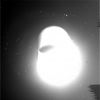
Tethys-N00061934.jpgTethys, mysterious but...overexposed!60 visiteCaption originale:"N00061934.jpg was taken on May 23, 2006 and received on Earth May 24, 2006. The camera was pointing toward Tethys that, at the time, was approximately 509.689 Km away.
The image was taken using the CL1 and CL2 filters".
|
|

Enceladus-PIA08500.jpgWhat's inside Enceladus?60 visiteCaption originale:"This graphic illustrates the interior of Saturn's moon Enceladus. It shows warm, low-density material rising to the surface from within, in its icy shell (yellow) and/or its rocky core (red). A NASA-funded study says Enceladus might have rolled or rotated itself to place this area of low density at the south pole. This finding is in the June 1, 2006, issue of the journal Nature.
This graphic uses parts of visible-light images taken by the Cassini spacecraft camera that have been modified for the purpose of showing the interior structure. Cassini's cameras captured a giant plume blasting icy particles into space".
|
|

Mimas-N00063438.jpgMimas and Enceladus (2)60 visiteCaption originale:"N00063438.jpg was taken on July 03, 2006 and received on Earth July 04, 2006. The camera was pointing toward Mimas that, at the time, was approximately 1.635.384 Km away. The image was taken using the CL1 and CL2 filters".
|
|

Saturn-N00063521-01.jpgIncredible "Meteor" (?) strikes the upper layers of Saturn's atmosphere (detail mgnf-1)60 visiteL'immagine dell'oggetto, una volta sottoposta ad un sensibile (ma non eccessivo) stretching, evidenzia una sostanziale disomogeneità nella intensità luminosa (o, se preferite, nella "tessitura") della striscia.
Ed infatti, come questo ed il successivo dettaglio mostrano bene, essa alterna momenti di "brillamento" a cui fanno contrasto dei momenti in cui la luce dello streak pare indebolirsi sensibilmente.
Si tratta, come qualcuno avrà probabilmente già intuito, di alcuni segnali visuali caratteristici del passaggio di un "bolide": una meteora, insomma (una shooting star, o stella cadente).
Un corpo celeste vagante che, passato troppo vicino a Saturno, sta ora andando a dirigersi - viaggiando a grandissima velocità (ipotizziamo intorno ai 40/45.000 Km/h) verso le profondità dell'atmosfera del Gigante Anellato.
Profondità che, ovviamente, non verranno mai raggiunte, poichè la roccia vagante (o qualunque altra cosa essa fosse...) si sta già disintegrando negli strati superiori della densa atmosfera di Saturno e, nel farlo, sprigiona questa intensa luce che, nel volgere di 1 o 2" (il tempo di esposizione usato, riteniamo, dalla fotocamera di Cassini), ha già disegnato una splendida e luminosissima traccia bianca nell'oscurità.
|
|

The_Rings-PIA08298.jpgFrom the Dark Side of Saturn60 visiteCaption NASA:"The Cassini spacecraft gazes down through the Dark Side of Saturn's Rings toward the softly glowing Planet. The night side Southern Hemisphere is lit by Sunlight reflecting off the opposite side of the Rings.
The Planet's shadow slices diagonally across the scene.
This view was acquired from about 23° above the Ring-Plane. The sliver of Saturn's sunlit crescent is partly overexposed as seen through the Cassini Division, a Region where there is less material to block or scatter incoming light.
Images taken using red, green and blue spectral filters were combined to create this natural color view. The images were taken with the Cassini spacecraft wide-angle camera on Sept. 11, 2006 at a distance of approx. 1,1 MKM (about 700.000 miles) from Saturn and at a phase angle of 151°.
Image scale is about 60 Km (such as approx. 37 miles) per pixel".
|
|
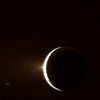
Enceladus-N00081664.jpgFountains in the Darkness (3) - natural colors, elab. Lunexit60 visiteCaption NASA:"N00081664.jpg was taken on April 24, 2007 and received on Earth April 25, 2007.
The camera was pointing toward ENCELADUS that, at the time, was approx. 189.299 Km away, and the image was taken using the CL1 and CL2 filters.
This image has not been validated or calibrated".MareKromium
|
|
| 2245 immagini su 188 pagina(e) |
 |
|
|
|
|
50 | |
|
|
|
|





