| Piú viste - Saturn: the "Ringed Beauty" and His Moons |

Saturn from 8.200.000 Km.jpgSaturn, Prometheus, Pandora and Janus from 8.200.000 Km60 visitenessun commento
|
|

Saturn from 8.500.000 Km.jpgSaturn, Mimas and Enceladus from 8.500.000 Km60 visitenessun commento
|
|

Saturn-HST-Oct.2000-PIA03162_modest.jpgSaturn from Hubble Space Telescope (Oct. 2000)60 visitenessun commento
|
|

Saturn-V2-PIA00030_modest.jpgSaturn from approx. 33.900.000 Km - Voyager 260 visiteCaption NASA originale:"NASA's Voyager 2 took this 'true color' photograph of Saturn on July 21, 1981, when the spacecraft was 33.900.000 Km from the planet. Two bright, presumably convective cloud patterns are visible in the mid-northern hemisphere and several dark spoke-like features can be seen in the broad B-ring (left of planet). The moons Rhea and Dione appear as blue dots to the south and southeast of Saturn, respectively. Voyager 2 made its closest approach to Saturn on Aug. 25, 1981".
|
|
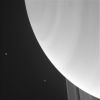
Saturn + 2-N00019308.jpgSatrun, one little Moon and "something else" - N 0001930760 visiteInnanzitutto il commento NASA originale: "N00019308.jpg was taken on September 24, 2004 and received on Earth September 25, 2004. The camera was pointing toward SATURN at approx. 7.752.875 Km away and the image was taken using the CL1 and UV3 filters".
Si vede subito che c'è un altro oggetto luminoso, accanto a Saturno, oltre alla Luna che avevamo già notato nel frame precedente. Se ingrandite l'immagine, poi, ecco la sorpresa: l'oggetto "nuovo" sembra essere il centro (o la causa?) di una sorta di "esplosione". Se osservate attentamente nell'area centrale dell'esplosione (!) vedrete qualcosa di simile ad un triangolino bianco: un effetto della possibile eccessiva luminosità dell'epicentro del fenomeno. Dunque, di che cosa si tratta?
Ancora un errore/difetto nella/della trasmisione dati? Una cometa che si disintegra?
E' purtroppo probabile che non lo sapremo mai, tuttavia il fenomeno immortalato (crediamo in maniera del tutto casuale) dalla Sonda potrebbe anche essere di valore storico. Potrebbe...
|
|

Saturn-W00003105.jpgSaturn and his shadow (3)60 visite...tutte le nuove immagini che, per un motivo o per l'altro, potevano prestarsi a far sorgere nuove domande, nuovi dubbi, nuovi interrogativi - più o meno scabrosi - e che, comunque, potevano "imbarazzare" la National Aeronautics and Space Administration. Detto in un altro modo, stiamo parlando di "CENSURA". Però, come ben sapete, la NASA non gestisce questa Missione da sola: c'è di mezzo anche l'European Space Agency e l'Agenzia Spaziale Italiana. Leggete:
"The Cassini-Huygens mission is a cooperative project of NASA, the European Space Agency and the Italian Space Agency. The Jet Propulsion Laboratory, a division of the California Institute of Technology in Pasadena, manages the Cassini-Huygens mission for NASA's Science Mission Directorate, Washington, D.C. The Cassini orbiter and its two onboard cameras were designed, developed and assembled at JPL. The imaging team is based at the Space Science Institute, Boulder, Colo".
|
|

Saturn_s Rings-PIA06533_modest.jpgSaturn's Rings from about 631.000 Km60 visiteCaption NASA originale:"The usually bright B-Ring (at center) appears very dim in this view of the rings taken on the side of the rings that is not illuminated. The scene resembles a photographic negative, with bright and dark areas reversed (although in some places in the rings, the blackness of space is seen). From this viewing angle, the rings are lit from below: both dense and empty regions are dark, and regions of intermediate particle density are bright.
The image was taken with the Cassini spacecraft wide angle camera on Oct. 27, 2004, at a distance of about 631.000 Km from Saturn through a filter sensitive to wavelengths of visible violet light. The image scale is 34 Km per pixel".
|
|

Mimas, Janus, Prometheus-PIA06529_modest.jpgMimas, Janus and Prometheus, from the darkside60 visiteCaption NASA originale: "Visible in this image are: Mimas (398 Km, or 247 miles across) brightest and above center; Janus (181 Km, or 112 miles across) second brightest at upper left; and Prometheus (102 Km, or 63 miles across) just above the main rings at upper left.
The normally bright B-Ring appears very dark from this vantage point. Regions with smaller concentrations of particles, such as the Cassini division (bright near center) transmit more sunlight and thus are brighter.
The image was taken in visible light with the Cassini spacecraft wide angle camera on Oct. 27, 2004, at a distance of 757.000 Km(470.000miles) from Saturn. The image scale is about 42 Km (26 miles) per pixel".
|
|

Dione-N00027217.jpgSinking in the Rings...60 visiteScusateci il "calambour", ma nessuna espressione ci è sembrata più azzeccata di questo "Sinking in the Rings" (che tanto ci ricorda la famosissima "Singing in the Rain"...) per commentare un'immagine simile e di enorme, intrinseca ed unica bellezza.
|
|

Saturn-PIA06177.jpgSaturn's Northern Hemisphere in natural colors60 visiteCaption NASA originale:"Saturn's Northern Hemisphere is presently a serene blue, more befitting of Uranus or Neptune, as seen in this natural color image from Cassini.
Light rays here travel a much longer path through the relatively cloud-free upper atmosphere. Along this path, shorter wavelength blue light rays are scattered effectively by gases in the atmosphere and it is this scattered light that gives the region its blue appearance. Why the upper atmosphere in the northern hemisphere is so cloud-free is not known, but may be related to colder temperatures brought on by the ring shadows cast there.
Shadows cast by the rings surround the pole, looking almost like dark atmospheric bands. The ring shadows at higher latitudes correspond to locations on the ringplane that are farther from the planet - i.e.: the northernmost ring shadow in this view is made by the outer edge of the A-Ring.
Spots of bright clouds also are visible throughout the region. This view is similar to an infrared image obtained by Cassini at nearly the same time".
|
|

Rhea-N00032543.jpgRhea, from approx. 242.000 Km (3)60 visitenessun commento
|
|

Tethys-N00036303.jpgTethys from 487.484 Km60 visitenessun commento
|
|
| 2245 immagini su 188 pagina(e) |
 |
|
|
|
|
49 | |
|
|
|
|





