| Piú viste - Saturn: the "Ringed Beauty" and His Moons |

Rhea-PIA06620.jpgRhea and Enceladus: which is which?61 visiteCaption NASA originale:"Though much farther away from Cassini when the spacecraft acquired this image, Saturn's second-largest moon Rhea still dwarfs the brightest icy moon Enceladus in this scene. Rhea is 1.528 Km (approx. 949 miles) across. Enceladus is 505 Km (approx. 314 miles) across.
The image was taken in visible light with the Cassini spacecraft narrow-angle camera on Feb. 21, 2005, at a distance of approx. 2 MKM (approx. 1,3 million miles) from Enceladus and 2,5 MKM (approx. 1,6 MMs) from Rhea. The image scale is 12 Km (approx. 7 miles) per pixel on Enceladus and 15 Km (approx. 9 miles) per pixel on Rhea".
|
|

Rings-PIA07556.jpgThe "Opposition Effect"61 visiteCaption NASA originale:"The "opposition effect" can be seen in this image of Saturn's B ring. The bright spot occurs where the angle between the spacecraft, the Sun and the Rings is near zero.
Studies of the Opposition Effect on Saturn's Rings may help scientists constrain some of the properties of the Ring particles, such as their sizes and spatial distribution.
The image was taken in visible light with the Cassini spacecraft wide-angle camera on June 26, 2005, at a distance of approximately 478.000 Km (about 297.000 miles) from Saturn. The image scale is 3 Km (about 2 miles) per pixel".
|
|

Hyperion-PIA07740.jpgHyperion - false colors61 visiteOriginal caption:"This stunning false-color view of Hyperion reveals crisp details across the strange, tumbling moon's surface. Differences in color could represent differences in the composition of surface materials. The view was obtained during Cassini's close flyby on Sept. 26, 2005.
Hyperion has a notably reddish tint when viewed in natural color. The red color was toned down in this false-color view and the other hues were enhanced, in order to make more subtle color variations across Hyperion's surface more apparent.
Images taken using infrared, green and ultraviolet spectral filters were combined to create this view. The images were taken with the Cassini spacecraft's narrow-angle camera at a distance of approx. 62.000 Km (about 38.500 miles) from Hyperion and at a Sun-Hyperion-spacecraft angle of 52°.
The image scale is 362 mt (about 1200 feet) per pixel".
|
|

Mimas-N00055623.jpgMimas (2)61 visiteCaption originale:"N00055623.jpg was taken on March 21, 2006 and received on Earth March 22, 2006. The camera was pointing toward Mimas that, at the time, was approximately 190.524 Km away.
The image was taken using the CL1 and CL2 filters".
|
|

Streak-N00065622-4.jpgWhat is that? (detail mgnf n. 3)61 visiteNotate ora la "coda" di questa striscia di luce: notate come essa suggerisca un'ipotesi di "dissolvenza", concettualmente simile a quello che accade ad una traccia lasciata nel cielo da un aviogetto (la quale, poco dopo essere stata creata, viene spazzata via dal vento)?
Ora, quanto è compatibile questa costruzione logica con l'ipotesi del "bolide" (per non parlare dell'ipotesi del "raggio cosmico")?
Poco. Davvero poco.
Purtroppo non conosciamo i tempi di scatto (un millesimo di secondo o, per esempio, 10 secondi? O forse di più?), ma la nostra esperienza in materia di fotografia ci spinge a ritenere che questo scatto è stato molto breve (forse non più di un paio di secondi). Perchè? Perchè non si vedono stelle - che, con una posa appena più lunga, apparirebbero a centinaia/migliaia - e perchè la Striscia di Luce NON è mossa (come invece dovrebbe inevitabilmente accadere se si fosse trattato di uno scatto a posa media o medio-lunga).
Conclusioni? Noi non ne abbiamo. Però abbiamo (ed avete anche Voi) parecchi elementi interessanti per valutare ed ipotizzare...
|
|

Prometheus-PIA08847.jpgPrometheus' trail61 visiteCaption NASA:"Prometheus interacts gravitationally with the inner flanking ringlets of the F-Ring, creating dark channels as it passes.
This image was taken in a complete azimuthal scan of the Rings, during which Cassini followed Prometheus (102 Km, or 63 miles across) around the Rings for one complete orbit, or about 14 hours. This view looks toward the unlit side of the Rings from about 41° above the Ring-Plane. The moon is partly lit by Sunlight (at left) and elsewhere lit by reflected light from Saturn.
The image was taken in visible light with the Cassini spacecraft narrow-angle camera on Nov. 23, 2006 at a distance of approx. 1,5 MKM (900.000 miles) from Prometheus and at a Sun-Prometheus-spacecraft, or phase, angle of 152°. Image scale is roughly 9 Km (a little more than 5 miles) per pixel".
|
|

Tethys-N00085206.jpgTethys' surface, in the Saturn-shine (2 - natural colors - elab. Lunexit)61 visiteCaption NASA:"N00085206.jpg was taken on June 27, 2007 and received on Earth June 28, 2007. The camera was pointing toward Tethys that, at the time, was approx. 16.027 Km away. The image was taken using the CL1 and CL2 filters.
This image has not been validated or calibrated".MareKromium
|
|

Janus-PIA10417-1.JPGRugged Janus (Saturated Natural Colors; credits for the additional process. and color.: Dr Paolo C. Fienga - Lunexit Team)61 visiteCaption NASA:"Craters large and small cover the rugged surface of Saturn's moon Janus.
This view looks toward the Southern Hemisphere of Janus (about 179 Km, or approx. 111 miles across at its widest point). The moon's South Pole is at center.
The image was taken with the Cassini Spacecraft narrow-angle camera on May 26, 2008 using a spectral filter sensitive to wavelengths of IR light centered at 930 nanometers. The view was acquired at a distance of approx. 186.000 Km (such as about 115.000 miles) from Janus and at a Sun-Janus-Spacecraft, or Phase, angle of 83°.
Image scale is roughly 1 Km (about 0,6 miles) per pixel".MareKromium
|
|
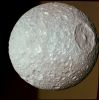
Mimas-EB3.jpgCosmic Clash: Mimas and Saturn (Natural Colors; credits: Elisabetta Bonora - Lunexit Team)61 visitenessun commentoMareKromium
|
|

Enceladus-Fly-By-EB.jpgEnceladus' Fly-By (Image-Mosaic; credits: Elisabetta Bonora - Lunexit Team)61 visiteUn altro Lavoro che Vi presentiamo con immenso piacere e soddisfazione...MareKromium
|
|

Dione_and_Titan-NOO152440-86-EB.gifDione, Titan and some "Mistery Moons"... (GIF-Movie - Natural Colors; credits: ELisabetta Bonora - Lunexit Team)61 visite...Il filmato è, semplicemente, di straordinaria fattura (un "Grazie di Cuore!" alla nostra Amica e Partner, Elisabetta Bonora), ed i suoi contenuti, come qualsiasi Appassionato di Astronomia potrà notare, sono - ancora una volta - estremamente suggestivi.
Titano, dal punto di vista dell'Orbiter Cassini, "scivola" accanto a Dione.
Ma sono soltanto Dione e Titano i "Protagonisti" di questo "inseguimento" nella Notte di Saturno?
Ebbene, se avete presente e chiaro il concetto di "Risonanza Orbitale" e se osservate MOLTO attentamente il filmato, alla risposta potreste e dovreste arrivare da soli...MareKromium
|
|
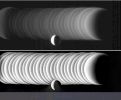
Polydeuces-EB.jpgPolydeuces? (an Image-Mosaic by Elisabetta Bonora and Marco Faccin - Lunexit Team)61 visitenessun commentoMareKromium
|
|
| 2245 immagini su 188 pagina(e) |
 |
|
|
|
|
47 | |
|
|
|
|





