| Piú viste - Saturn: the "Ringed Beauty" and His Moons |

TITAN-N00006513.jpgTitan from Cassini-Huygens - app.x 340.000 Km away61 visitenessun commento
|
|

Janus from Voyager 2.jpgJanus from Voyager 261 visiteGiano, un'altra (fra le tante...) Lune Minori di Saturno.
Ma Voi sapevate chi era Giano, nella Mitologia Romana? Era - ovviamente - una Divinità il cui compito (decisamente delicato) era quello di vegliare sulle "Porte del Paradiso".
Il "Guardiano della Dimora degli Dei", insomma.
Da non dimenticare, infine, il fatto che Gennaio è proprio il mese dell'anno che deve a Giano (Janus) il suo nome.
|
|

Mimas from Voyager 1.jpgMimas from Voyager 161 visiteEd eccoVi una splendida immagine di Mimas che "guarda" verso di noi. I colori di questo frame, a quanto ne sappiamo e per quanto riusciamo a capire, non sono reali (si tratta di colori impiegati per esaltare ancora di più - anche se, forse, non ce n'era bisogno...) le caratteristiche superficiali di questo mondo che giace immerso nel buio perenne. In ogni caso non possiamo non sottolineare e rimarcare la più che eccellente qualità dell'immagine di Mimas la quale è stata ottenuta con mezzi e tecnologie di gran lunga inferiori a quelle oggi messe a disposizione di Cassini-Huygens (ma la differenza, a dire il vero, non si vede!).
|
|
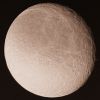
Rhea from Voyager 2.jpgRhea from Voyager 161 visiteRhea Data and Statistics
Discovered by = Giovanni Domenico Cassini
Date of discovery = 1672
Mass (kg) = 2.49e+21
Mass (Earth = 1) = 4.1667e-04
Equatorial radius = 765 Km
Equatorial radius (Earth = 1) = 1.1994e-01
Mean density (gm/cm^3) = 1,33
Mean distance from Saturn = 527.040 Km
Rotational period (days) = 4,517500
Orbital period (days) = 4,517500
Mean orbital velocity (km/sec) = 8,49
Orbital inclination = 0,35°
Escape velocity (km/sec) = 0,659
Visual geometric albedo = 0,7
Magnitude (Vo) = 9,7
Maximum surface temperature = -174°C
Minimum surface temperature = -220°C
|
|

Mimas-PIA01968.jpgMimas from Cassini/Huygens61 visiteMimas, in questo recente frame, sembra aver distolto il suo "sguardo" da noi e pare guardare verso l'alto, in una zona di cielo che non possiamo vedere. Ricollegandoci al commento che si faceva in precedenza, a proposito delle tecnologie possedute dal Voyager in rapporto a quelle disponibili per Cassini-Huygens, dobbiamo dire che questa immagine è sicuramente bella e chiara, ma NON più bella e più chiara di quella ottenuta dal Voyager 1 vent'anni fa!
C'è di che meditare, non è vero?!?
|
|

Phoebe (3D).jpgThree-dimensional Phoebe61 visiteCaption NASA originale:"The Sun is coming from the left, illuminating craters and bumps on the surface, along with a prominent ridge-like feature in the middle. Bright material, likely to be ice, is exposed atop this ridge-like feature as well as around small craters and down the slopes of large craters. There are also bright streaks on steep slopes, perhaps where loose material slid downhill during the seismic shaking of impact events".
|
|

Saturn_s F-Ring+Mimas-PIA06471_modest.jpgLonely Mimas...61 visiteCaption NASA originale:"Mimas swings around Saturn, seeming to gaze down at the planet's splendid rings. The outermost, narrow F ring is visible here and exhibits some clumpy structure near the bottom of the frame. The shadow of Saturn's southern hemisphere stretches almost entirely across the rings. Mimas is 398 Km (247 miles) wide.
The image was taken with the Cassini spacecraft narrow angle camera on August 15, 2004, at a distance of 8,8 MKM (5.5 million miles) from Saturn".
|
|

Saturn-The Atlas Ring-PIA06113_modest.jpgThe "F-Ring" (or "Atlas Ring") of Saturn61 visiteRiteniamo la dichiarazione che riportiamo qui di seguito di GRANDE INTERESSE, specie per coloro che sappiano dei cosiddetti "Ring-Masters", ossìa i ("Mitologici") Creatori degli Anelli di Saturno: "...Scientists examining Saturn's contorted F-Ring - which has baffled them since its discovery - have found 1 or 2 small bodies orbiting in the F-ring region, and a ring of material associated with Saturn's moon Atlas...".
Cosa sono questi 1 o 2 "small bodies"? Perchè non si parla di nuovi mini-satelliti?
|
|
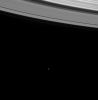
Saturn and Mimas-PIA06473.jpgSaturn and Mimas61 visiteCaption NASA originale:"On its first orbit of the ringed planet, the Cassini spacecraft gazed into the distance to capture this image of the icy moon Mimas (398 Km - 247 miles wide). The faint F-Ring is visible as the outermost strand of the rings in this view. The image was taken in visible light with the narrow angle camera on August 16, 2004, at a distance of 8.9 MKm (5.5 MMs) from Saturn. The image scale is 53 kilometers (33 miles) per pixel. Contrast was slightly enhanced to aid visibility".
|
|

Tethys-PIA06140_modest.jpgTethys in natural colors61 visiteCaption NASA originale:"Having passed closer to Tethys than the Voyager 2 spacecraft, Cassini has returned the best-ever natural color view of this icy Saturnian moon.
As seen here, the battered surface of Tethys has a neutral hue. The image here is a mosaic of two footprints. Three images taken in the red, green and blue filters were taken to form a natural color composite. The result reveals a world nearly saturated with craters - many small craters lie on top of older, larger ones, suggesting an ancient surface. At the top and along the boundary between day and night, the moon's terrain has a grooved appearance.
This moon is known to have a density very close to that of water, indicating it is likely composed mainly of water ice. Its frozen mysteries await Cassini's planned close flyby in September 2005".
|
|

Dione-PIA06528_modest.jpgDione from approx. 1.200.000 Km61 visiteA gorgeous Dione poses for Cassini, with shadowed craters and bright, wispy streaks first observed by the Voyager spacecraft 24 years ago. The wispy areas will be imaged at higher resolution in mid-December 2004. Subtle variations in brightness across the surface of this moon are visible here as well. Dione's diameter is 1.118 Km. The image shows primarily the trailing hemisphere of Dione, which is the side opposite the moon's direction of motion in its orbit. The image has been rotated so that north is up.
The image was taken in visible light with the Cassini spacecraft narrow angle camera on Oct. 27, 2004, at a distance of about 1.2 MKMs from Dione and at a Sun-Dione-spacecraft, or phase, angle of 28°. The image scale is 3.5 Km per pixel.
|
|
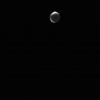
Japetus-N25973.jpgJapetus from approx. 2,2 MKM61 visiteGiapeto: in questa immagine, ripresa da una considerevolissima distanza, possiamo vedere una parte del suo "volto": quella più scura ed enigmatica. La causa del buio che regna su un'ampia porzione della superficie di Giapeto viene attribuita, da qualche Scienziato, alla possibile presenza, su di essa, di enormi depositi di polveri (di carbone o, comunque, di qualcosa di molto simile alle polveri di carbone) i quali, letteralmente, "soffocano e spengono" tutta la luce che arriva. Un Mondo tenebroso, quindi: un Mondo fatto più di ombra che di luce.
Un Mondo, dunque, che sarebbe ancora più affascinante tentare di scoprire...
|
|
| 2245 immagini su 188 pagina(e) |
 |
|
|
|
|
45 | |
|
|
|
|





