| Piú viste - Saturn: the "Ringed Beauty" and His Moons |

Janus from Voyager 2.jpgJanus from Voyager 262 visiteGiano, un'altra (fra le tante...) Lune Minori di Saturno.
Ma Voi sapevate chi era Giano, nella Mitologia Romana? Era - ovviamente - una Divinità il cui compito (decisamente delicato) era quello di vegliare sulle "Porte del Paradiso".
Il "Guardiano della Dimora degli Dei", insomma.
Da non dimenticare, infine, il fatto che Gennaio è proprio il mese dell'anno che deve a Giano (Janus) il suo nome.
|
|
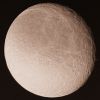
Rhea from Voyager 2.jpgRhea from Voyager 162 visiteRhea Data and Statistics
Discovered by = Giovanni Domenico Cassini
Date of discovery = 1672
Mass (kg) = 2.49e+21
Mass (Earth = 1) = 4.1667e-04
Equatorial radius = 765 Km
Equatorial radius (Earth = 1) = 1.1994e-01
Mean density (gm/cm^3) = 1,33
Mean distance from Saturn = 527.040 Km
Rotational period (days) = 4,517500
Orbital period (days) = 4,517500
Mean orbital velocity (km/sec) = 8,49
Orbital inclination = 0,35°
Escape velocity (km/sec) = 0,659
Visual geometric albedo = 0,7
Magnitude (Vo) = 9,7
Maximum surface temperature = -174°C
Minimum surface temperature = -220°C
|
|

Tethis from Voyager 2.jpgTethis from Voyager 262 visiteTethys Data and Statistics:
Discovered by = Giovanni Domenico Cassini
Date of discovery = 1684
Mass (kg) = 7.55e+20
Mass (Earth = 1) = 1.2634e-04
Equatorial radius = 530 Km
Equatorial radius (Earth = 1) = 8.3098e-02
Mean density (gm/cm^3) = 1,21
Mean distance from Saturn = 294.660 Km
Rotational period (days) = 1,887802
Orbital period (days) = 1,887802
Mean orbital velocity (km/sec) = 11,36
Orbital inclination = 1.09°
Escape velocity (km/sec) = 0,436
Visual geometric albedo = 0,9
Magnitude (Vo) = 10,2
Mean surface temperature = -187°C
|
|

Dione from appx. 1.400.000.jpgDione from Cassini-Huygens - app.x 1.400.000 Km away62 visitenessun commento
|
|

Saturn in the darkness-N00015836.jpgSaturn (and Titan?) in the darkness62 visiteA volte, quando invitiamo i nostri Lettori ad immaginare, mentre guardano le "istantanee dell'Universo", di "essere lì", sospesi in una sorta di abisso senza confini visibili, circondati da oggetti maestosi ed impenetrabili, pensiamo al film "2001 - Odissea nello Spazio", quando Dave Bowman esce nello Spazio di Giove a bordo della sua navetta, per andare a vedere il Monolito da vicino. Questo frame, in qualche modo, ci ricorda quella sequenza e noi ve lo proponiamo...
|
|

Saturn & family-PIA06475_modest.jpgSaturn and Family62 visiteCaption NASA originale:"Satellites visible in this image are (clockwise from upper left): Dione (1.118 Km or 695 miles wide), Enceladus (499 Km or 310 miles wide), Tethys (1.060 Km or 659 miles wide), Mimas (398 Km or 247 miles wide) and Rhea (1.528 Km or 949 miles wide).
The image was taken in visible red light on Aug. 1, 2004, at a distance of 7.8 MKm (4.8 million miles) from Saturn. The image scale is 464 Km (288 miles) per pixel".
|
|

Saturn-W00003105.jpgSaturn and his shadow (3)62 visite...tutte le nuove immagini che, per un motivo o per l'altro, potevano prestarsi a far sorgere nuove domande, nuovi dubbi, nuovi interrogativi - più o meno scabrosi - e che, comunque, potevano "imbarazzare" la National Aeronautics and Space Administration. Detto in un altro modo, stiamo parlando di "CENSURA". Però, come ben sapete, la NASA non gestisce questa Missione da sola: c'è di mezzo anche l'European Space Agency e l'Agenzia Spaziale Italiana. Leggete:
"The Cassini-Huygens mission is a cooperative project of NASA, the European Space Agency and the Italian Space Agency. The Jet Propulsion Laboratory, a division of the California Institute of Technology in Pasadena, manages the Cassini-Huygens mission for NASA's Science Mission Directorate, Washington, D.C. The Cassini orbiter and its two onboard cameras were designed, developed and assembled at JPL. The imaging team is based at the Space Science Institute, Boulder, Colo".
|
|

Dione-PIA06528_modest.jpgDione from approx. 1.200.000 Km62 visiteA gorgeous Dione poses for Cassini, with shadowed craters and bright, wispy streaks first observed by the Voyager spacecraft 24 years ago. The wispy areas will be imaged at higher resolution in mid-December 2004. Subtle variations in brightness across the surface of this moon are visible here as well. Dione's diameter is 1.118 Km. The image shows primarily the trailing hemisphere of Dione, which is the side opposite the moon's direction of motion in its orbit. The image has been rotated so that north is up.
The image was taken in visible light with the Cassini spacecraft narrow angle camera on Oct. 27, 2004, at a distance of about 1.2 MKMs from Dione and at a Sun-Dione-spacecraft, or phase, angle of 28°. The image scale is 3.5 Km per pixel.
|
|
Japetus-N25973.jpgJapetus from approx. 2,2 MKM62 visiteGiapeto: in questa immagine, ripresa da una considerevolissima distanza, possiamo vedere una parte del suo "volto": quella più scura ed enigmatica. La causa del buio che regna su un'ampia porzione della superficie di Giapeto viene attribuita, da qualche Scienziato, alla possibile presenza, su di essa, di enormi depositi di polveri (di carbone o, comunque, di qualcosa di molto simile alle polveri di carbone) i quali, letteralmente, "soffocano e spengono" tutta la luce che arriva. Un Mondo tenebroso, quindi: un Mondo fatto più di ombra che di luce.
Un Mondo, dunque, che sarebbe ancora più affascinante tentare di scoprire...
|
|

Rhea-PIA06620.jpgRhea and Enceladus: which is which?62 visiteCaption NASA originale:"Though much farther away from Cassini when the spacecraft acquired this image, Saturn's second-largest moon Rhea still dwarfs the brightest icy moon Enceladus in this scene. Rhea is 1.528 Km (approx. 949 miles) across. Enceladus is 505 Km (approx. 314 miles) across.
The image was taken in visible light with the Cassini spacecraft narrow-angle camera on Feb. 21, 2005, at a distance of approx. 2 MKM (approx. 1,3 million miles) from Enceladus and 2,5 MKM (approx. 1,6 MMs) from Rhea. The image scale is 12 Km (approx. 7 miles) per pixel on Enceladus and 15 Km (approx. 9 miles) per pixel on Rhea".
|
|

Saturn-N00031212.jpgPan and Epimetheus (from approx. 1,5 MKM)62 visitenessun commento
|
|

Mimas-N00055634.jpgMimas (3)62 visiteCaption originale:"N00055634.jpg was taken on March 21, 2006 and received on Earth March 22, 2006. The camera was pointing toward Mimas that, at the time, was approximately 191.303 Km away.
The image was taken using the P0 and MT2 filters".
|
|
| 2245 immagini su 188 pagina(e) |
 |
|
|
|
|
44 | |
|
|
|
|





