| Piú viste - Saturn: the "Ringed Beauty" and His Moons |

TITAN-N00006531.jpgTitan from Cassini-Huygens - app.x 340.000 Km away62 visitenessun commento
|
|

Janus from Voyager 2.jpgJanus from Voyager 262 visiteGiano, un'altra (fra le tante...) Lune Minori di Saturno.
Ma Voi sapevate chi era Giano, nella Mitologia Romana? Era - ovviamente - una Divinità il cui compito (decisamente delicato) era quello di vegliare sulle "Porte del Paradiso".
Il "Guardiano della Dimora degli Dei", insomma.
Da non dimenticare, infine, il fatto che Gennaio è proprio il mese dell'anno che deve a Giano (Janus) il suo nome.
|
|

Tethis from Voyager 2.jpgTethis from Voyager 262 visiteTethys Data and Statistics:
Discovered by = Giovanni Domenico Cassini
Date of discovery = 1684
Mass (kg) = 7.55e+20
Mass (Earth = 1) = 1.2634e-04
Equatorial radius = 530 Km
Equatorial radius (Earth = 1) = 8.3098e-02
Mean density (gm/cm^3) = 1,21
Mean distance from Saturn = 294.660 Km
Rotational period (days) = 1,887802
Orbital period (days) = 1,887802
Mean orbital velocity (km/sec) = 11,36
Orbital inclination = 1.09°
Escape velocity (km/sec) = 0,436
Visual geometric albedo = 0,9
Magnitude (Vo) = 10,2
Mean surface temperature = -187°C
|
|

Dione from appx. 1.400.000.jpgDione from Cassini-Huygens - app.x 1.400.000 Km away62 visitenessun commento
|
|

Saturn in the darkness-N00015836.jpgSaturn (and Titan?) in the darkness62 visiteA volte, quando invitiamo i nostri Lettori ad immaginare, mentre guardano le "istantanee dell'Universo", di "essere lì", sospesi in una sorta di abisso senza confini visibili, circondati da oggetti maestosi ed impenetrabili, pensiamo al film "2001 - Odissea nello Spazio", quando Dave Bowman esce nello Spazio di Giove a bordo della sua navetta, per andare a vedere il Monolito da vicino. Questo frame, in qualche modo, ci ricorda quella sequenza e noi ve lo proponiamo...
|
|

Saturn & family-PIA06475_modest.jpgSaturn and Family62 visiteCaption NASA originale:"Satellites visible in this image are (clockwise from upper left): Dione (1.118 Km or 695 miles wide), Enceladus (499 Km or 310 miles wide), Tethys (1.060 Km or 659 miles wide), Mimas (398 Km or 247 miles wide) and Rhea (1.528 Km or 949 miles wide).
The image was taken in visible red light on Aug. 1, 2004, at a distance of 7.8 MKm (4.8 million miles) from Saturn. The image scale is 464 Km (288 miles) per pixel".
|
|

Dione-PIA06156_modest.jpgDione: close-up (1) - HR62 visiteCaption NASA originale:"This incredible, HR view of Saturn's moon Dione was taken during Cassini's first close approach to the icy moon on Dec. 14, 2004. The view shows linear, curving features within the region of the bright wispy terrain Dione is known for.
The image was obtained in visible light with the Cassini spacecraft narrow angle camera at a distance of approximately 156.000 Km (97.000 miles) from Dione. The Sun-Dione-spacecraft, or phase, angle is 34°. The image scale is about 1 Km (0.6 miles) per pixel".
|
|

Enceladus-PIA06581_modest.jpgEnceladus: getting closer...62 visiteCaption NASA originale:"This Cassini image of Saturn's moon Enceladus shows a region containing bizarre, wrinkled terrain. Enceladus is covered with bright water ice. The part of its surface visible here appears to be largely free of craters - indicating that it is geologically young (NOTA LUN-EX-IT: la mancanza di crateri non è solo indice di "gioventù geologica"; essa può anche essere dipendente dal fatto - improbabile ma da NON escludersi a-priori - che taluni processi geologici sìano ancora in corso!
Il tutto senza escludere la possibilità - anch'essa remota ma non assurda - che Encelado sia stata una "luna fortunata" e bombardata in misura inferiore rispetto alle altre...).
The first close imaging of this moon will be done by Cassini in February 2005 and should reveal many surprises. Enceladus has a diameter of 499 Km (310 miles). This view shows primarily the leading hemisphere of Enceladus and it was taken from a distance of 367.000 Km. Resolution in the original image was about 2 Km per pixel".
|
|

Dione-PIA07638.jpgDione: Carthage Linea62 visiteDione's icy surface is scarred by craters and sliced up by multiple generations of geologically-young bright fractures. Numerous fine, roughly-parallel linear grooves run across the terrain in the upper left corner. Most of the craters seen here have bright walls and dark deposits of material on their floors. As on other Saturnian moons, rockslides on Dione may reveal cleaner ice, while the darker materials accumulate in areas of lower topography and lower slope (e.g. crater floors and the bases of scarps).
The terrain seen here is centered at 15,4° North Latitude, 330,3° West Longitude, in a Region called Carthage Linea. North on Dione is up and rotated 50° to the left.
The image was taken in visible green light with the Cassini narrow-angle camera on Oct. 11, 2005, at a distance of approx. 19.600 Km (roughly 12.200 miles) from Dione. The image scale is about 230 mt (760 feet) per pixel".
|
|

Mimas-N00055634.jpgMimas (3)62 visiteCaption originale:"N00055634.jpg was taken on March 21, 2006 and received on Earth March 22, 2006. The camera was pointing toward Mimas that, at the time, was approximately 191.303 Km away.
The image was taken using the P0 and MT2 filters".
|
|

Rhea-N00055723.jpgMoments of Rhea (2)62 visitenessun commento
|
|
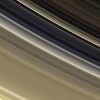
The_Rings-PIA08306.jpgThe A and B-Rings (and the Cassini Division) in natural colors (Credits: NASA/JPL/Space Science Institute)62 visiteThe Rings are awash in subtle tones of gold and cream in this view which shows the outer B-Ring, the Cassini Division and the inner part of the A-Ring. In this viewing geometry, the brightest feature in the Cassini Division is the recently discovered diffuse Ringlet near the outer edge of the Division.
The diffuse Ringlet has a distinctive bluish cast.
The color of the Rings appears more golden than earlier in the mission because of the viewing geometry here - increased scattering in the Rings is brought about by the high phase angle and the view being toward the Rings' unlit side. This view looks toward the unlit side of the rings from about 30° above the Ring-Plane.
Images taken using red, green and blue spectral filters were combined to create this natural color view. The images were acquired by the Cassini spacecraft narrow-angle camera on Sept. 29, 2006 at a distance of approx. 1,8 MKM (about 1,13 MMs) from Saturn. Image scale is roughly 11 Km (about 7 miles) per pixel.
|
|
| 2245 immagini su 188 pagina(e) |
 |
|
|
|
|
43 | |
|
|
|
|





