| Piú viste - Saturn: the "Ringed Beauty" and His Moons |

Dione-N160934-48-EB-LXTT.jpgDione (an Image-Mosaic in RAW Natural Colors by Elisabetta Bonora - Lunexit Team)64 visitenessun commentoMareKromium
|
|

Prometheus~0.jpgThe "Rise" of Prometheus...64 visiteCaption NASA:"What is that dark streak below Prometheus? Although it may look like a shadow or a trail blazed by sweeping up material, computer simulations indicate that the dark streak is better understood as an empty path pulled away by the gravity of Saturn's small moon. The particles don't follow Prometheus so much as glide sideways past where Prometheus used to be. One dark Streamer is created during each pass of Prometheus through the F-Ring that it shepherds.
The Streamers were unpredicted and first discovered in 2004 on HR images taken by the Cassini Spacecraft orbiting Saturn.
Close inspection of the Surface of Prometheus itself in the above image shows interesting structure and craters.
The Cassini Spacecraft arrived at Saturn in 2004 and, as it continues to function well, is now expected to continue to send back data and images from the distant ringed world until 2017".MareKromium
|
|
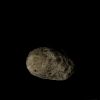
Hyperion-MF-PCF-LXTT-6.jpgHyperion and its Surfacing Hydrocarbons (Absolute Natural Colors; credits for the additional process. and color.: Elisabetta Bonora and Paolo C. Fienga)64 visiteNota: questa colorizzazione "Naturale Assoluta" (e cioè che risponde a quello che, a nostro parere, un essere umano vedrebbe se si trovasse a bordo della Sonda CASSINI) è un prodotto UNICO ed ESCLUSIVO del "Lunexit Team". MareKromium
|
|

Saturn-PIA08823~0.jpgCrescent Saturn (Natural Colors; credits: NASA/JPL/Space Science Institute)64 visiteFrom Norther than the North Pole...
Caption NASA originale:"The Cassini spacecraft gazes down at the marvelous Rings and swirling clouds of giant Saturn from above the Planet's North Pole.
Such views are possible as the spacecraft performs its "180°-transfer," a key navigation maneuver that quickly raises the inclination of Cassini's orbit and shifts the orbital ellipse around to a different side of the Planet, before quickly lowering the inclination again.
The image was taken in visible light with the Cassini spacecraft wide-angle camera on Oct. 30, 2006. Cassini was then at a distance of approx. 1,2 MKM (about 700.000 miles) from Saturn and at a Sun-Saturn-spacecraft, or phase, angle of 142°.
Image scale is roughly 67 Km (about 41 miles) per pixel".MareKromium
|
|

PHOEBE-PIA06069_modest.jpgPhoebe's Fly-By (2)63 visitenessun commento
|
|

SATURN-N00006384.jpgThe Rings from approx. 7.000.000 Km63 visitenessun commento
|
|
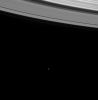
Saturn and Mimas-PIA06473.jpgSaturn and Mimas63 visiteCaption NASA originale:"On its first orbit of the ringed planet, the Cassini spacecraft gazed into the distance to capture this image of the icy moon Mimas (398 Km - 247 miles wide). The faint F-Ring is visible as the outermost strand of the rings in this view. The image was taken in visible light with the narrow angle camera on August 16, 2004, at a distance of 8.9 MKm (5.5 MMs) from Saturn. The image scale is 53 kilometers (33 miles) per pixel. Contrast was slightly enhanced to aid visibility".
|
|

Dione-PIA06156_modest.jpgDione: close-up (1) - HR63 visiteCaption NASA originale:"This incredible, HR view of Saturn's moon Dione was taken during Cassini's first close approach to the icy moon on Dec. 14, 2004. The view shows linear, curving features within the region of the bright wispy terrain Dione is known for.
The image was obtained in visible light with the Cassini spacecraft narrow angle camera at a distance of approximately 156.000 Km (97.000 miles) from Dione. The Sun-Dione-spacecraft, or phase, angle is 34°. The image scale is about 1 Km (0.6 miles) per pixel".
|
|

Japetus-N00026251.jpgJapetus: the terminator, in HD (2)63 visitevedi i commenti al frame precedente
|
|

Enceladus-PIA06581_modest.jpgEnceladus: getting closer...63 visiteCaption NASA originale:"This Cassini image of Saturn's moon Enceladus shows a region containing bizarre, wrinkled terrain. Enceladus is covered with bright water ice. The part of its surface visible here appears to be largely free of craters - indicating that it is geologically young (NOTA LUN-EX-IT: la mancanza di crateri non è solo indice di "gioventù geologica"; essa può anche essere dipendente dal fatto - improbabile ma da NON escludersi a-priori - che taluni processi geologici sìano ancora in corso!
Il tutto senza escludere la possibilità - anch'essa remota ma non assurda - che Encelado sia stata una "luna fortunata" e bombardata in misura inferiore rispetto alle altre...).
The first close imaging of this moon will be done by Cassini in February 2005 and should reveal many surprises. Enceladus has a diameter of 499 Km (310 miles). This view shows primarily the leading hemisphere of Enceladus and it was taken from a distance of 367.000 Km. Resolution in the original image was about 2 Km per pixel".
|
|

Enceladus-PIA07459.jpgEnceladus in infrared63 visiteCaption NASA originale:"This infrared color image of Enceladus was obtained by the Cassini visual infrared mapping spectrometer on March 9, 2005, when the Cassini spacecraft was 9.145 Km away from Enceladus.
Enceladus shows substantial differences in composition or, more likely, particle size on its surface. Redder areas correspond to larger grain sizes, and appear to be correlated with craters and ridged regions. The surface of Enceladus is nearly pure water ice; no other components have been identified yet. The middle of the image is located at the equator near a longitude of 210°.
The image is about 100 Km square and it shows the ratio of reflected light at 1,34 and 1,52 microns, wavelengths that are not visible to the human eye".
|
|

Mimas and Janus.jpgMimas (from 1,8 MKM) and Janus (from 1,9 MKM)63 visiteCaption NASA originale:"Saturn's icy, impact-riddled moon Mimas slips briefly in front of Saturn's moon Janus in this movie from Cassini. The movie was created from 37 original images taken over the course of 20 minutes as the spacecraft's narrow-angle camera remained pointed toward Janus. Although Mimas moves a greater distance across the field of view, Janus also moved perceptibly during this time. The images were aligned to keep Janus close to the center of the scene. Additional frames were inserted between the 37 Cassini images in order to smooth the appearance of Mimas' movement - a scheme called interpolation. Close-up images from the few minutes surrounding the occultation are arranged into a strip along the bottom of the movie. Contrast on Janus was mildly enhanced to aid the visibility of its surface. The right side of Mimas appears bright because the moon was partly overexposed in this image sequence".
|
|
| 2245 immagini su 188 pagina(e) |
 |
|
|
|
|
41 | |
|
|
|
|





