| Piú viste - Saturn: the "Ringed Beauty" and His Moons |

Wispy_Star-PIA08875.jpgTwinkle, twinkle, Little Star...64 visiteCaption NASA:"The Cassini spacecraft gazes toward a distant star as Saturn's Rings slip past in the foreground. At upper left is the outer A-Ring, with its dark Keeler Gap. At lower right, a train of bright clumps shuttles past in the wispy F-Ring.
A temporal sequence of images like this allows Cassini scientists to correlate features in the rings with stellar occultation data acquired by other instruments. As the star passes behind the Rings, the changes in its brightness indicate how much empty space is between particles at different locations on the Rings.
This view looks toward the lit side of the Rings from about 56° below the Ring-Plane.
The image was taken in visible light with the Cassini spacecraft narrow-angle camera on Dec. 30, 2006 at a distance of approx. 633.440 Km (such as about 393.686 miles) from Saturn. Image scale is roughly 4 Km (2 miles) per pixel".
|
|

Prometheus-PIA08910.jpgRestless Prometheus...64 visiteCaption NASA:"Prometheus draws a fresh streamer of material from the F-Ring as it passes the Ring's interior edge. The streamer will continuously shear out as it orbits the planet, becoming more elongated and increasingly aligned with the F-Ring with time.
A single large crater is the principle feature visible on Prometheus (102 Km, or about 63 miles across) in this view. The moon is lit partly by bright Sunlight and partly by reflected light from Saturn.
This view looks toward the unlit side of the rings from about 57° above the Ring-Plane.
The image was taken in visible light with the Cassini spacecraft narrow-angle camera on Feb. 11, 2007 at a distance of approx. 1,7 MKM (about 1,1 MMs) from Prometheus and at a Sun-Prometheus-spacecraft, or phase, angle of 130°.
Image scale is roughly 10 Km (about 6 miles) per pixel".
|
|

Enceladus-N00086989.jpgSpace Encounter: Enceladus and Tethys (1)64 visitenessun commentoMareKromium
|
|

Enceladus-PIA08386.jpgThe Blue Fountains of Enceladus (false colors; elab. NASA)64 visiteThis false-color view was created by combining 3 clear filter images taken at nearly the same time of PIA07759. This image product was then specially processed to enhance the individual jets that compose the plume (while PIA07759 was instead processed to reveal subtleties in the brightness of the overall plume that comprises the jets).
Some artifacts due to the processing are present in the image. The final product was colored as blue for dramatic effect.
The images were acquired with the Cassini spacecraft narrow-angle camera on Nov. 27, 2005 at a distance of approx. 148.000 Km (about 92.000 miles) from Enceladus and at a Sun-Enceladus-Spacecraft, or phase, angle of 161°.
Scale in the original images is about 880 meters (0,5 mile) per pixel.
This view has been magnified by a factor of two from the original images".MareKromium
|
|

Rhea-PIA10429.jpgRhea (MULTISPECTRUM; credits: Lunexit)64 visiteCaption NASA:"The Cassini Spacecraft surveys the stark beauty of Saturn's moon Rhea.
Rhea's North Pole is up and tilted slightly away from Cassini in this view; the moon's south pole is in sunlight at bottom. Lit terrain seen here is on the Anti-Saturn Side of Rhea.
The image was taken in visible red light with the Cassini Spacecraft narrow-angle camera on June 10, 2008. The view was acquired at a distance of approx. 420.000 Km (approx. 261.000 miles) from Rhea and at a Sun-Rhea-Spacecraft, or Phase, Angle of 53°.
Image scale is roughly 3 Km (about 2 miles) per pixel".MareKromium
|
|

Prometheus-PIA08916~0.jpgOrb-at-Work! (natural colors; credits: Lunexit)64 visiteCaption NASA:"Prometheus draws material from the F-Ring along an invisible thread of gravity. Near lower left is an identical feature the moon created on a previous pass near the Ring.
Prometheus (approx. 102 Km, or about 63 miles across) is overexposed in this image, which was taken as part of a sequence designed to help refine scientists' understanding of the orbits of Saturn's small moons. This view looks toward the unlit side of the Rings from about 41° above the Ring-Plane.
The image was taken in visible light with the Cassini spacecraft narrow-angle camera on March 14, 2007 at a distance of approx. 1,8 MKM (such as about 1,1 MMs) from Prometheus.
Image scale is roughly 11 Km (about 7 miles) per pixel". MareKromium
|
|

Atlas-N00084627.jpgAtlas (by Dr M. Faccin)64 visitenessun commentoMareKromium
|
|

Saturn-PIA11478.jpgTransparencies (Natural Colors; credits: NASA/JPL/Space Science Institute)64 visiteCaption NASA:"This Natural Color view from the Cassini Spacecraft highlights the myriad gradations in the transparency of Saturn's inner Rings.
The dark shadows of the Rings separate Saturn's Southern Hemisphere in the bottom of the image from the North. The innermost D-Ring is invisible, laid over the Planet's Northern Hemisphere. The translucent C-Ring runs through the middle of the image. The denser B-Ring stretches across the top of the image.
This view looks toward the sunlit side of the Rings from about 48° below the Ring-Plane. Images taken using red, green and blue spectral filters were combined to create this Natural Color view. The images were acquired with the Cassini Spacecraft wide-angle camera on Feb. 28, 2009 at a distance of approx. 1 MKM (about 620.000 miles) from Saturn.
Image scale is roughly 59 Km (approx. 37 miles) per pixel".MareKromium
|
|
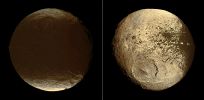
Japetus-PIA11690.jpgGlobal View of Japetus' "Brightness Dichotomy" (Approx. True Colors; credits: Lunexit)64 visiteCaption NASA:"These two global images of Japetus show the extreme brightness dichotomy on the Surface of this peculiar Saturnian moon. The left-hand panel shows Japetus' Leading Hemisphere and the right-hand panel shows its Trailing Side. While Low and Mid Latitudes of the Leading Side exhibit a Surface almost as dark as charcoal, broad tracts of the Trailing Side are almost as bright as snow.
The dark terrain covers about 40% of the Surface of Japetus and it has been named "Cassini Regio". The names of the bright terrain are Roncevaux Terra (North) and Saragossa Terra (South).
On both Hemispheres, the dominant landforms are impact craters. The largest known well-preserved basin on Japetus, called "Turgis", has a diameter of about 580 Km (approx. 360 miles). It lies at 17° North Latitude and 28° West Long., at the Eastern Edge of the Cassini Regio and is visible on the right side of the left-hand panel. The prominent basin on the Southern Trailing Side (at the lower left of the right-hand panel) is named Engelier.
Engelier is located at 41° South Latitude and 265° West Longitude, and it has a diameter of about 504 Km (such as approx. 313 miles).
Its formation destroyed about half of Gerin, another large basin on Japetus. Gerin is located at 46° South Latitude and 233° West Longitude; it has a diameter of about 445 Km (approx. 276 miles).
Tortelosa Montes, a part of the giant Equatorial Ridge that was discovered in Cassini images on December 25, 2004, is visible in the left panel as a thin line within Cassini Regio, and as a tall prominence at the Western Limb. It continues onto the Trailing Side (right side of right panel), where the bright Western Flanks of the Carcassone Montes appear as dominant bright spots within the Western Edge of Cassini Regio.
The cause of the extreme brightness dichotomy on Japetus is likely to be "thermal segregation of water ice" on a global scale.
Thermal effects are usually expected to act latitudinally.
That is, Polar Areas are colder than Equatorial Terrain in most cases due to the more oblique angle of the Solar Irradiation. Therefore, an additional process is required to explain the longitudinal difference as well.
In one model, dark, reddish dust coming in from space and preferentially deposited on the Leading Side forms a small, but crucial difference between the Leading and Trailing Hemispheres, which is sufficient to allow the thermal effect to evaporate the water ice on the Leading Side completely, but only marginally on the Trailing Side. (see PIA11689 to learn more)
Japetus' extremely slow Rotation Rate (about 1 hour and 54 minutes), its distance from the Sun, its relatively small size and Surface Gravity and its outer position within the regular satellite system of Saturn are also crucial contributing conditions for this mechanism to work as observed.
North on Japetus is approx. up in the images. Japetus has a diameter of about 1471 Km (approx. 914 miles).
The right-hand panel, released previously as PIA08384, shows a mosaic of 60 different images, obtained on September 10, 2007.
The left-hand panel is a color composite of three images obtained through InfraRed, Green and UltraViolet Spectral Filters (centered at 752, 568 and 338 nanometers, respectively) by Cassini's narrow-angle camera on Dec. 27, 2004.
The view was acquired at a distance of approx. 717.000 Km (about 446.000 miles) from Japetus and at a Sun-Japetus-Spacecraft, or Phase, Angle of 22°.
Scale in the original image on the left was about 4 Km (approx. 2,5 miles) per pixel. For ease of comparison, the scales in both the left and right images were set to 1400 meters (such as 4600 feet) per pixel".MareKromium
|
|
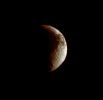
Japetus-PIA12521.jpgCrescent Japetus (possible Natural Colors; credits: Dr Paolo C. Fienga - Lunexit Team)64 visiteCaption NASA:"The Cassini Spacecraft examines the rough Dark-Light Dichotomy of the Terrain on Saturn's moon Japetus. Scientists continue to investigate the nature of this moon's Surface.
Lit Terrain seen here is on the Saturn-facing side of Japetus.
North on Japetus is up and rotated 8° to the left. Scale on Japetus was about 7 Km (about 4,3 miles) per pixel in the original image. The image was contrast enhanced and magnified by a factor of two to enhance the visibility of Surface Features.
The image was taken in Visible Green Light with the Cassini Spacecraft narrow-angle camera on Sept. 13, 2009. The view was acquired at a distance of approx. 1,2 MKM (about 746.000 miles) from Iapetus and at a Sun-Japetus-Spacecraft, or Phase, Angle of 103°".MareKromium
|
|

Prometheus-PIA12593.jpgPrometheus (Possible Natural Colors; credits: Dr Paolo C. Fienga - Lunexit Team)64 visiteCaption NASA:"Appearing like eyes on a potato, craters cover the dimly lit Surface of the moon Prometheus in this HR image from the Cassini Spacecraft's early 2010 flyby.
The Jan. 27 encounter represented the closest imaging sequence yet of that moon for Cassini.
This view looks toward the Trailing Hemisphere of Prometheus (about 86 Km, or approx. 53 miles across). North on Prometheus is up and rotated 8° to the right.
The moon is lit by Sunlight on the right and Saturnshine on the left.
The image was taken in Visible Light with the Cassini Spacecraft narrow-angle camera on Jan. 27, 2010. The view was obtained at a distance of approx. 34.000 Km (about 21.000 miles) from Prometheus and at a Sun-Prometheus-Spacecraft, or Phase, Angle of 126°.
Image scale is roughly 200 meters (656 feet) per pixel".MareKromium
|
|

Dione-N160934-48-EB-PCF-LXTT.jpgDione (an Image-Mosaic in Absolute Natural Colors by Elisabetta Bonora - Lunexit Team)64 visitenessun commentoMareKromium
|
|
| 2245 immagini su 188 pagina(e) |
 |
|
|
|
|
40 | |
|
|
|
|





