| Piú viste - Saturn: the "Ringed Beauty" and His Moons |

Enceladus-N00161119-21-EB-LXTT.jpgAlmost Full Enceladus (Natural Colors; credits for the additional process. and color.: Elisabetta Bonora - Lunexit Team)65 visitenessun commentoMareKromium
|
|

Dione-N00160857-60-EB-LXTT.jpgJust a "Slice" of Dione (Superdefinition and Natural Colors; credits for the additional process. and color.: Elisabetta Bonora - Lunexit Team)65 visitenessun commentoMareKromium
|
|

Prometheus~0.jpgThe "Rise" of Prometheus...65 visiteCaption NASA:"What is that dark streak below Prometheus? Although it may look like a shadow or a trail blazed by sweeping up material, computer simulations indicate that the dark streak is better understood as an empty path pulled away by the gravity of Saturn's small moon. The particles don't follow Prometheus so much as glide sideways past where Prometheus used to be. One dark Streamer is created during each pass of Prometheus through the F-Ring that it shepherds.
The Streamers were unpredicted and first discovered in 2004 on HR images taken by the Cassini Spacecraft orbiting Saturn.
Close inspection of the Surface of Prometheus itself in the above image shows interesting structure and craters.
The Cassini Spacecraft arrived at Saturn in 2004 and, as it continues to function well, is now expected to continue to send back data and images from the distant ringed world until 2017".MareKromium
|
|

PHOEBE-PIA06074_modest.jpgPhoebe's Overview (3)64 visitenessun commento
|
|

Helene from Voyager 2.jpgHelene from Voyager 264 visiteAnche per "Helene" vale quanto detto per Epimetheus e le altre Lune Minori di Saturno: forme irregolari e dimensioni davvero modeste. Schegge (frammenti) di corpi più grandi i quali, oggi, ci rammentano catastrofi planetarie occorse in epoche remote, o dei semplici KBO, catturati da Saturno mentre si trovavano a passare nelle prossimità del Gigante Anellato?
Voi che dite?
|
|

Dione-PIA06156_modest.jpgDione: close-up (1) - HR64 visiteCaption NASA originale:"This incredible, HR view of Saturn's moon Dione was taken during Cassini's first close approach to the icy moon on Dec. 14, 2004. The view shows linear, curving features within the region of the bright wispy terrain Dione is known for.
The image was obtained in visible light with the Cassini spacecraft narrow angle camera at a distance of approximately 156.000 Km (97.000 miles) from Dione. The Sun-Dione-spacecraft, or phase, angle is 34°. The image scale is about 1 Km (0.6 miles) per pixel".
|
|

Enceladus-PIA06581_modest.jpgEnceladus: getting closer...64 visiteCaption NASA originale:"This Cassini image of Saturn's moon Enceladus shows a region containing bizarre, wrinkled terrain. Enceladus is covered with bright water ice. The part of its surface visible here appears to be largely free of craters - indicating that it is geologically young (NOTA LUN-EX-IT: la mancanza di crateri non è solo indice di "gioventù geologica"; essa può anche essere dipendente dal fatto - improbabile ma da NON escludersi a-priori - che taluni processi geologici sìano ancora in corso!
Il tutto senza escludere la possibilità - anch'essa remota ma non assurda - che Encelado sia stata una "luna fortunata" e bombardata in misura inferiore rispetto alle altre...).
The first close imaging of this moon will be done by Cassini in February 2005 and should reveal many surprises. Enceladus has a diameter of 499 Km (310 miles). This view shows primarily the leading hemisphere of Enceladus and it was taken from a distance of 367.000 Km. Resolution in the original image was about 2 Km per pixel".
|
|

Japetus-N00043073.jpgJapetus...in a very unusual "look"!64 visiteOriginal caption:"N00043073.jpg was taken on November 03, 2005 and received on Earth November 05, 2005. The camera was pointing toward Japetus at approximately 1.617.411 kilometers away, and the image was taken using the CL1 and CL2 filters. This image has not been validated or calibrated".
|
|

Dione-PIA07638.jpgDione: Carthage Linea64 visiteDione's icy surface is scarred by craters and sliced up by multiple generations of geologically-young bright fractures. Numerous fine, roughly-parallel linear grooves run across the terrain in the upper left corner. Most of the craters seen here have bright walls and dark deposits of material on their floors. As on other Saturnian moons, rockslides on Dione may reveal cleaner ice, while the darker materials accumulate in areas of lower topography and lower slope (e.g. crater floors and the bases of scarps).
The terrain seen here is centered at 15,4° North Latitude, 330,3° West Longitude, in a Region called Carthage Linea. North on Dione is up and rotated 50° to the left.
The image was taken in visible green light with the Cassini narrow-angle camera on Oct. 11, 2005, at a distance of approx. 19.600 Km (roughly 12.200 miles) from Dione. The image scale is about 230 mt (760 feet) per pixel".
|
|

Prometheus-PIA07653.jpgThe Runners in the Ring: Prometheus and Pandora64 visiteThis spectacular image shows Prometheus (at left) and Pandora (at right), with their flock of icy ring particles (the F-Ring) between them. Pandora is exterior to the Ring, and closer to the spacecraft here. Each of the shepherd satellites has an unusual shape, with a few craters clearly visible.
The effect of Prometheus (about 102 Km across) on the F-Ring is visible as it pulls material out of the Ring when it is farthest from Saturn in its orbit. Pandora is about 84 Km across.
The image was taken in polarized green light with the Cassini spacecraft narrow-angle camera on Oct. 29, 2005, at a distance of approx. 459.000 Km (about 285.000 miles) from Pandora and 483.500 Km (roughly 300.500 miles) from Prometheus. The image scale is 3 Km (about 2 miles) per pixel on Pandora and 3 Km (idem) per pixel on Prometheus. The view was acquired from about 1/3 of 1° below the Ring-Plane.
|
|
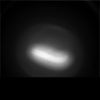
Enygma-W00012863.jpgEnygma (3)64 visiteOriginal caption:"W00012863.jpg was taken on January 05, 2006 and received on Earth January 06, 2006. The camera was pointing toward SKY, and the image was taken using the IR3 and CL2 filters. This image has not been validated or calibrated"
|
|

Mimas-N00048613.jpgOver the clouds of Saturn: Mimas (1)64 visiteOriginal caption:"N00048613.jpg was taken on January 19, 2006 and received on Earth January 19, 2006. The camera was pointing toward Mimas that, at the time, was approximately 1.011.360 kilometers away, and the image was taken using the CL1 and CL2 filters.
This image has not been validated or calibrated".
|
|
| 2245 immagini su 188 pagina(e) |
 |
|
|
|
|
39 | |
|
|
|
|





