| Piú viste - Saturn: the "Ringed Beauty" and His Moons |

Atlas-N00066579.jpgAtlas...maybe...65 visiteAbbiamo delle difficoltà ad identificare con certezza quale sia l'oggetto ripreso da Cassini ma, dopo aver dato una scorsa ai nostri Archivi, riteniamo - effettuando una comparazione visuale - che l'oggetto ripreso in questo frame sia la piccola luna conosciuta come Atlas.
Se Voi avete dei dubbi o ritenete che la nostra valutazione possa essere (o sia), di fatto, errata, scriveteci e dateci una mano a risolvere il mistero.
Caption NASA:"N00066579.jpg was taken on September 25, 2006 and received on Earth September 26, 2006. The camera was pointing toward SATURN, and the image was taken using the CL1 and CL2 filters. This image has not been validated or calibrated".
|
|

Atlas-N00084635.jpgAtlas (3)65 visitenessun commentoMareKromium
|
|
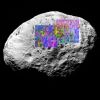
Hyperion-PIA09214.jpgWhat's all over Hyperion? (context image)65 visiteCaption NASA:"Hyperion, the eighth largest of Saturn's nearly 60 known moons, is covered in craters and landslides. Sprinkled over the icy surface is a thin layer of organic dust, which has somehow been concentrated in the bottoms of some of the craters, forming a reddish/black deposit.
This new color map shows the composition of a portion of Hyperion's surface determined with the Visual and Infrared Mapping Spectrometer aboard the Cassini spacecraft. The new composition map is overlaid onto a previously released Cassini image of Hyperion, taken with the Imaging Science Subsystem.
(...) Discovered in 1848, Hyperion held its secrets until the Cassini spacecraft flew close in September 2005, revealing its icy and organic composition.
Hyperion is irregular in shape, tumbles chaotically, and takes 21 days to orbit Saturn. It is 300 Km (about 180 miles) in its longest dimension".MareKromium
|
|

Saturn-PIA08982.jpgIn the Night...65 visiteCaption NASA:"Graceful giant Saturn poses with a few of the small Worlds it holds close. From this viewpoint the Cassini Spacecraft can see across the entirety of the Planet's shadow on the Rings, to where the Ring-Plane emerges once again into Sunlight.
Tethys shines large and bright near the bottom of the scene. Pandora sits outside the F-Ring, below center. Epimetheus is a speck on the far side of the Ring-Plane, immediately to the right of Saturn's limb. Most of the other bright specks near the Rings are background stars.
This view looks toward the unilluminated side of the Rings from about 8° above the Ring-Plane. The image has been brightened to enhance the appearance of the small moons.
The image was taken with the Cassini spacecraft wide-angle camera on June 2, 2007 using a spectral filter sensitive to wavelengths of infrared light centered at 918 nanometers.
The view was obtained at a distance of approx. 2,2 MKM (such as about 1,4 MMs) from Saturn.
Image scale is roughly 131 Km (about miles) per pixel".MareKromium
|
|

Rhea-PIA08986.jpgRhea, in the Saturnshine (natural colors - elab. Lunexit)65 visiteCaption NASA:"The night side of Rhea shines softly in reflected light from Saturn. A similar effect, called Earthshine, can often be seen dimly illuminating the dark side Earth's Moon.
Background stars make short, dim trails across the black sky. The sunlit terrain on Rhea is so much brighter than the part lit by Saturn that the former is completely overexposed in this view, which took more than 30" to acquire.
This view looks toward the Leading Hemisphere on Rhea. North is up and rotated 28° to the left.
The image was taken in visible light with the Cassini spacecraft narrow-angle camera on June 11, 2007. The view was obtained at a distance of approx. 364.000 Km (such as about 226.000 miles) from Rhea and at a Sun-Rhea-spacecraft, or phase, angle of 154°. Image scale is roughly 4 Km (about 3 miles) per pixel".MareKromium
|
|
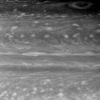
Saturn-PIA09778.jpgMonitoring the Maelstrom65 visiteCaption NASA:"Clouds and vortices churn in this beautiful, close-up view of Saturn. This image is part of a series of important Cassini observations designed to provide information about winds and convection on Saturn.
The view is centered on a Region 44° North of Saturn 's Equator.
The image was taken with the Cassini spacecraft narrow-angle camera on Nov. 7, 2007 using a spectral filter sensitive to wavelengths of infrared light centered at 750 nanometers. The view was acquired at a distance of approx. 2,9 MKM (such as about 1,8 MMs) from Saturn.
Image scale is roughly 17 Km (11 miles) per pixel".MareKromium
|
|
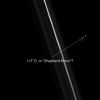
The_Rings-N00124204.jpgAnother UFO in the Space of Saturn?65 visiteCaption NASA:"N00124204.jpg was taken on November 16, 2008 and received on Earth November 17, 2008. The camera was pointing toward SATURN-RINGS that, at the time, were approx. 383.855 Km away, and the image was taken using the CL1 and CL2 filters. This image has not been validated or calibrated". MareKromium
|
|

Saturn-PIA11473.jpgThe Northern Region of Saturn (Natural Colors; credits: NASA/JPL/Space Science Institute)65 visiteCaption NASA:"Saturn's Northern Hemisphere is seen here against its nested Rings.
This view from the Cassini Spacecraft looks toward the unilluminated side of the Rings from about 30° above the Ring-Plane. The rings have been brightened relative to the Planet to enhance visibility.
Images taken using red, green and blue spectral filters were combined to create this Natural Color view.
The images were acquired with the Cassini Spacecraft wide-angle camera on Feb. 24, 2009 at a distance of approx. 866.000 Km (about 538.000 miles) from Saturn.
Image scale is roughly 38 Km (about 24 miles) per pixel".MareKromium
|
|
Enceladus-N00145360-N00145369.gifChange of Trajectory? (GIF-Movie; credits: Dr G. Barca)65 visiteUno spettacolo al quale siamo (si fa per dire) "abituati": le Fontane di Encelado. Ed ancora una volta, mentre le Fontane disegnano lampi ed archi di luce nello Spazio circum-Saturniano, un oggetto non identificato sfreccia davanti alle fotocamere di CASSINI.
La peculiarità? E' nel fatto che l'oggetto luminoso SEMBRA effettuare un leggero - ma visibile! - cambio di traiettoria proprio mentre passa davanti agli occhi elettronici dell'Orbiter.
Che dire? Il "traffico", dalle parti di Saturno, è veramente intenso... Grandissimi Complimenti e Ringraziamenti al Dr Barca per l'ennesimo - splendido - Lavoro.MareKromium
|
|

The_Sky_of_Saturn-4256690919_1c0b492298_o.gifIn the Sky of Saturn (GIF-Movie; credits: Dr M. Faccin)65 visitenessun commentoMareKromium
|
|

Moons-EB.gifKnown and Unknown Saturnian Moons' Carousel... (GIF-Movie; credits: Elisabetta Bonora - Lunexit Team)65 visitenessun commentoMareKromium
|
|

Dione-N160934-48-EB-LXTT.jpgDione (an Image-Mosaic in RAW Natural Colors by Elisabetta Bonora - Lunexit Team)65 visitenessun commentoMareKromium
|
|
| 2245 immagini su 188 pagina(e) |
 |
|
|
|
|
38 | |
|
|
|
|





