| Piú viste - Saturn: the "Ringed Beauty" and His Moons |

Enceladus-N00028182.jpgEnceladus: from VERY close! (2)66 visiteIn questa seconda immagine del Fly-by della Sonda Cassini su Encelado possiamo vedere, sul lato Sx del frame, a ridosso di un grande crepaccio che descrive un ampio arco di circonferenza (ed in apertissima contrapposizione rispetto al panorama che invece caratterizza il lato Dx dell'immagine: cioè un'area della superficie Enceladiana TOTALMENTE ricoperta da solchi, canali e crepacci), un vero e proprio "crater cluster", ossìa un "ammasso di crateri".
Questo 'crater cluster' costituisce la prova indelebile (o quasi...) di un'intensa e ravvicinata attività di bombardamento meteorico la quale ebbe ad interessare Encelado in epoche (molto probabilmente) assai remote.
|
|

Japetus-A-W-Deathstar-16a.jpgThe "Pentagon" of Japetus66 visiteAl momento dell'impatto, la superficie di Giapeto (o della Luna, o di qualsiasi altro pianeta) si fonde, in ragione del calore viene sprigionato in quei momenti e la meteora, letteralmente, compie una sorta di 'splash-down' nel "corpo" del pianeta colpito (guardate cosa succede quando una goccia d'acqua cade nell'acqua...). La crosta fusa che viene proiettata verso l'alto a seguito dell'urto, viste le temperature del "deep space", solidifica in pochissimo tempo e così, quello che rimane dopo l'impatto, è una "colonna di roccia", tanto più alta quanto maggiore fu il quantitativo di crosta fusa che venne sollevato. Teoria credibile? Forse si e forse no, ma questo è l'approccio scientifico al problema! Continuiamo: guardate questo gigantesco rilievo montuoso posto a ridosso dell'equatore di Giapeto. Esso è fatto di colline, montagne, crateri e crepacci. Tutti rilievi naturali, eppure...Eppure non sembra che esso disegni un pentagono? E' anche questo un rilievo naturale e scientificamente spiegabile?
|
|
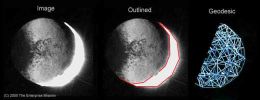
Japetus-A-W-Deathstar-23a.jpgWhat is the "real shape" of Japetus?66 visiteEcco il punto: tutte (o quasi tutte) le Singolarità che troviamo su Giapeto, sono "convenzionalmente spiegabili"! E' evidente che poi qualcuno crederà (istintivamente) alla loro spiegazione convenzionale e qualcun altro, invece, propenderà per la natura artificiale di queste strutture: fa parte del "gioco"... Ma ciò che noi pensiamo è che è proprio il QUANTITATIVO di Singolarità e NON la singola (e magari eclatante) Anomalia a fare la differenza! Noi non condividiamo l'approccio impiegato dal Prof. Hoagland perchè Lui ricollega immediatamente ogni Singolarità all'esistenza di una "struttura artificiale" la quale, a sua volta, si inserisce in un tessuto uniforme, coerente e stratificato di Anomalie di Superficie le quali, impiegando questa chiave di lettura, diventano le "erose vestigia" di una (per nulla) evidente Civiltà estinta.
Ebbene noi diciamo "NO": secondo noi questo modo di ragionare è errato in termini di principio! Giapeto è una luna "anomala", in tutto e per tutto, e ne prendiamo atto.
|
|

The Rings-PIA06195.jpgGravitational Anomalies and Interferences in the Rings66 visiteCaption NASA originale:"Image A displays an unusual mottled-looking narrow region, with a radial width varying with longitude from 5 to 10 Km, seen for the first time about 60 Km inside the outer edge of Saturn's A-Ring.
Image B is a close-up of this region, mapped into a longitude-radius system and contrast enhanced, that is characterized by blotchy light and dark areas about 30/40 Km in longitudinal extent.
The mottled regions also are probably caused by particle clumping brought about by gravitational disturbances. The outer A-Ring edge is sculpted into a 7-lobed pattern called a Lindblad resonance (a type of dynamical resonance that occurs in rings systems) with the co-orbital satellites Janus and Epimetheus. The resonant perturbations in this region are complicated by the presence of these 2 moons whose orbits are within 50 Km of each other.
Image C is a dark-side image of the outer edge of the Encke gap, with a resolution of about 270 meters per pixel".
|
|

Enceladus-N00030070.jpgEnceladus, from approx. 22.500 Km : a controversial "crack"66 visiteNon ci vogliono "occhi da geologo" o grandi esperienze nella classificazione dei rilievi superficiali dei corpi celesti esterni per capire che il crack che attraversa tutta l'immagine presenta della caratteristiche assolutamente peculiari ed anomale. Esso sembra avere inizio dal margine di un piccolo cratere da impatto (che vedete in basso, a ridosso del bordo inferiore del frame) e poi si prolunga per centinaia di Km, seguendo quasi una linea retta ed aumentando le proprie dimensioni per poi, improvvisamente, dopo aver costeggiato un grande cratere da impatto, dividersi in due cracks più piccoli e tortuosi (parte alta dell'immagine).
Si tratta di un crack "giovane", senza dubbio, e molto diverso da quelli che caratterizzano la maggior parte di questa piccola luna.
|
|

Rhea~0.jpgRhea (false colors)66 visiteCaption NASA originale:"This false-color picture of Saturn's moon Rhea from Cassini enhances slight differences in natural color across the moon's face. The extreme north and south latitudes have a notable difference in hue compared to the mid-latitudes.
This view of Rhea is a composite of images taken using filters sensitive to green (centered at 568 nnmts) and infrared light (2 infrared filters, centered at 752 and 930 nnmts) and has been processed to accentuate subtle color differences.
The image was taken with the Cassini spacecraft narrow angle-camera on Feb. 18, 2005, at a distance of approximately 890.000 Km from Rhea and at a Sun-Rhea-spacecraft phase angle of 116°. The image scale is 5 Km per pixel".
|
|

Mimas-N00037684.jpgMimas, from approx. 63.000 Km66 visitenessun commento
|
|

Tethys-PIA07662.jpgGrand Canyon on Tethys66 visiteA crescent Tethys shows off its Grand Canyon, Ithaca Chasma, for which the moon is renowned. The chasm is about 100 Km (app.x 60 miles) across on average, and its up to 4 Km (about 2 miles) deep in places.
Ithaca Chasma is the most prominent sign of ancient geologic activity on Tethys, whose surface is characterized principally by heavy cratering.
The lit surface visible here is on the moon's Saturn-facing Hemisphere. North on Tethys is straight up.
The image was taken with the Cassini spacecraft narrow-angle camera on Nov. 28, 2005 using a filter sensitive to wavelengths of infrared light centered at 930 nnmts. The view was acquired from a distance of app.x 1,1 MKM (equivalento to about 700.000 miles) from Tethys and at a phase angle of 123°. Resolution in the original image was 6 Km (about 4 miles) per pixel. The image has been magnified by a factor of two and contrast-enhanced to aid visibility.
|
|

Enygma-W00012880.jpgEnygma (4)66 visiteOriginal caption:"W00012880.jpg was taken on January 05, 2006 and received on Earth January 06, 2006. The camera was pointing toward SKY, and the image was taken using the CB2 and CL2 filters. This image has not been validated or calibrated".
|
|
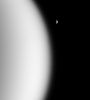
Rhea and Titan-PIA08204-br500.jpgOff the "smog"...66 visiteDuring a recent flyby of Titan, the Cassini spacecraft looked beyond the utterly overcast moon and spied clear, distant Rhea in the blackness.
Titan (5,150 kilometers, or 3,200 miles across) is two-and-a-half times smaller than Earth and much less massive. This circumstance causes its atmosphere to extend to much higher altitudes above the surface than does Earth's. The Cassini spacecraft is unable to fly much closer than about 1000 kilometers (600 miles) above Titan's surface -- much closer, and the spacecraft would experience excessive torques from the atmosphere that could interfere with its ability to track the target. By contrast, the International Space Station orbits Earth at an altitude of about 350 kilometers (220 miles).
The bright, fresh crater on Rhea (1,528 kilometers, or 949 miles across) appears near the center of the moon's crescent.
The image was taken in visible-light with the Cassini spacecraft wide-angle camera on May 20, 2006, at a distance of approximately 53,000 kilometers (33,000 miles) from Titan and 873,000 kilometers (543,000 miles) from Rhea. Image scale is 320 meters (1,050 feet) per pixel on Titan and 5 kilometers (3 miles) per pixel on Rhea.
|
|

Saturn-W00018107.jpgDust and other particles in the E-Ring Space (1)66 visitenessun commento
|
|
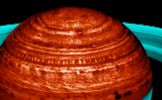
Saturn-PIA01941.jpgInfrared Saturn66 visiteIn this image, Saturn's fascinating meteorology manifests itself in a "string of pearls" formation, spanning over 60.000 Km (about 37.000 miles). Seen in new images acquired by Cassini's VIMS (Visual and Infrared Mapping Spectrometer) and lit from below by Saturn's internal thermal glow, the bright "pearls" are actually clearings in Saturn's deep cloud system. More than two dozen occur at 40° North Latitude. Each clearing follows another at a regular spacing of some 3,5° in Longitude.
This is the first time such a regular and extensive train of cloud-clearings has been observed. The regularity indicates that they may be a manifestation of a large planetary wave. Scientists plan to take more observations of this phenomenon over the next few years to try to understand Saturn's deep circulation systems and meteorology. This image was taken on April 27, 2006.
|
|
| 2245 immagini su 188 pagina(e) |
 |
|
|
|
|
36 | |
|
|
|
|





