| Piú viste - Saturn: the "Ringed Beauty" and His Moons |

Saturn-PIA14119.jpgLarge Ammonia Crystals in Saturn Storm (False Colors; credits: NASA/JPL-University of Arizona)68 visiteCaption NASA:"This false-color InfraRed image, obtained by NASA's Cassini Spacecraft, shows clouds of large Ammonia ice particles dredged up by a powerful storm in Saturn's Northern Hemisphere. Large updrafts dragged Ammonia gas upward more than 30 miles (approx. 50 Km) from below. The Ammonia then condensed into large crystals in the frigid Upper Atmosphere. This storm is the most violent ever observed at Saturn by an orbiting Spacecraft.
Cassini's Visual and InfraRed Mapping Spectrometer obtained these images on Feb. 24, 2011. Scientists colorized the image by assigning red to brightness detected from the 4.08-micron wavelength, green to brightness from the 0.90-micron wavelength, and blue to brightness from the 2.73-micron wavelength. Large particles (red) reflect Sunlight well at 4.08 microns. Particles at high altitude (green) reflect Sunlight well at 0.9 microns. Particles comprised of Ammonia -- especially large ones -- do not reflect 2.73-micron sunlight well, but instead absorb light at this wavelength.
The storm here shows up as yellow, demonstrating that it has a large signal in both red and green colors. This indicates the cloud has large particles and extends upward to relatively high altitude. In addition, the lack of blue in the feature indicates that the storm cloud has a substantial component of Ammonia Crystals. The head of the storm is particularly rich in such particles, as created by powerful updrafts of Ammonia gas from depth in the throes of Saturn's thunderstorm".MareKromium
|
|

Saturn-PIA12824.jpgSaturnian Storm (Natural Colors; credits: NASA/JPL-Caltech/Space Science Institute)68 visiteCaption NASA:"The huge storm churning through the Atmosphere in Saturn's Northern Hemisphere overtakes itself as it encircles the Planet in this Natural Colors view from NASA's Cassini Spacecraft.
This picture, captured on Feb. 25, 2011, was taken about 12 weeks after the storm began, and the clouds by this time had formed a tail that wrapped around the Planet. Some of the clouds moved south and got caught up in a current that flows to the East (to the right) relative to the storm head. This tail, which appears as slightly blue clouds South and West (left) of the storm head, can be seen encountering the storm head in this view.
This storm is the largest, most intense storm observed on Saturn by NASA's Voyager or Cassini Spacecraft. It is still active today. As scientists have tracked this storm over several months, they have found it covers 500 times the area of the largest of the Southern Hemisphere storms observed earlier in the Cassini Mission (see PIA06197).
The shadow cast by Saturn's Rings has a strong seasonal effect, and it is possible that the switch to powerful storms now being located in the Northern Hemisphere is related to the change of seasons after the Planet's August 2009 Equinox.
Huge storms called Great White Spots have been observed in previous Saturnian years (each of which is about 30 Earth years), usually appearing in late Northern Summer. Saturn is now experiencing early Northern Spring, so this storm, if it is a Great White Spot, is happening earlier than usual. This storm is about as large as the largest of the Great White Spots, which also encircled the planet but had latitudinal sizes ranging up to approx. 20.000 Km (roughly 12.000 miles). The Voyager and Cassini Spacecrafts were not at Saturn for previous Great White Spot appearances.
The storm is a prodigious source of radio noise, which comes from lightning deep in the Planet's Atmosphere. The lightning is produced in the water clouds, where falling rain and hail generate electricity. The mystery is why Saturn stores energy for decades and releases it all at once. This behavior is unlike that at Jupiter and Earth, which have numerous storms going on at all times.
This view looks toward the sunlit side of the Rings from just above the Ring-Plane. Images taken using red, green and blue spectral filters were combined to create this Natural Color view. The images were acquired with the Cassini Spacecraft wide-angle camera at a distance of approx. 1,4 MMs (such as about 2,2 MKM) from Saturn. Image scale is roughly 80 miles (128,7472 Km) per pixel".MareKromium
|
|

Tethys-PIA06526_modest.jpgTethys and the South Pole of Saturn67 visiteCaption NASA originale:"This dazzling view looks beyond gigantic storms near Saturn's South Pole to the small but clear disc of Tethys (1.060 Km across). Clouds and ribbons of gas swirl about in the planet's atmosphere in the foreground, while a tremendous chasm is visible on the icy moon. The image was taken with the Cassini spacecraft narrow angle camera on Oct. 18, 2004, at a distance of about 3.9 MKMs from Saturn and at a Sun-Saturn-spacecraft, or phase, angle of 61°. The view is in wavelengths of visible red light centered at 619 nanometers. The image scale is 23 Km per pixel".
|
|

Dione-PIA07748.jpgThe surface of Dione from about 4486 Km67 visiteThe terrain in this image is located within a 60-Km-wide impact crater along the feature called Padua Linea. The western rim of the encompassing crater runs from the middle left to the upper right. The crater's central peak can be seen at the lower right. Multiple generations of fractures are visible here. Numerous fine, roughly parallel linear grooves run across the terrain from top to bottom and are interrupted by the larger, irregular bright fractures. In several places, fractures postdate some deposits in the bottoms of craters that are not badly degraded by time. Such a fracture, for example, runs from the center toward the upper right. Most of the craters seen here have bright walls and dark deposits of material on their floors. As on other Saturnian moons, rockslides on Dione may reveal cleaner ice, while the darker materials accumulate in areas of lower topography and lower slope (e.g. crater floors and the bases of scarps). This view is centered on terrain near 11° South lat. and 238° West long.
|
|

Japetus-N00042823.jpgApproaching Japetus67 visiteOriginal caption:"N00042823.jpg was taken on November 08, 2005 and received on Earth November 09, 2005. The camera was pointing toward IAPETUS at approx. 774,151 Km away, and the image was taken using the CL1 and IR3 filters".
|
|

Atlas from Voyager2.jpgAtlas, from Voyager 2 (extra detail mgnf)67 visiteUn buon super detail-mgnf per evidenziare la forma (curiosa) della mini-luna Saturniana Atlas, sino ad ora mai ripresa in maniera soddisfacente dalle Sonde che sono passate (o sono tuttora in transito) nello Spazio di Saturno.
Il frame è stato portato a stretch estremi dal nostro Tecnico delle Immagini ed il risultato è più che decoroso; tuttavia, proprio perchè lo stretch estremo crea o concorre nella creazione di anomalìe ed artefatti, non commentiamo i dettagli "strani" che questo frame ora pare evidenziare.
O meglio: li commenteremo se anche Voi li vedrete e chi chiederete conto di essi...
|
|

Anthe-PIA11100.jpgThe "Anthe Arc"67 visiteCaption NASA:"Caption NASA:"Cassini images reveal the existence of a faint "Arc of material" orbiting with Saturn's small moon Anthe.
The moon is moving downward and to the right in this perspective. In this image, most of the visible material in the Arc lies ahead of Anthe (2 Km, or a little more than 1 mile across) in its orbit. However, over time the moon drifts slowly back and forth with respect to the Arc.
The Arc extends over about 20° in Longitude (about 5,5% of Anthe's orbit) and appears to be associated with a gravitational resonance caused by the moon Mimas). Micrometeoroid impacts on Anthe are the likely source of the Arc material.
The orbit of Anthe lies between the larger moons Mimas and Enceladus. Anthe shares this region with two other small moons, Pallene (4 Km, or about 3 miles across) and Methone (3 Km, or approx. 2 miles across).
Methone also possesses an Arc (see PIA11102), while Pallene is known to orbit within a faint, complete ring of its own (see PIA08328).
Cassini imaging scientists believe the process that maintains the Anthe and Methone Arcs is similar to that which maintains the Arc in the G-Ring (see PIA08327). The general brightness of the image (along with the faint horizontal banding pattern) results from the long exposure time of 32" required to capture the extremely faint ring arc and the processing needed to enhance its visibility (which also enhances the digital background noise in the image). The image was digitally processed to remove most of the background noise. The long exposure also produced star trails in the background.
The image was taken in visible light with the Cassini Spacecraft narrow-angle camera on April 4, 2008. The view was acquired at a distance of approx. 1,2 MKM (such as about 746.000 miles) from Anthe and at a Sun-Anthe-Spacecraft Angle of 23°. Image scale is roughly 7 Km (about 4 miles) per pixel".MareKromium
|
|

Enceladus-PIA11125.jpgDamascus Sulcus67 visiteCaption NASA:"This Cassini image was the eight 'skeet shoot' narrow-angle image captured during the October 31, 2008, flyby of Saturn's moon Enceladus.
The source region for jets II and III (see PIA08385) has been identified. The image was taken with the Cassini Spacecraft narrow-angle camera on Oct. 31, 2008, at a distance of approximately 5568 Km (about 3480 miles) from Enceladus and at a Sun-Enceladus-Spacecraft, or Phase, Angle of 75°.
Image scale is roughly 33 meters (108 feet) per pixel".MareKromium
|
|

The_Rings-PIA10525.jpgSpokes in the "B-Ring" (possible True Colors; credits: Lunar Explorer Italia)67 visiteCaption NASA:"Broad, dark spokes in the B-Ring are clearly seen in this image of Saturn's Rings. The spokes are finally becoming quite common, as they were during the Voyager flybys. These observations and others like it seem to support the idea that the spokes become most prominent near the Saturnian Equinox. Also visible in this image is the moon Janus off beyond the Rings.
The image was taken in visible light with the Cassini Spacecraft wide-angle camera on Oct. 19, 2008 at a distance of approx. 1,1 MKM (such as about 628.000 miles) from Saturn and at a Phase Angle of 29°.
Image scale is roughly 57 Km (about 35 miles) per pixel".MareKromium
|
|

The_Rings-PIA11142.jpgSaturn's Rings: the whole System67 visitenessun commentoMareKromium
|
|
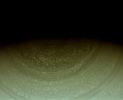
Saturn-PIA10568.jpgNorth Polar Hues (possible Natural Colors; credits: Lunar Explorer Italia)67 visiteCpation NASA:"Cassini imaging scientists have waited years for the Sun to reveal the Hexagonal Wave Pattern (a.k.a.: The Hexagon) in the clouds of Saturn's North Pole, part of which can be seen at the top of this image from the Cassini Spacecraft. This mosaic combines four separate near-InfraRed images to show one full side of the Hexagon and two partial sides cut off by shadow.
When the Spacecraft arrived in 2004, Winter darkened the North Pole. As the Planet continues its 29-year orbit, the Sun sheds more light on northern features and uncovers more of this strange, long-lived formation first observed in Voyager images of the illuminated Northern Pole from the early 1980's.
False color images made from data collected by Cassini's Visual and InfraRed Mapping Spectrometer (VIMS) have previously captured the full six-sided pattern in the IR Light. (See PIA09188)
South of the Hexagon at least five large storm systems can be seen spinning in a sea of smaller storms.
The image was taken with the Cassini Spacecraft wide-angle camera on Dec. 1, 2008 using a spectral filter sensitive to wavelengths of near-iIR Light centered at 752 nanometers. The view was obtained at a distance of approx. 712.000 kilometers (442,000 miles) from Saturn and at a Sun-Saturn-spacecraft, or phase, angle of 69 degrees. Image scale is 39 Km (such as about 24 miles) per pixel".MareKromium
|
|

Prometheus-PIA10593.jpgStreamer Channel (Natural Colors; credits: Lunar Explorer Italia)67 visiteCaption NASA:"Half an hour after Prometheus tore into this region of Saturn's F -Ring, the Cassini Spacecraft snapped this image just as the moon was creating a new Streamer in the Ring. The dark pattern shaped like an upside down check mark in the lower left of the image is Prometheus and its shadow.
The potato shaped moon can just be seen coming back out of the Ring. The moon's handiwork also is apparent in 2 previous Streamer-Channel formations on the right of the image. The darkest Streamer-Channel stretching from the top right to the center of the image shows Prometheus' previous apoapse passage about 15 hours earlier. A fainter, even earlier channel extends to the edge of the image.
Prometheus (about 86 Km, or approx. 53 miles across) dips into the inner edge of the F-Ring when it reaches apoapse, the moon's farthest orbital point from Saturn. At apoapse, the moon's gravity pulls particles of the ring outward into a streamer.
As Prometheus moves onward toward periapse — its orbit's closest point to the Planet — the Streamer gets longer. Then, as Prometheus moves back toward apoapse, the Streamer breaks apart which results in a dark channel.
This Streamer-Channel cycle repeats once every orbit with the Streamer-Channel features being streamers during Prometheus periapse and channels during Prometheus apoapse. The F-Ring is overexposed in this image which has been brightened to reveal the moon.
This view looks toward the unilluminated side of the Rings from about 18° above the Ring-Plane. The image was taken in Visible Light with the Cassini Spacecraft narrow-angle camera on Jan. 14, 2009.
The view was obtained at a distance of approx. 555.000 Km (345.000 miles) from Saturn and at a Sun-Saturn-Spacecraft, or Phase, Angle of 145°.
Image scale is roughly 3 Km (a little less than 2 miles) per pixel".MareKromium
|
|
| 2245 immagini su 188 pagina(e) |
 |
|
|
|
|
34 | |
|
|
|
|





