| Piú viste - Saturn: the "Ringed Beauty" and His Moons |

Japetus-N00042823.jpgApproaching Japetus69 visiteOriginal caption:"N00042823.jpg was taken on November 08, 2005 and received on Earth November 09, 2005. The camera was pointing toward IAPETUS at approx. 774,151 Km away, and the image was taken using the CL1 and IR3 filters".
|
|

The_Rings-PIA10525.jpgSpokes in the "B-Ring" (possible True Colors; credits: Lunar Explorer Italia)69 visiteCaption NASA:"Broad, dark spokes in the B-Ring are clearly seen in this image of Saturn's Rings. The spokes are finally becoming quite common, as they were during the Voyager flybys. These observations and others like it seem to support the idea that the spokes become most prominent near the Saturnian Equinox. Also visible in this image is the moon Janus off beyond the Rings.
The image was taken in visible light with the Cassini Spacecraft wide-angle camera on Oct. 19, 2008 at a distance of approx. 1,1 MKM (such as about 628.000 miles) from Saturn and at a Phase Angle of 29°.
Image scale is roughly 57 Km (about 35 miles) per pixel".MareKromium
|
|
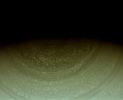
Saturn-PIA10568.jpgNorth Polar Hues (possible Natural Colors; credits: Lunar Explorer Italia)69 visiteCpation NASA:"Cassini imaging scientists have waited years for the Sun to reveal the Hexagonal Wave Pattern (a.k.a.: The Hexagon) in the clouds of Saturn's North Pole, part of which can be seen at the top of this image from the Cassini Spacecraft. This mosaic combines four separate near-InfraRed images to show one full side of the Hexagon and two partial sides cut off by shadow.
When the Spacecraft arrived in 2004, Winter darkened the North Pole. As the Planet continues its 29-year orbit, the Sun sheds more light on northern features and uncovers more of this strange, long-lived formation first observed in Voyager images of the illuminated Northern Pole from the early 1980's.
False color images made from data collected by Cassini's Visual and InfraRed Mapping Spectrometer (VIMS) have previously captured the full six-sided pattern in the IR Light. (See PIA09188)
South of the Hexagon at least five large storm systems can be seen spinning in a sea of smaller storms.
The image was taken with the Cassini Spacecraft wide-angle camera on Dec. 1, 2008 using a spectral filter sensitive to wavelengths of near-iIR Light centered at 752 nanometers. The view was obtained at a distance of approx. 712.000 kilometers (442,000 miles) from Saturn and at a Sun-Saturn-spacecraft, or phase, angle of 69 degrees. Image scale is 39 Km (such as about 24 miles) per pixel".MareKromium
|
|
Enceladus-N00145360-N00145369.gifChange of Trajectory? (GIF-Movie; credits: Dr G. Barca)69 visiteUno spettacolo al quale siamo (si fa per dire) "abituati": le Fontane di Encelado. Ed ancora una volta, mentre le Fontane disegnano lampi ed archi di luce nello Spazio circum-Saturniano, un oggetto non identificato sfreccia davanti alle fotocamere di CASSINI.
La peculiarità? E' nel fatto che l'oggetto luminoso SEMBRA effettuare un leggero - ma visibile! - cambio di traiettoria proprio mentre passa davanti agli occhi elettronici dell'Orbiter.
Che dire? Il "traffico", dalle parti di Saturno, è veramente intenso... Grandissimi Complimenti e Ringraziamenti al Dr Barca per l'ennesimo - splendido - Lavoro.MareKromium
|
|

SaturnianAurora-PIA11681.jpgSaturnian Aurora69 visitenessun commentoMareKromium
|
|

Japetus-EB.gifJapetus, like a "True Star"! (GIF-Movie; credits: Elisabetta Bonora - Lunexit Team)69 visitenessun commentoMareKromium
|
|

Saturn-PIA14119.jpgLarge Ammonia Crystals in Saturn Storm (False Colors; credits: NASA/JPL-University of Arizona)69 visiteCaption NASA:"This false-color InfraRed image, obtained by NASA's Cassini Spacecraft, shows clouds of large Ammonia ice particles dredged up by a powerful storm in Saturn's Northern Hemisphere. Large updrafts dragged Ammonia gas upward more than 30 miles (approx. 50 Km) from below. The Ammonia then condensed into large crystals in the frigid Upper Atmosphere. This storm is the most violent ever observed at Saturn by an orbiting Spacecraft.
Cassini's Visual and InfraRed Mapping Spectrometer obtained these images on Feb. 24, 2011. Scientists colorized the image by assigning red to brightness detected from the 4.08-micron wavelength, green to brightness from the 0.90-micron wavelength, and blue to brightness from the 2.73-micron wavelength. Large particles (red) reflect Sunlight well at 4.08 microns. Particles at high altitude (green) reflect Sunlight well at 0.9 microns. Particles comprised of Ammonia -- especially large ones -- do not reflect 2.73-micron sunlight well, but instead absorb light at this wavelength.
The storm here shows up as yellow, demonstrating that it has a large signal in both red and green colors. This indicates the cloud has large particles and extends upward to relatively high altitude. In addition, the lack of blue in the feature indicates that the storm cloud has a substantial component of Ammonia Crystals. The head of the storm is particularly rich in such particles, as created by powerful updrafts of Ammonia gas from depth in the throes of Saturn's thunderstorm".MareKromium
|
|

Saturn-PIA12825.jpgSaturnian Storm (False Colors; credits: NASA/JPL-Caltech/Space Science Institute)69 visiteCaption NASA:"These false-color images from NASA's Cassini Spacecraft chronicle a day in the life of a huge storm that developed from a small spot that appeared 12 weeks earlier in Saturn's Northern Mid-Latitudes.
This storm is the largest and most intense observed on Saturn by NASA's Voyager or Cassini Spacecraft. The storm is still active. As seen in these and other Cassini images, the storm encircles the Planet - whose circumference at these latitudes is approx. 186.000 miles (about 300.000 Km).
From North to South, it covers a distance of about 9000 miles (approx. 15.000 Km), which is one-third of the way around the Earth. It encompasses an area of about 1,5 BSMs (Billion Square Miles - such as approx. 4 BSKM), or eight times the surface area of Earth. This storm is about 500 times the area of the biggest of the Southern Hemisphere storms observed by Cassini.
The highest clouds in the image are probably around 100 millibars pressure, or 60 miles (approx. 100 Km) above the regular undisturbed clouds. These false colors show clouds at different altitudes. Clouds that appear blue here are the highest and are semitransparent, or optically thin. Those that are yellow and white are optically thick clouds at high altitudes. Those shown green are intermediate clouds. Red and brown colors are clouds at low altitude unobscured by high clouds, and the deep blue color is a thin haze with no clouds below. The base of the clouds, where lightning is generated, is probably in the water cloud layer of Saturn's Atmosphere. The storm clouds are likely made out of Water Ice covered by crystallized Ammonia.
Taken about 11 hours -- or one Saturn day -- apart, the two mosaics in the lower half of this image product consist of 84 images each. The mosaic in the middle was taken earlier than the mosaic at the bottom. Both mosaics were captured on Feb. 26, 2011, and each of the two batches of images was taken over about 4,5 hours.
Two enlargements from the earlier, middle mosaic are shown at the top of this product. The white lines below the middle mosaic identify those parts of the mosaic that were enlarged for these close-up views. The enlargement on the top left shows the head of the storm, and that on the top right shows the turbulent middle of the storm. Cassini observations have shown the head of the storm drifting West at a rate of about 2,8° of Longitude each Earth day (28 meters per second, or 63 miles per hour). The central latitude of the storm is the site of a Westward jet, which means that the clouds to the North and South are drifting Westward more slowly or even drifting eastward. In contrast, clouds at Saturn's Equator drift Eastward at speeds up to 450 meters per second (about 1000 miles per hour).
Both of the long mosaics cover an area ranging from about 30° to 51° North Latitude. The views stretch from about 138° (on the left) to 347° West Longitude (on the right), passing through 360/0° West Longitude near the far right of the mosaics.
The images were taken with the Cassini Spacecraft narrow-angle camera using a combination of spectral filters sensitive to wavelengths of Near-InfraRed light. The images filtered at 889 nanometers are projected as blue. The images filtered at 727 nanometers are projected as green, and images filtered at 750 nanometers are projected as red.
The views were acquired at a distance of approx. 1,5 MMs (such as about 2,4 MKM) from Saturn and at a Sun-Saturn-Spacecraft Angle (i.e.: Phase Angle) of 62°. Both the top and bottom images are simple cylindrical map projections, defined such that a square pixel subtends equal intervals of Latitude and Longitude. At higher Latitudes, the pixel size in the North-South direction remains the same, but the pixel size in the East-West direction becomes smaller. The pixel size is set at the Equator, where the distances along the sides are equal. The images of the long mosaics have a pixel size of 33 miles (53,108 Km) at the Equator, and the two close-up views have a pixel size of 6 miles (9,656 Km) per pixel at the equator".MareKromium
|
|

Saturn-PIA12824.jpgSaturnian Storm (Natural Colors; credits: NASA/JPL-Caltech/Space Science Institute)69 visiteCaption NASA:"The huge storm churning through the Atmosphere in Saturn's Northern Hemisphere overtakes itself as it encircles the Planet in this Natural Colors view from NASA's Cassini Spacecraft.
This picture, captured on Feb. 25, 2011, was taken about 12 weeks after the storm began, and the clouds by this time had formed a tail that wrapped around the Planet. Some of the clouds moved south and got caught up in a current that flows to the East (to the right) relative to the storm head. This tail, which appears as slightly blue clouds South and West (left) of the storm head, can be seen encountering the storm head in this view.
This storm is the largest, most intense storm observed on Saturn by NASA's Voyager or Cassini Spacecraft. It is still active today. As scientists have tracked this storm over several months, they have found it covers 500 times the area of the largest of the Southern Hemisphere storms observed earlier in the Cassini Mission (see PIA06197).
The shadow cast by Saturn's Rings has a strong seasonal effect, and it is possible that the switch to powerful storms now being located in the Northern Hemisphere is related to the change of seasons after the Planet's August 2009 Equinox.
Huge storms called Great White Spots have been observed in previous Saturnian years (each of which is about 30 Earth years), usually appearing in late Northern Summer. Saturn is now experiencing early Northern Spring, so this storm, if it is a Great White Spot, is happening earlier than usual. This storm is about as large as the largest of the Great White Spots, which also encircled the planet but had latitudinal sizes ranging up to approx. 20.000 Km (roughly 12.000 miles). The Voyager and Cassini Spacecrafts were not at Saturn for previous Great White Spot appearances.
The storm is a prodigious source of radio noise, which comes from lightning deep in the Planet's Atmosphere. The lightning is produced in the water clouds, where falling rain and hail generate electricity. The mystery is why Saturn stores energy for decades and releases it all at once. This behavior is unlike that at Jupiter and Earth, which have numerous storms going on at all times.
This view looks toward the sunlit side of the Rings from just above the Ring-Plane. Images taken using red, green and blue spectral filters were combined to create this Natural Color view. The images were acquired with the Cassini Spacecraft wide-angle camera at a distance of approx. 1,4 MMs (such as about 2,2 MKM) from Saturn. Image scale is roughly 80 miles (128,7472 Km) per pixel".MareKromium
|
|
AH-Before the Streak-N00015684.jpgBefore the "Big Streak"68 visiteE, per completare il riassunto fotografico dell'ennesima (possibile) Anomalia che abbiamo incontrato, eccoVi il frame precedente alla Striscia. L'intera sequenza, per Vostra informazione, si svolge su uno spazio di 911 Km (infatti in questo frame la Sonda Cassini/Huygens si trova a 9.062.781 Km da Saturno; al momento del "contatto" è a 9.062.214 e nel frame dopo a 9.061.870 Km).
|
|

Japetus-PIA06521_modest.jpgThe "dark side" of Japetus68 visiteCaption NASA originale: "This image shows the dark, leading hemisphere of the mysterious moon Iapetus. The dark area is the Cassini region, named for Giovanni Cassini, who discovered the moon in 1672. The diameter of Iapetus is of approx. 1,436 Km (892 miles).
Cassini noted that he was able to see the moon on one side of its orbit around Saturn, but not on the other side. From this, he correctly deduced that one hemisphere must be dark while the other is much brighter".
|
|

Japetus-PIA07003_modest.jpgJapetus' surface composition (organic material?!?)68 visiteCaption NASA originale:"The polar water ice is relatively dark at this wavelength, so the ice cap is not seen. The next frame shows carbon dioxide on the surface. The carbon dioxide peaks at mid latitudes and shows less strength at the pole and along the equator (the dark band curving near the left edge of the image). The third frame shows the strength of water absorption on Japetus. The brightest regions are due to water ice near the pole. The grayer areas indicate water bound to minerals on the surface. The color composite shows water as blue, carbon dioxide as green, and non-ice minerals as red".
|
|
| 2245 immagini su 188 pagina(e) |
 |
|
|
|
|
33 | |
|
|
|
|





