| Piú viste - Saturn: the "Ringed Beauty" and His Moons |

Japetus-Orbit-00.jpgSide view of Japetus's orbit70 visiteThe orbit of Japetus is somewhat unusual. Although it is Saturn's third-largest moon, it orbits much farther from Saturn than the next closest major moon, Titan. It has also the most inclined Orbital Plane of the regular satellites; only the irregular outer satellites like Phoebe have more inclined orbits. The cause of this is unknown.
Because of this distant, inclined orbit, Japetus is the only large moon from which the Rings of Saturn would be clearly visible; from the other inner moons, the Rings would be edge-on and difficult to see.MareKromium
|
|
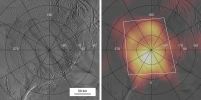
Enceladus-PIA10360.jpgStripes and Heat Map Side-by-Side70 visiteCaption NASA:"Cassini's March 12, 2008, flyby of Enceladus provided the best view yet of the heat radiation from the active South Pole of the satellite. These images summarize what was learned about the South Polar landscapes and heat radiation during the previous close flyby on July 15, 2005.
The left panel shows a map of the South Pole constructed from images taken by the Spacecraft's Imaging System. Four prominent fractures, informally called "Tiger Stripes", cut diagonally across the South Polar Region. In the right-hand panel, a July 2005 map of the south polar heat radiation, obtained by Cassini's Composite Infrared Spectrometer, is superimposed in false color on the visible images.
The observations revealed a prominent warm region centered on the South Pole, appearing yellow and orange in this view, which coincides with the locations of the tiger stripes. However, these data were taken from too far away from Enceladus (about 80.000 Km) to distinguish the fine details of the heat radiation.
The July 2005 flyby also included some scattered close-up snapshots by the Composite Infrared Spectrometer; these showed that the heat radiation was concentrated along the Tiger Stripe fractures, but those snapshots covered only a small fraction of the South Polar Region.
The white lines enclose the area covered by the much more detailed view of the South Pole obtained by the spectrometer during the March 12, 2008, flyby.
Numbers on the map show Latitude and Longitude".MareKromium
|
|

Prometheus-N00128992-a.gifPrometheus: the "Wave-Maker" (GIF-Movie; credits: Dr M. Faccin)70 visitenessun commentoMareKromium
|
|

Pandora-N00154612-13-14-EB-LXTT.jpgApproaching Pandora (an Image-Mosaic by Elisabetta Bonora - Lunexit Team)70 visitenessun commentoMareKromium
|
|

Japetus-PIA12706.jpgJapetus70 visiteCaption NASA:"Some of Japetus' Dark Surface interrupts the moon's lighter Terrain in this Cassini view.
Scientists continue to investigate the nature of this moon's dark and light Surface. Lit Terrain seen here is on the Trailing Hemisphere of Japetus. North on Japetus is up and rotated 10° to the right.
The image was taken in visible light with the Cassini Spacecraft narrow-angle camera on May 9, 2010. The view was acquired at a distance of approx. 1,3 MKM (about 808.000 miles) from Iapetus and at a Phase Angle of 95°.
Image scale is roughly 8 Km (about 5 miles) per pixel".MareKromium
|
|

AG-After the Streak-N00015686.jpgAfter the "Big Streak"69 visitePer una questione di onestà intellettuale e di obbiettività, noi Vi proponiamo anche l'immagine successiva alla "striscia" che ha attratto la nostra attenzione. Adesso si può cogliere, con una certa chiarezza, un riflesso vero e proprio, in basso. Come vedete, l'effetto da esso provocato è diverso da quanto visto in precedenza. Certo, potremmo anche sbagliarci: ma immagini come quella di prima devono (almeno...) farci riflettere!
|
|

Enceladus-N00030123.jpgEnceladus, from approx. 166.000 Km69 visiteIl Fly-By è finito e, purtroppo, le immagini di Encelado da distanza inferiore ai 1000 Km, la NASA non le ha (ancora?) rese disponibili. In attesa, quindi, di vedere i dettagli ravvicinati delle incredibili increspature che segnano la superficie di Encelado, contentiamoci di questa - comunque - bellissima immagine di "arrivederci": una falce bene illuminata (e stupendamente definita) della "Luna di Neve", ossìa il corpo celeste più brillante - sia pure solo di luce riflessa - di tutto quanto il Sistema Solare.
|
|

Saturn-PIA03557.jpgSaturn's pressure69 visiteOriginal NASA caption:"This new view on the right side shows clouds at an altitude where pressure is nearly 2 bars. (nota---->1 bar rappresenta l'unità di misura della pressione atmosferica terrestre esistente al livello del mare). These clouds are about 30 Km underneath the clouds usually observed on Saturn. This is distinctly different from the typical view of Saturn in reflected sunlight, shown on the left.
The left view is characterized by broad expanses of clouds near the 1-bar level, such as the white cloud seen circling the Equator, with little hint of the discrete cloud complexes lying underneath (...)".
|
|

Telesto-PIA07586.jpgTelesto69 visiteCaption originale:"The blob of light seen here is Saturn's moon Telesto, which shares its orbital path with much larger Tethys. Telesto is 24 Km across.
Although this view may hint at a flattened, potato-like shape for Telesto (a common shape for Saturn's smaller moons), no features on the moon's surface can be resolved here.
The image was taken in visible green light with the Cassini spacecraft narrow-angle camera on Aug. 1, 2005, at a distance of approximately 768.000 Km from Telesto and at a Sun-Telesto-spacecraft angle of 37°. Resolution in the original image was 5 Km per pixel. The image has been contrast-enhanced and magnified by a factor of 4 to aid visibility".
|
|

Pandora-N00042197.jpgPandora?69 visiteOriginal caption:"N00042197.jpg was taken on October 29, 2005 and received on Earth October 30, 2005. The camera was pointing toward PANDORA at approximately 455.248 Km away, and the image was taken using the CL1 and IR1 filters. This image has not been validated or calibrated".
|
|

Rhea-N00055757.jpgMoments of Rhea (6)69 visiteCerchiature Bianche: due bizzarri crateri esagonali (quello di Sx sembra un esagono quasi regolare...).
Il Prof. Hoagland, parlando di Giapeto, per un rilievo simile si sbilanciò parlando di "...simmetrie evidenti... - ergo di - ...chiare origini artificiali...".
Tuttavia, sui pentagoni e gli esagoni di Rhea (addirittura - come questi - più regolari e definiti del rilievo Giapetiano) nonchè su alcune (curiose) linee che la attraversano per Km e Km (linee - apparentemente - lisce e dritte come autostrade), Hoagland non ha detto nulla.
Sarà perchè, forse, non se n'è accorto...
|
|
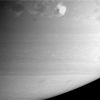
Saturn-PIA08142.jpgSaturnian Super-Storm "Alley"!69 visiteStorm Alley's latest, greatest resident, the recent lightning-producing storm seen by the Cassini spacecraft and Earth-based observers churns away. Turbulent eddies to the West (left) of the storm indicate that it is moving eastward relative to the westward-flowing winds at this latitude on Saturn.
Scientists gave the nickname "Storm Alley" to the area around 35° South Latitude because of the large amount of activity seen there from the beginning of the Cassini spacecraft's approach to Saturn in early 2004. The Region has spawned two large and powerful storms since the Cassini spacecraft began observations.
The image was taken with the Cassini spacecraft narrow-angle camera on Feb. 16, 2006, using a filter sensitive to wavelengths of infrared light centered at 750 nanometers, and at a distance of approx. 3,2 MKM (such as about 2 MMs) from Saturn. The image scale is roughly 19 Km (about 12 miles) per pixel.
|
|
| 2245 immagini su 188 pagina(e) |
 |
|
|
|
|
31 | |
|
|
|
|





