| |

| Piú viste - Saturn: the "Ringed Beauty" and His Moons |

Janus-N00060322.jpgLonely Janus...71 visiteCaption NASA:"N00060322.jpg was taken on April 29, 2006 and received on Earth April 29, 2006. The camera was pointing toward Janus that, at the time, was approximately 225.386 Km away.
The image was taken using the P120 and GRN filters. This image has not been validated or calibrated".
|
|
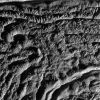
Enceladus-N00118364.jpgThe Unbelievable Surface of Enceladus, from about 2000 Km!71 visiteCaption NASA:"N00118365.jpg was taken on August 11, 2008 and received on Earth August 12, 2008. The camera was pointing toward ENCELADUS that, at the time, was approximately 2628 Km away.
The image was taken using the CL1 and CL2 filters and it has not been validated or calibrated".MareKromium
|
|

The_Rings-N00124200-N00124206.gifAnother UFO in the Space of Saturn? (GIF-Movie; credits: Dr G. Barca)71 visiteQuesto GIF-Movie costituisce una (bella!) risposta del Dr Barca al quesito posto in sede di commento ai frames che potrebbero raffigurare un OVNI che sfreccia nello Spazio di Saturno, a ridosso del suo Anello "F": osservate la traiettoria dell'oggetto.
Essa è palesemente iperbolica (nota: "...in Astrodinamica ed in Meccanica Celeste una Traiettoria Iperbolica è un'orbita con eccentricità maggiore di 1. Sotto le ipotesi standard, un corpo che viaggia lungo una Traiettoria Iperbolica arriverà all'infinito con una Velocità Orbitale (detta anche Velocità d'Eccesso Iperbolica, Eccesso Iperbolico o Terza Velocità Cosmica), rispetto al Corpo Centrale, non nulla (ricorda: la Velocità Orbitale di un Corpo Celeste, generalmente un pianeta, un satellite naturale, un satellite artificiale o una stella parte di un sistema multiplo, è la velocità con cui esso orbita attorno al Baricentro del Sistema - ed in genere attorno ad un corpo con massa maggiore. Il termine può riferirsi sia alla Velocità Orbitale Media (misurata su un'intera orbita), sia alla Velocità Istantanea in un certo punto dell'orbita).
Analogamente alle Traiettorie Paraboliche, quelle Iperboliche sono Orbite di Fuga e l'energia specifica di una Traiettoria Iperbolica è positiva...") e quindi - come ben spiegato dalla definizione estrapolata da Wikipedia - del tutto incoerente rispetto alle orbite e traiettorie (dette "Stazionarie") proprie dei satelliti (naturali e non) di un Corpo Celeste.
E questo è un PRIMO elemento che ci porta ad escludere l'eventualità che il Corpo Anomalo in transito sia una Luna Saturniana...Altre idee?MareKromium
|
|

Enceladus-N00145393lll.jpgFountains of Light (Natural Colors; image processing credits: Dr M. Faccin)71 visitenessun commentoMareKromium
|
|

Tethys_and_Saturn-PIA18318-PCF-LXTT-IPF.jpgFather and Daughter... (Absolute Natural Colors; credits for the additional process. and color.: Dr Paolo C. Fienga - Lunexit Team)71 visiteThe two large Impact Craters on Tethys, near the line where the day fades into the night (the so-called "Terminator Line"), almost resemble two giant eyes observing Saturn. The location of these aforementioned Impact Craters on Tethys' Terminator throws their topography into sharp relief. Both are large Impact Craters, but the larger and Southernmost of the two, shows a more complex structure.
The angle of the lighting highlights a Central Peak in this Crater. In fact, Central Peaks are the final and well visible result of the Surface (of the impacted Celestial Body) reacting to the violent Post-Impact Excavation of the Crater itself. On the other hand, the Northern Crater does not show a similar Surface Feature. Why? No one knows for sure but, possibly, the impact was too small (better yet: to small AND slow) to form a Central Peak or, maybe, the composition of the Materials located in the immediate vicinities of the Impact Area couldn't support the formation of a Central Peak. In this image, Tethys is significantly closer to the NASA - Cassini Spacecraft's Wide-Angle Camera, while the Ringed Gas-Giant Planet (---> Saturn) is in the background. And yet, the moon is still utterly dwarfed by Saturn.
This view looks toward the Anti-Saturn Side of Tethys; North is up and rotated 42° to the right (Dx). The image was taken in Visible Light with the NASA - Cassini Spacecraft's Wide-Angle Camera on April 11, 2015. The view was obtained at a distance of approximately 75.000 miles (such as about 120.700,5 Km) from Tethys and the Image Scale on Tethys is roughly 4 miles (such as about 6,437 Km) per pixel.
This frame (which is an Original NASA - CASSINI Spacecraft's b/w and NON Map-Projected image published on the NASA - Planetary Photojournal with the ID n. PIA 18318) has been additionally processed, contrast enhanced, magnified, in order to allow the vision of the slightest details of the Surface, Gamma corrected and then colorized - according to an educated guess (or, if you wish, an informed speculation) carried out by Dr Paolo C. Fienga - in Absolute Natural Colors (such as the colors that a human eye would actually perceive if someone were onboard the NASA - Cassini Spacecraft and then looked outside, toward Saturn and the Saturnian moon "Tethys"), by using an original technique created - and, in time, dramatically improved - by the Lunar Explorer Italia Team. Different colors, as well as different shades of the same color, mean, among other things, the existence of different Elements (Gases and Minerals, respectively) present in the Atmosphere of Saturn, and on the Surface of Tethys, each having a different Albedo (---> Reflectivity) and Chemical Composition.
Note: it is possible (but we, as IPF, have no way to be one-hundred-percent sure of such a circumstance), that the actual luminosity of Saturn and Tethys - as it is in this frame - would appear, to an average human eye, a little bit lower than it has been shown (or, better yet: interpreted) here.MareKromium
|
|

Saturn and 2 Companions-N00015014.jpgSaturn and some Companion from about 9.000.000 Km70 visitenessun commento
|
|
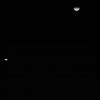
Rhea and Titan-N00027159.jpgRhea (or Tethys?) and Titan70 visiteUna ripresa davvero suggestiva e bellissima della "rocciosa" Rhea (o forse Tethys? Purtroppo il frame NASA è abbastanza ambiguo)e del "nebbioso" Titano, provvisoriamente "vicini" - si fa solo per dire, come ovvio... - e pertanto inquadrati nello stesso frame.
Come avevamo già detto in passato, le fotografie NASA non sono scattate - a quanto ne sappiamo - usando uno "spirito artistico" ma, alle volte, anche delle semplici coincidenze (come, in questo caso, i momenti orbitali di Rhea e Titano) riescono a trasformare un frame altrimenti "anonimo" in una "Finestra sull'Universo" e, dunque, in un'opera d'arte.
Secondo noi, ovviamente...
|
|

Saturn-dragonstorm_cassini_full.jpgSaturn "dragon-storm" (false colors/near infrared)70 visiteDa "NASA - Picture of the Day" del 25 Febbraio 2005:"Dubbed the "Dragon Storm", convoluted, swirling cloud features are tinted orange in this false-color, near-infrared image of Saturn's Southern Hemisphere. In one of a series of discoveries announced by Cassini researchers, the Dragon Storm was found to be responsible for mysterious bursts of radio static monitored by Cassini instruments during the last year as the spacecraft orbited the ringed planet. The storm is now thought to be a giant Saturnian thunderstorm, like storms on Earth, with radio noise produced in high-voltage lightning discharges. The Cassini observations are also consistent with the Dragon Storm being a long-lived storm, deep within the gas giant's atmosphere, that periodically flares-up to produce large, visible storm regions".
|
|

Rhea-PIA07554.jpgRhea's "Bright Splat"70 visiteCaption NASA originale:"This view of Saturn's moon Rhea shows the tremendous "Bright Splat" that coats much of the moon's leading hemisphere. The bright feature may be impact-related and is visible in other Cassini images of Rhea.
The image was taken in visible green light with the Cassini spacecraft narrow-angle camera on June 25, 2005, at a distance of approx. 1,1 MKM from Rhea and at a phase angle of less than 1°. Resolution in the original image was 7 Km (about 4 miles) per pixel (...)".
Nota: in qualità di Ricercatori nel campo delle Scienze Planetarie e quindi al di fuori di ogni intendimento strumentalmente polemico nei confronti della NASA e degli Scienziati che attribuiscono il 99,99% dei crateri presenti sui corpi celesti attualmente più conosciuti (dalla nostra Luna alle lune di Nettuno) all'azione di impatti, desideriamo sottolineare che un "Bright Splat" come questo, al 99,99%, NON è attribuibile ad un impatto (a meno che l'agente impattante non fosse una gigantesca palla di fango).
|
|

Hyperion-N00040207.jpgHyperion (4)70 visiteSiamo a meno di 75.000 Km da Hyperion: il rilievo a forma ellissoidale a cui avevamo fatto cenno in precedenza (e che la NASA battezzerà certamente come "impact basin") si riesce a vedere molto bene, così come si vede molto bene che l'intera superficie di Hyperion, in tutte le direzioni, è (letteralmente) martoriata da crateri (crateri che, sulla base della nostra esperienza, presentano caratteristiche esteriori - diremmo una "conicità" pronunciata - tali da renderli decisamente anomali). Molto interessante, inoltre, potrebbe essere il rilievo - che abbiamo cerchiato in grigio - il quale è appena intuibile, fra luce ed ombra, sul Polo Nord apparente di Hyperion.
Forse una montagna? O forse, dopo una depressione posta proprio su quello che, in questi frames, appare come il Polo Nord di Hyperion, si innalza una nuova parete rocciosa di svariati Km? Noi non lo sappiamo, ma quello che vediamo ci spinge a credere che il record di altezza di un crepaccio (attualmente detenuto dalle "Verona Rupes") sia in pericolo.
|
|
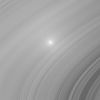
The Rings-PIA08248.jpgOpposition "Surge" on the B-Ring70 visiteBoth images ("A" and "B" Ring) were taken in visible light with the Cassini spacecraft wide-angle camera on July 23, 2006 at a distance of approxi. 262.000 Km (about 163.000 miles) from Saturn.
Image scale in the radial, or outward from Saturn, direction is roughly 13 Km (such as about 8 miles) per pixel.
|
|
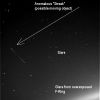
Saturn-W00018088.jpgWhat do some images show? (4)70 visiteNota: lo "streak" lo abbiamo definito anomalo poichè NON si tratta di un photo-artifact (sicuramente) e non pare proprio essere un "raggio cosmico".
Il motivo per cui escludiamo l'ipotesi di "raggio cosmico" deriva dalla circostanza per cui lo "streak" appare, innanzitutto, troppo lungo - esperienza su immagini relative a precedenti "raggi cosmici" confermati come tali dalla NASA alla mano - e poi perchè, operando un'elevata risoluzione del frame, la traccia si risolve in una serie di "puntini" allineati, tipici - anche in fotografia terrestre - della ripresa di un oggetto luminoso in movimento su campo scuro (es. aereo o satellite artificiale in transito).
|
|
| 2245 immagini su 188 pagina(e) |
|
|
|
|
|
30 | |
|
|
|
|
|
|





