| Piú viste - Saturn: the "Ringed Beauty" and His Moons |

Japetus-N00092000.jpgThe "Cassini Regio" of Japetus (1) - possible natural colors; elab. Lunexit72 visiteCaption NASA:"Iapetus, Saturn's third largest moon, is a candidate for the strangest moon of Saturn. Tidally locked in its orbit around the Ringed Gas Giant, Iapetus is sometimes called the "Yin-Yang Moon" because its Leading Hemisphere is very dark, reflecting about 5% of the Sun's light, while its Trailing Hemisphere is almost as bright as snow. This recent Cassini spacecraft flyby image is one of the closest views ever and spans about 35 Km across a cratered transition zone between bright and dark terrain. Iapetus itself has a density close to that of water ice, but the detailed reflective properties of the dark material suggest an organic composition.
Honoring the moon's discoverer, the dark terrain is called Cassini Regio".MareKromium
|
|

Prometheus-PIA09916.jpgSpotting Prometheus (MULTISPECTRUM; credits: Lunexit)72 visiteCaption NASA:"The flattened, potato-like form of Prometheus glides silently within the Roche Division, between Saturn's A and F-Rings.
Prometheus (86 Km, or about 53 miles across at its widest point) is on the side of the Rings closest to the Cassini Spacecraft in this view. The image looks toward the sunlit side of the Rings from about 1° below the Ring-Plane.
The image was taken in visible light with the Cassini Spacecraft narrow-angle camera on May 2, 2008. The view was acquired at a distance of approx. 1,1 MKM (such as about 660.000 miles) from Prometheus.
Image scale is roughly 6 Km (about 4 miles) per pixel".MareKromium
|
|

Saturn-N00114462.jpgSaturnian "Cirrus-like" Clouds Formation (MULTISPECTRUM-2; credits: Lunexit)72 visitenessun commentoMareKromium
|
|

Epimetheus-EB-LXTT.jpgOne Name, but Many Faces: Epimetheus (an Image-Mosaic by Elisabetta Bonora - Lunexit Team)72 visitenessun commentoMareKromium
|
|

Enceladus-N00161054-55-EB-LXTT~0.jpgIs there any "Luminescence" over the "Tiger Stripes"? (1 - Superdefinition and Natural Colors; credits for the additional process. and color.: Elisabetta Bonora & Paolo C. Fienga - Lunexit Team)72 visitenessun commentoMareKromium
|
|

Saturn-PIA12826.jpgSaturnian Storm (Natural Colors; credits: NASA/JPL-Caltech/Space Science Institute)72 visitenessun commentoMareKromium
|
|

Enceladus-PIA14599-PCF-LXTT-IPF.jpgEnceladian Night (Absolute Natural Colors; credits for the additional process. and color.: Dr Paolo C. Fienga/Lunar Explorer Italia/Italian Planetary Foundation)72 visiteBelow an almost completely darkened Enceladus, huge Plumes of Water Ice, coming from at least 4 (four) different Sulci (---> cracks of the Surface) located its South Polar Regions, are backlit in this view of one of Saturn's most dramatic moons. The lit Terrain seen here is on the Leading Hemisphere of Enceladus (whose diameter is approx. 313 miles - such as about 504 Km). North is up.
The picture was taken in Visible Light with the NASA - Cassini Spacecraft Narrow-Angle Camera, on February 20, 2012. The view was acquired at a distance of approximately 83.000 miles (such as approx. 134.000 Kilometers) from Enceladus, and at a Sun-Enceladus-CASSINI Spacecraft (also known as "Phase"), Angle of 165°. Image scale is 2628 feet (801 meters) per pixel.
This picture (which is an Original NASA - CASSINI Spacecraft b/w frame published on the NASA - Planetary Photojournal with the ID n. PIA 14599) has been additionally processed and then colorized, according to an informed speculation carried out by Dr Paolo C. Fienga (LXXT/IPF), in Absolute Natural Colors (such as the colors that a human eye would actually perceive if someone were onboard the NASA - CASSINI Spacecraft and then looked outside, towards the Saturnian moon, Enceladus), by using an original technique created - and, in time, dramatically improved - by the Lunar Explorer Italia Team. Different colors, as well as different shades of the same color, mean, among other things, the existence of different Elements (Minerals) present on the Surface of Enceladus, each having a different Albedo (---> Reflectivity) and Chemical Composition.MareKromium
|
|
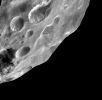
PHOEBE-PIA06067_modest.jpgPhoebe - closing up71 visitenessun commento
|
|

F-RING FROM VOYAGER-PIA02292_modest.jpgThe "F" Ring from Voyager 271 visitenessun commento
|
|

The Rings from approx 120.000 Km.jpgThe Rings from app.x 120.000 Km71 visitenessun commento
|
|

Rhea-N00029094.jpgRhea and Prometheus71 visiteUna nuova istantanea di due dei protagonisti delle "danze planetarie" che si susseguono nello spazio di Saturno e che Sir Stanley Kubrick riuscì ad immaginare molto bene più di 36 anni fa ed a farne un tassello fondamentale del film di fantascienza più famoso (e certamente più suggestivo ed attuale) al Mondo.
|
|

Helene-PIA07547.jpgThe Trojan Moons: Helene, from 760.000 Km71 visiteCaption NASA originale:"Saturn's moons Helene and tiny Polydeuces (not seen here) are Trojan moons of Dione, orbiting about 60° ahead of and behind, the much larger moon. Trojan moons are usually found near gravitationally stable points ahead or behind a larger moon. Polydeuces (or S/2004 S5) was discovered by the Cassini imaging team. Helene is 32 Km (20 miles) across, while Dione is 1.118 Km (695 miles) across.
Tethys also has two of its own Trojan moons.
The image was taken in visible light with the Cassini spacecraft narrow-angle camera on May 20, 2005, at a distance of approx. 760.000 Km (such as about 472.000 miles) from Helene. The image scale is 5 Km (about 3 miles) per pixel. This view of Helene has been magnified by a factor of three and sharpened to aid visibility".
Nota: raffrontate questa immagine di Helene con quella ottenuta dalla Sonda Voyager 2. Ma secondo Voi stiamo guardando sempre lo stesso oggetto?!?
|
|
| 2245 immagini su 188 pagina(e) |
 |
|
|
|
|
29 | |
|
|
|
|





