| Piú viste - Saturn: the "Ringed Beauty" and His Moons |

PIA05075-Color Rings.jpgThe "A" Ring of Saturn in the ultraviolet73 visiteColori "falsi" - decisamente... - ma grande "suggestione per questa vista di Saturno, colta attraverso la radiazione ultravioletta.
|
|

Rhea.jpgRhea in "strange" colors73 visiteAbbiamo intitolato questa immagine "Rhea in colori strani" ma, a ben vedere, avremmo forse fatto meglio a scrivere "Rhea falsa". Questa ripresa di Rhea è, in effetti - ed a quanto ci è dato sapere - completamente unica. Il colorito azzurrino e quelle formazioni frastagliate bianche che attraversano l'intero Pianeta (e che assomigliano a nuvole) non sono visibili in nessun altra fotografia di questa Luna di Saturno. Si tratta dunque di un falso? O forse di un errore occorso durante l'attività di processo del frame originale? Cattivi abbinamenti cromatici? Potremmo andare avanti per pagine, senza arrivare a nulla. L'unica cosa che si può dire, ad oggi, è che Rhea, agli occhi di Voyager o di Cassini/Huygens (ed ai nostri occhi), appare - di regola! - in maniera completamente differente. L'unica cosa che possiamo fare è aspettare nuove immagini a colori per tentare di vederci più chiaramente.
|
|

Japetus-N00026231.jpgJapetus (and the "Pentagon") from about 180.000 Km (2)73 visitenessun commento
|
|
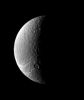
Rhea-PIA08851.jpgRhea73 visiteCaption NASA:"This view looks toward Rhea's North Polar Region, where icy fractures slither away toward the South. The lit terrain in this view is on the Saturn-facing Hemisphere of Rhea.
The image was taken in visible light with the Cassini spacecraft narrow-angle camera on Dec. 4, 2006 at a distance of approx. 773.000 Km (about 480000 miles) from Rhea and at a Sun-Rhea-spacecraft, or phase, angle of 105°.
Image scale is 5 Km (a little more than 3 miles) per pixel".MareKromium
|
|

Rhea-PIA09895.jpgThe Ancient Plains of Rhea73 visiteCaption NASA:"Densely cratered plains cover the ancient surface of Saturn's moon Rhea. Following the Voyager Spacecraft encounters with Saturn, cryovolcanism was suggested as a source for the wispy markings on both Rhea and Dione.
Cassini has shown that Rhea's bright streaks are, like those on Dione, tectonic features and planetary scientists now think it is unlikely that cryovolcanic activity has ever occurred on this moon.
This view looks toward the Trailing Hemisphere of Rhea (1528 Km, or about 949 miles across). North is up.
The image was taken in visible light with the Cassini Spacecraft narrow-angle camera on April 4, 2008. The view was acquired at a distance of approx. 1,2 MKM (such as about 735.000 miles) from Rhea and at a Sun-Rhea-Spacecraft, or Phase, angle of 39°.
Image scale is roughly 7 Km (about 4 miles) per pixel".MareKromium
|
|
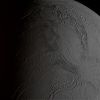
Enceladus-9_cassini_big.jpgEnceladus (natural colors; credits: Lunexit)73 visiteCaption NASA:"What telling impurities taint the ice plumes of Enceladus? To help answer this question, the robotic Cassini spacecraft dove last week to within 30 kilometers of Saturn's ice-plume emitting moon. At this closest-ever approach, Cassini attempted to sniff and obtain chemical data on particles ejected from Enceladus' regular surface, while at other times Cassini flew right through -- and sampled -- ice geysers directly. Searches in the data for impurity clues in the water-ice dominated plumes and surface ejecta are progressing. Although the main purpose of this flyby was particle analysis, several interesting images are emerging. Visible in the above image, for example, is an unusual gray sheen running vertically up the image center that might be water vapor escaping from surface canyons. Other notable features visible above include vast plains of craterless icy grooves, the day-night terminator across the image left, and an area near the top comparatively rich in craters. Cassini is scheduled to buzz by Enceladus in an imaging run near the end of this month".MareKromium
|
|
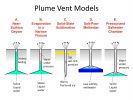
Enceladus-PIA12081.jpgEnceladus' Ice-Plume Models73 visiteCaption NASA:"These illustrations indicate possible ways in which the water vapor and ice particles in the plume of Enceladus may be formed. The Cassini spacecraft recently found a small fraction of salt-rich ice particles from the plumes, while Earth-based observations indicate gas from the plumes is very poor in sodium. These measurements are helping scientists to evaluate how the plumes form.
In model A, salty water boils explosively near the surface of Enceladus when it encounters the vacuum of space. This model can be ruled out, because such explosive activity would spread large amounts of sodium into space where it would have been seen by the Earth-based observers. If this model was correct, then nearly all the ice particles observed by Cassini would be salt-rich, instead of just a fraction of them.
In model B, salty water evaporates more slowly at some depth in a narrow fissure, creating vapor which escapes to the surface to form the plume. This model also seems unlikely because the fissure would rapidly become clogged by salt left behind as water evaporates. The water would also freeze, because not enough heat could reach the water surface up the narrow fissure to replace the heat lost by evaporation.
In model C, the warm ice evaporates directly into vapor to form the plume, in a process called sublimation. The salty particles found in the plume would have been created by liquid water in an earlier epoch and would have been stored in the near-surface layers of Enceladus until the present. These particles would now be incorporated into the plume by the escaping gases. This model cannot be ruled out, but seems unlikely because it may be difficult to dislodge old ice grains from the walls of the fracture.
In model D, the liquid water results from melting of near-surface ice rather than coming from an underlying salty ocean. The water is initially only slightly salty, but its salinity increases as evaporation removes some of the water and leaves the salt behind. Thus, in this model, the salt-rich ice particles seen by Cassini would be derived from initially salt-poor water. This model may be plausible and has not yet been evaluated in detail.
In model E, the water is originally salty, and perhaps comes from a subsurface ocean in contact with an underlying rocky core. The water evaporates slowly into a pressurized chamber, from which water vapor and ice particles, including salty particles from the salt water, escape to the surface along narrow fissures. The large area of the evaporating water surface prevents accumulated salt from clogging the vent and allows enough heat to reach the water surface from below to prevent the water from freezing. This model seems he simplest, and perhaps most likely of the models shown here, but is not the only possibility. Enceladus' plumes may involve a combination of several of these idealized models".MareKromium
|
|
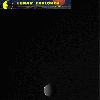
EnceladusSky-EB-N00148200-N00148225.gifIcy-Jets, Cosmic Rays and other UFO's in the Space of Saturn (GIF-Movie; credits: Elisabetta Bonora)73 visiteDalla nostra Amica e Partner, Elisabetta Bonora, un suggestivo GIF-Movie che ci porta nello Spazio circum-Enceladiano ad ammirare, ancora una volta, assieme alle Fontane di ghiaccio tipiche della "Luna di Neve", una serie di interssantissimi targets: dalla semplice "noise" (i puntini bianchi che tempestano il filmato e che assecondano patterns del tutto casuali) ai noti ed agevolmente riconoscibili "Cosmic Rays", passando dal transito di (MOLTI) altri OVNI - e cioè Oggetti Volanti Non Identificati - i quali, talora in coppia (porzione superiore del quadro), talora singolarmente (porzione inferiore), sfrecciano davanti alle ottiche di CASSINI.
Si tratta di Lune Saturniane? Sinceramente, noi ne dubitiamo...
Grandissimi Complimenti ad Elisabetta Bonora!
Technical Data: from N00148200 up to N00148229 ---> frames taken between 16:00 and 16:35 UTC; from this data we can derive that the average time-lap existing between each exposure was about 1' and 10" (in other words, the captioned pictures were taken about every 70" from each other). During that period of time the speed of the CASSINI Probe varied from 10,23 Km-per-sec up to 10,42 Km-per-sec.MareKromium
|
|

Enceladus-N00160966-79-EB-LXTT.jpgIs there any "Luminescence" over the "Tiger Stripes"? (Superdefinition; credits for the additional process.: Elisabetta Bonora - Lunexit Team)73 visitenessun commentoMareKromium
|
|

Hyperion-MF-PCF-LXTT-3.jpgHyperion and its Surfacing Hydrocarbons (Absolute Natural Colors; credits for the additional process. and color.: Elisabetta Bonora and Paolo C. Fienga)73 visiteNota: questa colorizzazione "Naturale Assoluta" (e cioè che risponde a quello che, a nostro parere, un essere umano vedrebbe se si trovasse a bordo della Sonda CASSINI) è un prodotto UNICO ed ESCLUSIVO del "Lunexit Team". MareKromium
|
|

Hyperion-MF-PCF-LXTT-2.jpgHyperion and its Surfacing Hydrocarbons (Absolute Natural Colors; credits for the additional process. and color.: Drr Marco Faccin and Paolo C. Fienga)73 visiteNota: questa colorizzazione "Naturale Assoluta" (e cioè che risponde a quello che, a nostro parere, un essere umano vedrebbe se si trovasse a bordo della Sonda CASSINI) è un prodotto UNICO ed ESCLUSIVO del "Lunexit Team". MareKromium
|
|

Enceladus from Voyager 2.jpgEnceladus from Voyager 272 visiteImmagine Voyager 2 di Enceladus in "natural colors". Anche per questa fotografia il contrasto è stato leggermente esaltato, in maniera tale da rendere visibili i lievi dettagli e le formazioni crateriche e montuose (canali inclusi) che caratterizzano questa "Luna di Ghiaccio".
|
|
| 2245 immagini su 188 pagina(e) |
 |
|
|
|
|
27 | |
|
|
|
|





