| Piú viste - Saturn: the "Ringed Beauty" and His Moons |
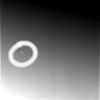
Saturn-N00052964.jpgVertical relief, Cosmic Ray or UFO?74 visiteCerchiatura Bianca: si tratta del solito (e banalissimo) photoartifact; di una curiosa nuvola "a colonna" (detta anche "vertical relief"), oppure di un Raggio Cosmico catturato "al volo" (uno dei tanti...), o magari di un oggetto di altra natura (un luminosissimo UFO?), colto durante un suo passaggio sulle nuvole di Saturno e ad una distanza imprecisata da Cassini?
|
|
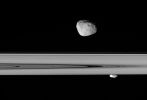
Janus&Prometheus-PIA08192.jpgJanus and Prometheus74 visiteSaturn's moons Janus and Prometheus look close enough to touch in this stunningly detailed view.
From just beneath the Ring-Plane, Cassini stares at Janus on the near side of the Rings, and Prometheus on the far side. The image shows that Prometheus is more elongated than Janus.
The view takes in the Cassini Division (about 4800 Km, or approx. 2980 miles wide), from its outer edge to about halfway across its width.
The image was taken in visible light with the Cassini spacecraft narrow-angle camera on April 29, 2006 at a distance of approx. 218.000 Km (such as about 135.000 miles) from Janus and approx. 379.000 Km (such as about 236.000 miles) from Prometheus. Image scale is about 1 Km (roughly 0,6 mile) per pixel on Janus and about 2 Km (a little more than 1 mile) per pixel on Prometheus.
|
|

Dione-N00064207.jpgCrescent Dione74 visiteCaption originale:"N00064207.jpg was taken on July 24, 2006 and was received on Earth on July 24, 2006. The camera was pointing toward Dione that, at the time, was approximately 262.021 Km away.
The image was taken using the P120 and GRN filters".
|
|

Hyperion-PIA08240.jpgPink Hyperion...74 visiteCaption NASA originale:"Unlike most of the dull grey moons in the Solar System, Hyperion's color is a rosy tan (---> Light Pink), as this view shows.
The origin of the moon's unusual hue is not known. Some scientists suspect the color comes from falling debris from moons further out.
A similar origin has been suggested for the dark reddish material on Saturn's moon Iapetus.
Images taken using red, green and blue spectral filters were combined to create this natural color view. The images were taken in visible light with the Cassini spacecraft narrow-angle camera on June 28, 2006 at a distance of approx. 291.000 Km (about 181.000 miles) from Hyperion. Image scale is roughly 2 Km (a little more than 1 mile) per pixel".
|
|

Rhea-N00064815.jpgMoments of Rhea (4) - The "Terminator"74 visitenessun commento
|
|

Streak-N00065622-3.jpgWhat is that? (detail mgnf n. 2)74 visiteAl "cambio di direzione" n. 2 - il più netto - si intravede una leggera "nebbia", come se l'oggetto stesse perdendo materiale. Questo comportamento è coerente con l'ipotesi del "bolide", ma l'ipotesi di un bolide che si "incendi" nel vuoto è, in sè, insostenibile.
Purtroppo.
|
|

Saturn-N00126685.jpgSaturnian Swirls (False Colors; credits: Lunar Explorer Italia)74 visiteCaption NASA:"N00126685.jpg was taken on December 16, 2008 and received on Earth December 17, 2008. The camera was pointing toward Saturn that, at the time, was approximately 655.610 Km away; the image was taken using the CL1 and CB2 filters.
This image has not been validated or calibrated".MareKromium
|
|

The_Rings-Shadows-1.gifLooooong (!) Shadows on the Rings (GIF-Movie)74 visitenessun commentoMareKromium
|
|

Saturn-PIA11518.jpgApproaching the Equinox74 visiteCaption NASA:"The shadow of the moon Mimas has just slipped off Saturn's Rings and onto the Planet in this Cassini Spacecraft image. The shadow is visible as a short dash below the Rings' shadows on the Planet. At this exposure setting, the Rings are too dim to be seen easily. As Saturn approaches its August 2009 equinox, the Planet's moons cast shadows onto the Rings.
This view looks toward the unilluminated side of the Rings from about 61° above the Ring-Plane. Images taken using red, green and blue spectral filters were combined to create this Natural Color view. The images were obtained with the Cassini Spacecraft wide-angle camera on April 30, 2009 at a distance of approx. 1,4 MKM (about 870.000 miles) from Saturn.
Image scale is roughly 80 Km (about 50 miles) per pixel".MareKromium
|
|

Japetus-MF-LXTT.jpgJapetus (an Image-Mosaic in possible Natural Colors by Drr Marco Faccin and Paolo C. Fienga - Lunexit Team)74 visitenessun commentoMareKromium
|
|

Pandora-N00154618-19-20-EB-LXTT.jpgApproaching Pandora (an Image-Mosaic by Elisabetta Bonora - Lunexit Team)74 visitenessun commentoMareKromium
|
|

Rhea-IMG004709-br500-PCF-LXTT-IPF.jpgFarewell to Rhea (Absolute Natural Colors; credits for the additional process. and color.: Dr Paolo C. Fienga/Lunar Explorer Italia/Italian Planetary Foundation)74 visiteOn its fourth and final targeted Fly-By of Rhea, the NASA - Cassini Spacecraft provided many stunning views its ancient, tormented and heavily cratered Surface. Billions of years of impacts, in fact, have sculpted Rhea's Surface into the form we see today and, with a diameter of approx. 950 miles (such as about 1528,8 Km), Rhea is the second-largest moon of Saturn.
In the EDM here (is on the lower right - Dx - of the CTX Frame), you can see an extremely interesting and, in a way, really mysterious and bizarre-looking Horizontal Linear Structure that looks like a Wall and whose upper edge is still illuminated by the Sun; the Structure - whose origin is and, most likely, will remain unknown - is located within a relatively small-sized and Unnamed Impact Crater and it extends for about one/third of its Inner Diameter. This view was taken in Visible Light on December 22, 2012, at a distance of approximately 16.805 miles (such as a little less than 27.045 Km) from the Surface of Rhea.
This frame (which is an Original NASA - Cassini Spacecraft b/w image identified by the serial n. N00199484) has been additionally processed, contrast enhanced, and then colorized in Absolute Natural Colors (such as the colors that a human eye would actually perceive if someone were onboard the NASA - Cassini Spacecraft and then looked down, towards the Surface of the Saturnian moon Rhea), by using an original technique created - and, in time, dramatically improved - by the Lunar Explorer Italia Team. Different colors, as well as different shades of the same color, mean, among others, the existence of different Elements present on the Surface of Rhea, each having a different Albedo (---> Reflectivity) and Chemical Composition.
Note: it is possible (but we, as IPF, have no way to be one-hundred-percent sure of such a circumstance), that the actual luminosity of the Surface of Rhea - as it is presented in this image - would appear, to an average human eye, way lower than it has been shown (or, better yet: interpreted) here.MareKromium
|
|
| 2245 immagini su 188 pagina(e) |
 |
|
|
|
|
26 | |
|
|
|
|





