| Piú viste - Saturn: the "Ringed Beauty" and His Moons |

Prometheus-PIA06488_modest.jpgPrometheus: one of the Ring-Masters75 visiteCaption NASA originale:"In its own way, the shepherd moon Prometheus is one of the Master of Saturn's rings. That's because the little moon maintains the inner edge of Saturn's thin, knotted, F-Ring, while its slightly smaller cohort Pandora (84 Km across) guards the ring's outer edge.
This view is a composite of nine raw images combined in a way that improves resolution and reduces noise. The final image was magnified by a factor of five.
The image clearly shows that Prometheus is not round, but instead has an oblong, potato-like shape.
The moon was discovered during the Voyager mission, and scientists then noted ridges, valleys and craters on its surface. Hints of its varied topography are present in this view, although Cassini will likely obtain much better images of Prometheus later in the mission".
|
|

Saturn-PIA08130.jpgIs that a "Vertical Relief"?!?75 visiteOccasional views like this one, showing "vertical relief" in Saturn's cloud tops, help the streamers and swirls of gas seem more like a three dimensional structure than a smooth surface. As on Saturn's solid moons, vertical relief is easiest to view near the Terminator, and makes visible the shading of deeper cloud tops by high altitude bands.
The image was taken in visible light with the Cassini spacecraft narrow-angle camera on Jan. 23, 2006, at a distance of approx. 2.7 MKM (about 1,7 MMs) from Saturn. Resolution in the original image was 16 Km (about 10 miles) per pixel. The image has been magnified by a factor of two and contrast-enhanced to aid visibility.
|
|

Saturn-N00080470-03.jpgShooting Star or Alien Spaceship in-transit? (extra detail mgnf)75 visiteNota: frame ORIGINALE NASA, colorizzato da Lunexit MA NON DIGITALMENTE RIPULITO.
|
|
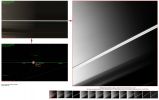
Saturn-EB-LXTT.jpgUn-Titan (an Image-Mosaic by Elisabetta Bonora - Lunexit Team)75 visitenessun commentoMareKromium
|
|

Albiorix-N00160116-001060221-EB-LXTT.gifAlbiorix and the Space of Saturn (a GIF-Movie by Elisabetta Bonora - Lunexit Team)75 visitenessun commentoMareKromium
|
|

Dione-EB-LXTT3~0.jpgIn the "Scars" of Dione... (an Image-Mosaic in possible Natural Colors by Elisabetta Bonora - Lunexit Team)75 visitenessun commentoMareKromium
|
|

Dione-PIA12743.jpgErulus Crater (Absolute Natural Colors; credits for the additional process. and color.: Dr Paolo C. Fienga - Lunexit Team)75 visiteCaption NASA:"The Cassini spacecraft snapped this shot of cratered Dione as it flew by the Saturnian moon on Oct. 17, 2010. The large crater at the center of the image is Erulus, which is about 120 Km, or approx. 75 miles, across. This view looks toward the Southern Latitudes of the Leading Hemisphere of Dione.
The image was taken in Visible Light with the Cassini Spacecraft narrow-angle camera. The view was acquired at a distance of approximately 41.000 Km (such as about 25.000 miles) from Dione and at a Sun-Dione-Spacecraft, or Phase, Angle of 53°.
Image scale is roughly 240 meters (787 feet) per pixel".MareKromium
|
|

Rhea-PIA14647-PCF-LXTT-IPF.jpgCrescent Rhea (Absolute Natural Colors; credits for the additional process. and color.: Dr Paolo C. Fienga/Lunar Explorer Italia/Italian Planetary Foundation)75 visiteThe NASA - Cassini Spacecraft captured, about four months ago, Saturn's moon Rhea during its Crescent Phase: a view, this one, which will never be visible from Earth. Near the Terminator, a few of Rhea's many Impact Craters show up their sharp and well defined outlines. With a diameter of approx. 950 miles (such as almost 1529 Km) Rhea is the Saturnian second-largest moon. This view looks toward the Leading Hemisphere of Rhea; North is up and rotated 12° to the right.
The image was taken in Visible Light with the NASA - Cassini Spacecraft Narrow-Angle Camera on November 6, 2012. The view was obtained at a distance of approximately 1,2 Million Miles (such as about 1,93 Million KiloMeters) from Rhea and at a Sun-Rhea-Cassini Spacecraft, or Phase, Angle of 129°. Scale in the original image was roughly 7 miles (approx. 11,26 Km) per pixel but, afterwards, the picture was magnified by a factor of 1.5 in order to enhance the visibility of some Surface Features.
This picture (which is an Original NASA - Cassini Spacecraft b/w frame published on the NASA - Planetary Photojournal with the ID n. PIA 14647) has been additionally processed, magnified (by applying a further 4.01 enlargement's factor) and then colorized, according to an educated guess carried out by Dr Paolo C. Fienga (LXTT-IPF), in Absolute Natural Colors (such as the colors that a human eye would actually perceive if someone were onboard the NASA - Cassini Spacecraft and then looked outside, towards the Saturnian moon Rhea), by using an original technique created - and, in time, dramatically improved - by the Lunar Explorer Italia Team. Different colors, as well as different shades of the same color, mean, among others, the existence of different Elements present on the Surface of Rhea, each having a different Albedo (---> Reflectivity) and Chemical Composition.MareKromium
|
|

Rhea-PIA14660-PCF-LXTT-IPF.jpgFarewell to Rhea (Absolute Natural Colors; credits for the additional process. and color.: Dr Paolo C. Fienga/Lunar Explorer Italia/Italian Planetary Foundation)75 visiteOn its fourth and final targeted Fly-By of Rhea, the NASA - Cassini Spacecraft provided, among others, this stunning view its ancient, tormented and heavily cratered Surface. Billions of years of impacts, in fact, have sculpted Rhea's Surface into the form we see today and, with a diameter of approx. 950 miles (such as about 1528,8 Km), Rhea is the second-largest moon of Saturn.
This view is centered on Terrain located at 33° North Latitude and 358° West Longitude. The image was taken in Visible Light with the NASA - Cassini Spacecraft Narrow-Angle Camera on March 9, 2013, at a distance of approximately 2.348 miles (such as about 3.778,73 Km) from the Surface of Rhea. Just out of curiosity, we, as IPF, have found (as far as this specific picture is concerned) a slight discrepancy between the data regarding the distance of the NASA - Cassini Spacecraft from the Surface of Rhea, as reported in the NASA - Planetary Photojournal (where it has been written that the distance was of approx. 2.280 miles) and in the caption attached to this frame - entitled "Rhea's Shadowy Craters" - and reported in the NASA - Cassini Solstice Mission Official WebSite (where the distance between the Spacecraft and Rhea is estimated to be 2.348 miles). Obviously, everybody - even our Friends from NASA - makes mistakes, every now and then...
This frame (which is an Original NASA - Cassini Spacecraft b/w image published on the NASA - Planetary Photojournal and identified by the serial n. PIA 14660) has been additionally processed, contrast enhanced, and then colorized in Absolute Natural Colors (such as the colors that a human eye would actually perceive if someone were onboard the NASA - Cassini Spacecraft and then looked down, towards the Surface of the Saturnian moon Rhea), by using an original technique created - and, in time, dramatically improved - by the Lunar Explorer Italia Team. Different colors, as well as different shades of the same color, mean, among others, the existence of different Elements present on the Surface of Rhea, each having a different Albedo (---> Reflectivity) and Chemical Composition.
Note: it is possible (but we, as IPF, have no way to be one-hundred-percent sure of such a circumstance), that the actual luminosity of the Surface of Rhea - as it is presented in this image - would appear, to an average human eye, way lower than it has been shown (or, better yet: interpreted) here.MareKromium
|
|

Rhea and Titan-N00027209.jpgRhea (or Tethys?) and Titan: getting closer...74 visitenessun commento
|
|

Prometheus&Pandora-PIA07612.jpgCosmic race: Prometheus and Pandora74 visiteSaturn's moon Prometheus (Sx) chases Pandora (Dx) in this Cassini view, but the outcome of their race has already been decided by gravity. Prometheus orbits closer to Saturn and thus moves faster than does Pandora. This view is from a third of a degree (1/3°) beneath the Ringplane. Familiar Ring features that are visible from higher angles above the Rings are foreshortened here. The Planet's dark shadow stretches across the Ringplane at center.
The image was taken in visible light with the Cassini spacecraft narrow-angle camera on Sept. 8, 2005, at a distance of approx. 1,8 MKM (such as about 1,1 MMs) from Saturn. The image scale is 10 Km (about 6 miles) per pixel on Prometheus and Pandora.
|
|
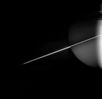
Saturn-PIA07678.jpgNeon-lights in the night of Saturn74 visiteOriginal caption:"Like a rope of brilliant neon, Saturn's Rings outshine everything else in this night side view, while the sunlit southern face of the Rings reflects a dim glow onto the atmosphere below. When viewed nearly edge-on, the Rings often appear very bright.
Epimetheus and Janus are mere specks to the left of the Ring edge (and Epimetheus being the outermost of the pair).
The image was taken in visible light with the Cassini spacecraft wide-angle camera on Dec. 17, 2005, at a distance of approximately 2,7 MKM (such as about 1,7 MMs) from Saturn and at a Sun-Saturn-spacecraft angle of 75°. The image scale is about 164 Km (roughly 102 miles) per pixel".
|
|
| 2245 immagini su 188 pagina(e) |
 |
|
|
|
|
25 | |
|
|
|
|





