| Piú viste - Saturn: the "Ringed Beauty" and His Moons |

Saturn-N00063521-03.jpgIncredible "Meteor" (?) strikes the upper layers of Saturn's atmosphere (detail mgnf-3)81 visiteNessun ulteriore commento.
|
|

The Rings-PIA08331.jpgNew "Ringlets" (2)81 visiteCaption NASA:"HR Cassini images show an astonishing level of structure in Saturn's Cassini Division, including two ringlets that were not seen in NASA Voyager spacecraft images 25 years ago.
This view was taken with the Sun almost directly behind Saturn and its Rings, a viewing geometry in which microscopic ring particles brighten substantially. The image shows the diffuse new ringlet in the Cassini Division as the brightest feature in that Region.
This image was taken in visible light with the Cassini spacecraft narrow-angle camera on Sept. 15, 2006, at a distance of approx. 2,2 MKM (such as about 1,4 MMs) from Saturn. This view looks toward the unlit side of the Rings from about 15° above the ringplane. The phase angle, or Sun-Saturn-spacecraft angle, was 179°. Image scale on the sky at the distance of Saturn is roughly 13 Km (such as about 8 miles) per pixel".
|
|

Saturn-N00080470-02.jpgShooting Star or Alien Spaceship in-transit? (extra detail mgnf)81 visiteNota: frame ORIGINALE NASA, colorizzato da Lunexit MA NON DIGITALMENTE RIPULITO.
L'interruzione nello streak è, a nostro parere e qualunque ipotesi vogliate sposare (dal bolide al raggio cosmico anomalo e dalla "nave spaziale aliena" al photographic artifact), totalmente inesplicabile.
Siamo aperti ad ascoltare e pubblicare i Vostri eventuali suggerimenti e/o le Vostre intuizioni.
|
|

Atlas-N00084624.jpgAtlas (1)81 visiteUna nuova (e secondo noi spettacolare, anche se segnata da innumerevoli artifacts) inquadratura della piccola luna-pastore saturniana "Atlas" la quale, nella maggior parte delle immagini Cassini, ci appare come un semplice ed insignificante puntino a ridosso dell'Anello "A" del Gigante Gassoso.
In questo frame, si distingue una regione di Atlas che appare caratterizzata da rilievi stratiformi i quali vengono a formare una sorta di montagna dall'apparenza conica e sulla cui sommità, che in questo frame è visibile proprio a ridosso del Terminatore, si intuisce l'esistenza di crepacci e, forse, di una vera e propria catena di strapiombi. Indefinibile in rilievo posto ad ore 11, sempre sulla linea del Terminatore (potrebbe essere un rilievo assimilabile ad una caldera).
Il resto di questo minuscolo mondo (dim. -> 37x34,4x27 Km), immerso nella luce del Sole, si presenta relativamente liscio - ma questo potrebbe essere un semplice effetto derivante dalla sovrasaturazione della porzione di frame che inquadra le regioni illuminate di Atlas - e molto luminoso. Da notare, tra ore 5 ed ore 6, la presenza di 2 o 3 rilievi che potrebbero essere dei crateri e, ad ore 2 e tra ore 4 ed ore 5, vediamo dei grandi bacini i quali conferiscono a questo corpo celeste l'apparente forma di un tubero.
La colorazione che abbiamo adottato (grigio/azzurra di base) è di fantasia ma, nello sceglierla, ci siamo riferiti ai colori naturali di Deimos (la Luna Marziana minore): un corpo celeste interno al quale Atlas a noi sembra assomigliare davvero parecchio.MareKromium
|
|
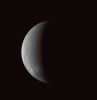
Enceladus-PIA10422.jpgCrescent Enceladus (MULTISPECTRUM-2; credits: Lunexit)81 visiteCaption NASA:"The Cassini Spacecraft observes the wrinkled surface of Enceladus.
The geologically active South Polar Region is visible at bottom.
This view looks toward the Saturn-facing side of Enceladus (about 504 Km, or 313 miles across). Lit terrain is on the moon's Leading Hemisphere. North is up and rotated 16° to the right.
The image was taken in visible green light with the Cassini Spacecraft narrow-angle camera on June 2, 2008. The view was obtained at a distance of approx. 285.000 Km (such as about 177.000 miles) from Enceladus and at a Sun-Enceladus-Spacecraft, or Phase, Angle of 108°.
Image scale is roughly 2 Km (a little more than 1 mile) per pixel".MareKromium
|
|

Enceladus-EB2-LXTT.gifSpewing Ice! (a GIF-Movie by Elisabetta Bonora - Lunexit Team)81 visitenessun commentoMareKromium
|
|

Enceladus-N00161059-SHD-EB-LXTT~0.jpgFlying over the "Tiger Stripes" (Superdefinition and Natural Colors; credits for the additional process. and color.: Elisabetta Bonora & Paolo C. Fienga - Lunexit Team)81 visitenessun commentoMareKromium
|
|

Dione-EB-LXTT4.jpgDeep inside the "Scars" of Dione (possible Natural Colors; credits for the additional process. and color.: Elisabetta Bonora - Lunexit Team)81 visitenessun commentoMareKromium
|
|

Dione-PIA12729-PCF-LXTT.jpgDione (Natural Colors; credits for the additional process. and color.: Dr Paolo C. Fienga - Lunexit Team)81 visitenessun commentoMareKromium
|
|

Mimas-PIA12739.jpgThe "Eye in the Sky"...81 visiteCaption NASA:"The Cassini Spacecraft turns the eye of its camera toward Saturn's moon Mimas and spies the large Herschel Crater which itself looks like the iris of an eye peering out into space.
Herschel Crater is about 130 Km (approx. 81 miles) wide and covers most of the right of this image. Scientists continue to study this Impact Basin and its surrounding Terrain (see also PIA12568). Lit Terrain seen here is on the Leading Hemisphere of Mimas. North on Mimas is up and rotated 1° to the left.
The image was taken in Visible Light with the Cassini Spacecraft narrow-angle camera on Oct. 16, 2010. The view was obtained at a distance of approx. 103.000 Km (such as about 64.000 miles) from Mimas and at a Sun-Mimas-Spacecraft, or Phase, Angle of 113°.
Image scale is roughly 613 meters (2011 feet) per pixel".MareKromium
|
|

Tethys-PIA12802.jpgThe "Face" of Tethys (Absolute Natural Colors; credits for the additional process. and color.: Dr Paolo C. Fienga - Lunexit Team)81 visiteCaption NASA:"Geologic faults among craters on Saturn's moon Tethys are depicted in this image captured during a Fly-By of the moon by NASA's Cassini Spacecraft on Aug. 14, 2010.
The brightly illuminated, prominent Impact Crater near the bottom middle of this image has been dissected by numerous parallel Faults that run diagonally across the image. The presence of the Faults that cut through the Crater and the movement of Surface Materials have made the Crater outline somewhat non-circular.
Near the center of the image, running diagonally from the left to right, is an old Graben, such as a "Linear Depression of the Terrain between two Faults".
Below these Faults and near the middle top of the image is a large ancient Impact Crater that is so highly overprinted by more recent Craters that it can barely be recognized.
On the left of the image, there are some horizontal lines that can be seen very faintly cutting across Craters. These lines are artifacts of missing data in the raw image that could not be eliminated through processing the image.
This view looks toward the Leading Hemisphere of Tethys. The view is centered on terrain at 59° North Latitude and 79° West Longitude.
The image was taken in Visible Light with the Cassini Spacecraft narrow-angle camera. The view was acquired at a distance of approx. 40.000 Km (such as about 25.000 miles) from Tethys and at a Phase Angle of 103°. Image scale is roughly 234 meters (767 feet) per pixel".MareKromium
|
|

Saturn-North_Pole-Vortex-Cassini-EB-MF-LXTT-IPF.gifPeering into the Storm (a GIF-Movie by Elisabetta Bonora and Marco Faccin/Lunar Explorer Italia/Italian Planetary Foundation)81 visite...Splendido e Affascinante...MareKromium
|
|
| 2245 immagini su 188 pagina(e) |
 |
|
|
|
|
21 | |
|
|
|
|





