| Piú viste - Saturn: the "Ringed Beauty" and His Moons |

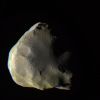
Janus-PIA09872-PCF-LXTT.jpgCrescent Janus (Natural Colors; credits for the additional process. and color.: Dr Paolo C. Fienga - Lunar Explorer Italia)218 visiteCaption NASA:"The Cassini Spacecraft snapped this exquisite, close-up view of Saturn's moon Janus, looking toward the South Polar Region, on Feb. 20, 2008.
Janus is about 181 Km (approx. 113 miles) across.
The image was taken in visible light with the Cassini spacecraft narrow-angle camera. The view was acquired at a distance of approx. 169.000 Km (such as about 105.000 miles) from Janus and at a Sun-Janus-Spacecraft, or phase, angle of 71°. Image scale is roughly 1 Km (about 0,6 mile) per pixel".
MareKromium
|
|
Helene-N00172877_78_79.jpgHelene (RAW Natural Colors; credits for the additional process. and color.: Dr Marco Faccin - Lunexit Team)217 visitenessun commentoMareKromium
|
|

Enceladus-PIA14588-PCF-LXTT.jpgCrescent Enceladus (Absolute Natural Colors; credits for the additional process. and color.: Dr Paolo C. Fienga - Lunexit Team)217 visiteCaption NASA:"The Cassini Spacecraft looks at a brightly illuminated Enceladus and examines the Surface of its Leading Hemisphere. North on Enceladus is up and rotated 21° to the right.
The image was taken in Visible Light with the Cassini Spacecraft narrow-angle camera on Nov. 6, 2011. The view was obtained at a distance of approx. 67.700 miles (such as about 109.000 Km) from Enceladus and at a Phase Angle of 21°. Image scale is 2130 feet (649 meters) per pixel".MareKromium
|
|

AA-Anomaly - Saturn_s Sky from Cassini-Huygens.jpgA bright light in the Space of Saturn: Saturn overexposed (1)214 visiteMa adesso che ci troviamo nello Spazio Esterno; che non c'è nessuna atmosfera di sorta da chiamare in causa e non ci sono neppure vecchie Sonde che possono precipitare ed alle quali si potrebbe "dare la colpa" per la presenza di "strisce di luce nel cielo", che cosa si inventeranno le Agenzie Spaziali per negare ancora l'evidenza?
|
|

Hyperion-PIA14580-PCF-LXTT.jpgFeatures of Hyperion (Absolute Natural Colors; credits for the additional process. and color.: Dr Paolo C. Fienga - Lunexit Team) 214 visiteCaption NASA:"The sponge-like Surface of Saturn's moon Hyperion is highlighted in this Cassini portrait, captured during the Spacecraft's Sept. 16, 2011, Fly-By. Hyperion (which is about 168 miles, or approx. 270 Km across) has an irregular shape, and it tumbles through its orbit: that is, it does not spin at a constant rate or in a constant orientation. (A standard reference latitude-longitude system has not yet been devised for this moon.)
Images such as this one extend previous coverage and allow a better inventory of the surface features, the satellite's shape and changes in its spin.
The image was taken in Visible Blue Light with the Cassini Spacecraft narrow-angle camera. The view was obtained at a distance of approx. 55.000 miles (such as about 88.000 Km) from Hyperion and at a Sun-Hyperion-Spacecraft, or Phase, Angle of 37°.
Image scale is roughly 1720 feet (524 meters) per pixel".MareKromium
|
|

Hyperion-PIA14583-PCF-LXTT.jpgHyperion (Absolute Natural Colors; credits for the additional process. and color.: Dr Paolo C. Fienga - Lunexit Team)211 visiteCaption NASA:The Cassini Spacecraft looks at Saturn's highly irregular moon Hyperion in this view taken from the Spacecraft's during the Fly-By that occurred on August, 25th, 2011. Hyperion (approx. 168 miles, or about 270 Km across) has an irregular shape, and it tumbles through its orbit: that is, it does not spin at a constant rate or in a constant orientation. (A standard reference latitude-longitude system has not yet been devised for this moon)
Images such as this one extend previous coverage and allow a better inventory of the Surface Features, the satellite's shape and changes in its spin.
The image was taken with the Cassini Spacecraft narrow-angle camera using a combination of spectral filters sensitive to wavelengths of Polarized Green Light centered at 617 and 568 nanometers. The view was obtained at a distance of approx. 36.000 miles (such as about 58.000 Km) from Hyperion and at a Phase Angle of 43° degrees. Image scale is 1145 feet (349 meters) per pixel".
MareKromium
|
|

Helene-N00172899_900.jpgHelene (High-Def-3D; credits for the additional process.: Dr Marco Faccin - Lunexit Team)206 visitenessun commentoMareKromium
|
|

0-Saturn and Friends.jpgSaturn and His Moons200 visiteThe dozens of moons orbiting Saturn vary drastically in shape, size, age and origin. Some of these moons have rocky surfaces, while others are porous, icy bodies. Many have craters, ridges and valleys and some show evidence of tectonic activity. Some appear to have formed billions of years ago, while others appear to be pieces of a bigger, fragmented body. The most interesting one is Titan, the biggest of them all. Larger than Earth's Moon, Titan even has its own thick atmosphere - the only natural satellite in the Solar System with such a luxury. During its 4-year mission in this immense region, the Cassini spacecraft will extensively photograph many of these moons and collect data that will increase our understanding of their composition.
To date, 34 moons have been officially named. In alphabetic order, they are: Albiorix, Atlas, Calypso, Dione , Enceladus, Epimetheus, Erriapo, Helene, Hyperion, Iapetus, Ijiraq, Janus, Kiviuq, Methone, Mimas, Mundilfari, Narvi, Paaliaq, Pallene, Pan, Pandora, Phoebe, Polydeuces, Prometheus, Rhea, Siarnaq, Skadi, Suttung, Tarvos, Telesto, Tethys, Thrym, Titan and Ymir.
|
|

Tethys-PIA14581-PCF-LXTT-0.jpgTethys (False b/w - credits for the additional process.: Dr Paolo C. Fienga - Lunexit Team)196 visiteCaption NASA:"Saturn's moon Tethys shows off its tortured Surface in this Cassini Spacecraft image. On the top left of the image there is huge Odysseus Crater. On the bottom right, instead, there is Ithaca Chasma: a series of Scarps that run North-to-South across the moon for more than 620 miles (approx. 1000 Km). North on Tethys is up and rotated 25° to the right. This view looks toward the area between the Leading Hemisphere and Saturn-facing side of Tethys.
The image was taken in Visible Green Light with the Cassini Spacecraft narrow-angle camera on Sept. 14, 2011. The view was acquired at a distance of approximately 178.000 miles (approx. 287.000 Km) from Tethys and at a Sun-Tethys-Spacecraft, or Phase, Angle of 11°. Image scale is about 1 mile (1,6 Km) per pixel". MareKromium
|
|

A - Saturn-a.jpgSaturn, Tethys and Dione in almost true colors189 visiteSaturn Data and Statistics
Mass (kg) = 5.688e+26
Mass (Earth = 1) = 9,5181e+01
Equatorial radius = 60.268 Km
Equatorial radius (Earth = 1) = 9,4494e+00
Mean density (gm/cm^3) = 0,69
Mean distance from the Sun = 1.429.400.000 Km
Mean distance from the Sun (Earth = 1) = 9,5388
Rotational period (hours) = 10,233
Orbital period (years) = 29,458
Mean orbital velocity = 9,67 Km per second
Tilt of axis = 25,33°
Orbital inclination = 2,488°
Equatorial surface gravity (m/sec^2) = 9,05
Equatorial escape velocity = 35,49 Km per second
Magnitude (Vo) = 0,67
Mean cloud temperature = - 125°C
Atmospheric pressure (bars) = 1,4
Atmospheric composition: Hydrogen 97% and Helium 3%
|
|

Enceladus-PIA14578-PCF-LXTT.jpgEnceladus' Southern Regions (Absolute Natural Colors; credits for the additonal process. and color.: Dr Paolo C. Fienga - Lunar Explorer Italia)189 visiteCaption NASA:"This image was taken in Visible Light with the Cassini Spacecraft narrow-angle camera on Sept. 13, 2011. The view was acquired at a distance of approx. 26.000 miles (such as about 41.842,84 Km) from Enceladus and at a Phase Angle of 52°. Image scale is roughly 830 feet (253 meters) per pixel".
MareKromium
|
|

AB-Another Streak in the Sky.jpgThe 2nd "Streak" in the Sky of Saturn - W00000828188 visiteMa ecco che, improvvisamente, accade qualcosa. La traccia luminosa che vediamo questa volta è assai meno brillante di quella del 4 Agosto, ma l'Anomalia è comunque del tutto evidente. Cosa è successo? E' successo che, ancora una volta, un oggetto luminoso in movimento lungo una traiettoria lineare è passato davanti ad uno degli "occhi elettronici" di Cassini/Huygens, facendosi "immortalare". Noi abbiamo battezzato questa seconda Anomalia con il nome di "Saturn PF2-08-2004". A quando la Terza?!?...
|
|
| 2245 immagini su 188 pagina(e) |
2 |  |
|
|
|
|
|
|
|
|
|





