| Piú viste - Saturn: the "Ringed Beauty" and His Moons |

Enceladus-FullColor-MF1.jpgEnceladus (an Image-Mosaic in RAW Natural Colors; credits for the additional process. and color.: Dr Marco Faccin - Lunexit Team)84 visitenessun commentoMareKromium
|
|

Dione-PIA12740-PCF-LXTT.jpgFlying over Dione's "Wisps" (Absolute Natural Colors; credits for the additional process. and color.: Dr Paolo C. Fienga - Lunexit Team)84 visiteCaption NASA:"The Cassini Spacecraft looks across the Surface of Saturn's moon Dione and details the so-called "Wispy" Terrain first chronicled by the Voyager probe.
This Fractured Terrain covers the Trailing Hemisphere of Dione (which is about 1123 Km, or approx. 698 miles across). This view is centered on Terrain at approx. 53° North Latitude and 209° West Longitude.
The image was taken in Visible Light with the Cassini Spacecraft narrow-angle camera on Oct. 17, 2010. The view was acquired at a distance of approx. 61.000 Km (about 38.000 miles) from Dione and at a Sun-Dione-Spacecraft, or Phase, Angle of 32°. Image scale is roughly 363 meters (1190 feet) per pixel".MareKromium
|
|

Hyperion-PIA17194-PCF-LXTT-IPF.jpgFarewell Hyperion! Part II (Absolute Natural Colors; credits for the additional process. and color.: Dr Paolo C. Fienga/Lunar Explorer Italia/Italian Planetary Foundation)84 visiteThe NASA - Cassini Spacecraft's Imaging Scientists processed this view of Saturn's so-called "spongy" moon Hyperion, which was taken - just like yesterday's one - during a close Fly-By that occurred on May 31, 2015. This Fly-By marks the Mission's Final Close Approach to this Saturnian highly irregularly shaped moon. North on Hyperion is up and rotated 34° to the left (Sx).
The image was taken in Visible Light, with the NASA - Cassini Spacecraft's Narrow-Angle Camera - as we wrote herebefore - on May 31, 2015. The view was acquired at a distance of approximately 24.000 miles (such as about 38.624,159 Km) from Hyperion and at a Sun-Hyperion-Cassini Spacecraft, or Phase, Angle of 46°. Image scale is roughly 145 feet (such as approx. 44,196 meters) per pixel. l.
This frame (which is an Original NASA - CASSINI Spacecraft's b/w and NON Map-Projected image published on the NASA - Planetary Photojournal with the ID n. PIA 17194) has been additionally processed, contrast enhanced, magnified to help the visibility of the Surface details, Gamma corrected and then re-colorized - according to an educated guess (or, if you wish, an informed speculation) carried out by Dr Paolo C. Fienga - in Absolute Natural Colors (such as the colors that a human eye would actually perceive if someone were onboard the NASA - Cassini Spacecraft and then looked outside, towards the Saturnian moon "Hyperion"), by using an original technique created - and, in time, dramatically improved - by the Lunar Explorer Italia Team. Different colors, as well as different shades of the same color, mean, among other things, the existence of different Elements (Minerals) present on the Surface of Hyperion, each having a different Albedo (---> Reflectivity) and Chemical Composition.
Note: it is possible (but we, as IPF, have no way to be one-hundred-percent sure of such a circumstance), that the actual luminosity of Hyperion - as it is in this frame - would appear, to an average human eye, a little bit lower than it has been shown (or, better yet: interpreted) here.MareKromium
|
|

Japetus from 6.100.000 Km.jpgJapetus from approx. 6.100.000 Km83 visitenessun commento
|
|

Japetus from 5.878.000 Km.jpgJapetus from approx. 5.878.000 Km83 visitenessun commento
|
|
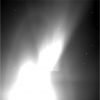
Saturn-W00002929.jpgSaturn's Rings overexposed (1)83 visiteVi offriamo 3 frames che, secondo noi, dovrebbero rappresentare Saturno sovraesposto. Qualche tempo fa - come testimoniano i frames che abbiamo inserito in questa Galleria ed i relativi commenti - non eravamo certi che si trattasse di semplice sovraesposizione di un corpo (sia pure molto luminoso) come Saturno e pensavamo che si trattasse di fotografie Up-Sun del Cielo di Saturno oppure che ci fosse un altro oggetto - brillante - nelle immediate vicinanze della Sonda. Ebbene, un pò di studio approfondito delle immagini, unito ad una razionale valutazione di alcuni indizi, ci hanno fatto cambiare idea. L'unico frame che ci ha dato ancora parecchi problemi interpretativi è stato il secondo. Il primo - questo - sembra enigmatico, ma non lo è. Il terzo è il frame decisivo per le nostre conclusioni.
Guardate bene...
|
|

Huygens-IMG001253-br500.jpgThe "Huygens Probe", "camera artifacts" and 4 "known" stars83 visiteShown in white boxes are known stars; the probe is the brightest item on the lower right. The other dots are artifacts of the camera. Although only a few pixels across, this image is helping navigators reconstruct the probe's trajectory and pinpoint its position relative to Cassini. This information so far shows that the probe and Cassini are right on the mark and well within the predicted trajectory accuracy. This information is important to help establish the required geometry between the probe and the orbiter for radio communications during the probe descent on January 14. The Huygens probe, built and managed by ESA, will remain dormant until the onboard timer wakes it up just before the probe reaches Titan's upper atmosphere. Then it will begin a dramatic plunge through Titan's murky atmosphere, tasting its chemical makeup and composition as it descends to touch down on its surface. The data gathered during this 2,5 hours descent will be transmitted from the probe to the Cassini orbiter. Afterward, Cassini will point its antenna to Earth and relay the data through NASA's Deep Space Network to JPL and on to the European Space Agency's Space Operations Center in Darmstadt, Germany, which serves as the operations center for the Huygens probe mission.
|
|
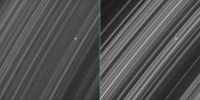
Aldebaran-PIA08300.jpgThrough the B-Ring83 visiteThese side-by-side views of a star (Aldebaran?) seen through Saturn's densely populated B-Ring show marked contrast between the region where spokes - the ghostly radial features periodically seen in it - are produced and regions where no spokes are seen.
In the view at left, the B-Ring displays an uneven grainy texture, with a great deal of variability in brightness along the direction of the particle motion. In the view at right, the B-Ring is far smoother and more uniform along the same longitudinal direction.
Ring scientists on the Cassini Imaging Team are studying images such as these to understand the processes by which spokes are created. This difference in appearance from one location to another on the Ring could provide the researchers with helpful insights into the features' formation.
These views were acquired about half an hour apart as the Cassini spacecraft looked toward the unlit side of the Rings from about 33° above the Ring-Plane.
|
|

The_Rings-PIA10408.jpg"Spiral Density Wave" in the B-Ring (MULTISPECTRUM; credits: Lunexit)83 visiteCaption NASA:"This High-Resolution view shows, at left, a Spiral Density Wave (SDW) in Saturn's inner B-Ring. A SDW is a spiral-shaped massing of particles that tightly winds many times around the Planet. These waves decrease in wavelength with increasing distance from the Planet.
Scientists use images like this one to understand the mass of the Rings and the collisional dynamics of the Ring Particles.
The view looks toward the sunlit side of the Rings from about 50° below the Ring-Plane. The image was taken in visible light with the Cassini Spacecraft narrow-angle camera on May 10, 2008. The view was obtained at a distance of approx. 279.000 Km (sich as about 173.000 miles) from Saturn.
Image scale is roughly 1 Km (0,6 mile) per pixel".MareKromium
|
|

Enceladus-N00146707_8.jpgTiger Stripes (Natural Colors; credits: Dr M. Faccin)83 visiteIn attesa che la NASA faccia di meglio (se non altro pubblicamente)...MareKromium
|
|

Dione-N00154016-17-19-EB-LXTT.jpgDione (Natural Colors; credits for the additional process. and color.: Elisabetta Bonora - Lunexit Team)83 visitenessun commentoMareKromium
|
|

The_Sky_of_Saturn-Quartet-N00159961-N00159982_logo.gifThe "Saturnian Quartet" (a GIF-Movie by Dr Gianluigi Barca)83 visiteOltre al fatto che si tratta di un filmato splendido, Vi invitiamo ad individuare le Lune Saturniane che vi appaiono.
Buon Lavoro e SEMPRE Complimenti al nostro Big "G"!MareKromium
|
|
| 2245 immagini su 188 pagina(e) |
 |
|
|
|
|
19 | |
|
|
|
|





