| Piú viste - Saturn: the "Ringed Beauty" and His Moons |

Saturn-HST-1996upto2000-PIA03156_modest.jpgSaturn from Hubble Space Telescope (1996 - 2000)53 visiteCaption NASA originale:"...Looming like a giant flying saucer in our outer solar system, Saturn puts on a show as the planet and its magnificent ring system nod majestically over the course of its 29-year journey around the Sun. These Hubble Space Telescope images, captured from 1996 to 2000, show Saturn's rings open up from just past edge-on to nearly fully open as it moves from autumn towards winter in its Northern Hemisphere..."
|
|

Saturn_s Clouds-V1-PIA00027_modest.jpgSaturn's Clouds from Voyager 153 visitecaption NASA originale:"This image was obtained on November 10, 1980 when Voyager 1 was at a distance of 3,500,000 kilometers (2,200,000 miles) from Saturn. The smallest resolved features in this photograph are 65 kilometers (40 miles) in diameter. Images with similar resolution indicate that Saturn's circulation is somewhat different from Jupiter's. The maximum westward velocities seen on Saturn are located in the middle of the darker regions, while on Jupiter they are located at the poleward interface between belts and zones".
|
|

Saturn_s Clouds-V2-PIA01958_modest.jpgSaturn's Clouds from Voyager 253 visiteCaption NASA originale:"In this Voyager 2 observation of Saturn’s northern mid-latitudes is seen a strangely curled cloud attached by a thin ribbon to the bright white cloud region to the north. The cloud has been monitored for seven rotations around the planet. It appears to be forming a closed loop. Other discrete clouds are seen to the east. Also evident is the “ribbonlike” structure at 47 north latitude in the white cloud region. The spacecraft took this image from a distance of about 9.300.000 Km".
|
|

Japetus from 2.900.000 Km - PIA06466_modest.jpgTwo-faced Japetus53 visiteCaption NASA originale:"The dark material that coats one hemisphere of Saturn's moon Iapetus is very dark, as these two processed views of the same frame can demonstrate.
The image on the left has been cleaned of cosmic rays and magnified; in this otherwise un-enhanced view, only a small part of the moon's surface, at the bottom, is visible because it is part of the bright side of Iapetus. (Only the right hand side of Iapetus is illuminated by sunlight.) The same image, shown on the right, has been contrast-enhanced to make visible the part of the illuminated side of Iapetus that is coated with dark material".
|
|

Saturn-N00016277.jpgSaturn, Moons and Stars53 visitenessun commento
|
|

Saturn-N00016178.jpgSaturn: clouds and rings from about 8.400.000 Km53 visitenessun commento
|
|

Saturn_s Rings in color - PIA06114_modest.jpgSaturn's Rings in natural colors from Cassini-Huygens53 visiteCaption NASA originale:Saturn's faintly banded atmosphere is delicately colored and its threadbare rings cross their own shadows in this marvelous natural color view from Cassini.
The planet and its rings would nearly fill the space between Earth and the Moon. Yet, despite their great breadth, the rings are a few meters thick and in some places, very translucent. In this image, we can see through the C-Ring, which is closest to Saturn, and through the Cassini division, the 4.800-Km wide gap that arcs across the top of the image and separates the optically thick B-Ring from the A-Ring. The part of the atmosphere seen through the gap appears darker and more bluish due to scattering at blue wavelengths by the cloud-free upper atmosphere.
The different colors in Saturn's atmosphere are due to particles whose composition is yet to be determined.
The image was obtained with the Cassini spacecraft narrow angle camera on July 30, 2004, at a distance of 7.6 MKM from Saturn".
|
|

Saturn-N00020544.jpgSaturn and many dark spots and swirls on the surface53 visiteImmagine di Saturno ripresa da una distanza di poco superiore ai 7 milioni di Km. Abbiamo scelto questo frame a causa dei notevoli dettagli superficiali che sono agevolmente osservabili senza la necessità di processare ulterioremente la fotografia. Potete vedere svariate nuvole bianche (probabilmente composte da vapore acqueo); una miriade di uragani scuri e di modeste dimensioni - sulla Sn -; i bordi frastagliati di una perturbazione di dimensioni quasi planetarie - sempre sulla Sn, ma più vicino al centro dell'immagine -; una porzione degli anelli (a Dx in basso) ed un paio di strisce luminose che - come dicono alla NASA - dovrebbero essere tracce lasciate dal passaggio di "raggi cosmici". Insomma: quasi tutta la fenomenologia tipica di Saturno in un solo frame!
|
|
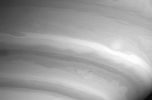
Saturn-PIA06491_modest.jpgSaturn's swirls and ribbons53 visiteCaption NASA originale:"This Cassini image shows mesmerizing detail in the swirls and ribbons of air in Saturn's atmosphere. The view was obtained at a distance of 8.5 million Km from Saturn and is but a taste of what the spacecraft's powerful cameras will show when Cassini draws nearer to the planet. The limb of the planet is visible at lower right.
The image was taken with the Cassini spacecraft narrow angle camera on Sept. 15, 2004, through a filter sensitive to wavelengths of infrared light. The image scale is 101 Km per pixel. The image was magnified by a factor of two and slightly contrast enhanced to improve visibility of features in the atmosphere".
|
|

Saturn-N00021000.jpgSaturn and his Rings53 visitenessun commento
|
|

Enceladus-N00021253.jpgEnceladus from about 6.000.000 Km53 visiteEcco un'immagine davvero interessante e che vale la pena studiare con attenzione: essa ritrae il bordo di Saturno, una delle sue lune (Enceladus) ed alcune stelle sullo sfondo. Non possiamo non notare il costante miglioramento nella qualità delle immagini e, sempre più spesso, la mancanza di "strisce di luce" le quali, come alla NASA hanno ribadito più volte, sono le inevitabili tracce del pasaggio di raggi cosmici. Noi vorremmo capire come i Tecnici NASA hanno fatto per eliminare le "strisciature": un cambio delle modalità di ripresa o una pulizia elettronica "ex post" di tutte le immagini? La differenza, come capirete, è essenziale...
|
|

Prometheus-N00021331.jpgRings and Prometheus53 visiteForse lo avevamo già suggerito e forse no, comunque non è un problema ripetersi quando la materia lo richiede: provate ad osservare e studiare, anche solo visivamente, gli anelli di Saturno in rapporto a quelli di Giove, Urano e Nettuno. Secondo noi la differenza non deve essere vista solo nella "estensione" degli anelli (ossìa nel "quantitativo" di materiale che li forma): essa è anche nella loro intrinseca struttura. Il che vuol dire, a nostro parere, che la/e causa/e degli anelli di Saturno è/sono diversa/e dalla/e causa/e che ha/hanno prodotto gli anelli di Giove, Urano e Nettuno.
|
|
| 2245 immagini su 188 pagina(e) |
 |
|
|
|
|
|
|
|
186 | |
|





