| Piú viste - Saturn: the "Ringed Beauty" and His Moons |

TheRings-GIF-W00059891.gifSaturn's "Moons-Carousel" (GIF-Movie; credits: Dr G. Barca)54 visitenessun commentoMareKromium
|
|

Propeller-PIA11672-b.jpgGiant "Propeller" in the A-Ring (EDM)54 visiteIt has since become a growing realization resulting from Cassini’s exploration of Saturn that the objects forming Saturn’s Rings very likely span the full spectrum of sizes, from the smallest dust-sized ring particles to the ring-moons like Daphnis and 29-Km-wide (18-mile-wide) Pan - a significant advance in divining the origin of Saturn’s Rings.
The novel illumination geometry that accompanies equinox lowers the Sun’s angle to the Ring-Plane, significantly darkens the Rings and causes out-of-plane structures to cast long shadows across the Rings. (The Rings have been brightened in this image to enhance visibility)
These scenes are possible only during the few months before and after Saturn’s Equinox which occurs only once in about 15 Earth years.
This view looks toward the Northern Side of the Rings from about 20° above the Ring-Plane.
The image was taken in Visible Light with the Cassini Spacecraft narrow-angle camera on Aug. 13, 2009.
This view was acquired at a distance of approx. 1,2 MKM (about 746.000 miles) from Saturn and at a Sun-Saturn-Spacecraft, or Phase, Angle of 87°.
Image scale is roughly 7 Km (about 4,5 miles) per pixel.MareKromium
|
|
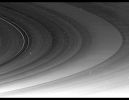
The_Rings-PIA11671.jpgInner B-Ring "Terminus" and Spiral Corrugation54 visiteCaption NASA:"This mosaic of Cassini images, part of a larger mosaic of images captured just hours before exact Equinox at Saturn, shows that the "Spiral Corrugation" in the Planet’s Inner Rings continues right up to the inner B-Ring: an unexpected result that scientists are working to understand.
The inner B-Ring boundary is visible on the right. The C-Ring’s Maxwell Gap, demarcated by two bright arcs in this view, is on the left.
The larger mosaic shows a gently undulating pattern stretching from the D-Ring to inner B-Ring (see PIA11670).
An earlier mosaic, captured in June, showed the corrugation extending only as far as the middle of the C-Ring (see PIA11664).
The periodic brightness variations in this corrugation are most likely caused by the changing slopes in the rippled Ring-Plane, much like the corrugations of a tin roof. Although previous Cassini observations (see PIA08325) had revealed corrugations in the D-Ring extending over 500 miles (about 800 Km), this image now shows these features extending beyond their origin in the D-Ring for 11.000 miles (approx. 17.000 Km) into the C-Ring.
This new imagery supports earlier evidence that something happened in the early 1980s to generate this feature.
In 2006, imaging scientists speculated that a collision with a comet or asteroid may have disturbed the D-Ring. That explanation seems less likely now that this new image shows the effect spread over a much broader radial range, extending completely across the C-Ring, and scientists are continuing to investigate the cause of this disturbance.
Whatever created the corrugation apparently tilted a vast region of the Inner Rings relative to Saturn’s gravitational field in a relatively short period of time during the early 1980s.
In the intervening years, the natural tendency for inclined orbits to systematically and slowly wobble at different rates, depending on their distance from Saturn, has created a tightly wound spiral corrugation in the Ring-Plane.
This view and others like it are only possible around the time of Saturn’s Equinox which occurs every half-Saturn-year (equivalent to about 15 Earth years). Exact Equinox is when the Sun is directly overhead at the Equator. The illumination geometry that accompanies equinox lowers the Sun’s angle to the Ring-Plane, significantly darkens the Rings and causes out-of-plane structures to cast long shadows across the Rings.
Cassini’s cameras have spotted not only the predictable shadows of some of Saturn’s moons (see PIA11657), but also the shadows of newly revealed vertical structures in the Rings themselves (see PIA11665).
This view looks toward the southern side of the Rings from about 4° below the Ring-Plane. Background stars are visible shining through the Rings, and the image has not been cleaned to remove Cosmic Rays, which struck the camera’s detector during the exposures.
The image was taken in Visible Light with the Cassini Spacecraft narrow-angle camera on Aug. 10, 2009. The view was acquired at a distance of approx. 888.000 Km (about 552.000 miles) from Saturn and at a Sun-Saturn-Spacecraft, or Phase, Angle of 157°.
Image scale is roughly 5 Km (a little more than 3 miles) per pixel".MareKromium
|
|

The_Rings-PIA11674.jpgRocky-Rain on the Rings54 visiteCaption NASA:"The bright Streaks visible in these Cassini images taken during Saturn’s August 2009 Equinox are exciting evidence of a constant rain of interplanetary projectiles onto the Planet’s Rings.
Objects, each estimated to be one meter (3 feet) in size and traveling tens of kilometers per second (tens of thousands of miles per hour), likely smashed into the Rings and created elevated clouds of tiny particles that have been sheared out, or elongated and tilted, by orbital motion into bright streaks.
The image on the left shows an impact in the A-Ring. The Streak stretches from the right of the image to the middle, and it does not quite follow the arc of the Rings. The brightest part of that Streak is about 5000 Km (approx. 3100 miles) long (its azimuthal dimension) and about 200 Km (approx. 120 miles) wide (its radial extent, tip to tip) in this image.
The image on the right shows an impact into the C-Ring. This Streak is much smaller than the A-Ring Streak, and it appears on the right of the image. The brightest part of this Streak is approx. 200 Km (about 120 miles) long (its azimuthal dimension) and approx. 10 Km (about 6 miles) wide (its radial dimension, tip to tip) in this image.
By the brightness and dimensions of the Streaks, scientists estimate the impactor sizes at roughly one meter (3 feet), and the elapsed time since impact at one to two days. These Equinox data lend more confidence to a Cassini imaging observation made in 2005 of similar Streaks seen in the C-Ring (see PIA11675).
All together, these observations constitute the visual confirmation of a long-held belief that bits of interplanetary debris continually rain down on Saturn’s Rings and contribute to the Rings’ erosion and evolution.
Although the phase angle of these images is not the best for seeing clouds of small particles, these ejecta clouds are easily seen because very little sunlight is falling on the Rings during the exceedingly low Sun-angle condition prevalent during the four days surrounding exact Saturn Equinox.
Exact Equinox is when the sun is directly overhead at the Equator. A cloud of dust rising above the dark Ring-Plane is more directly catching the Sun’s rays, and is hence well lit and easily visible by contrast.
When the Ring background is at its usual brightness, impacts such as these are very difficult to detect.
The view of the A-Ring Streak on the left looks toward the northern side of the Rings from about 20° above the Ring-Plane. The image was taken in Visible Light with the Cassini Spacecraft narrow-angle camera on Aug. 13, 2009. The view was obtained at a distance of approx. 1,2 MKM (about 746.000 miles) from Saturn and at a Phase Angle of 87°.
Image scale is 7 kilometers (4 miles) per pixel.
The view of the C-Ring Streak on the right looks toward the southern side of the Rings from about 22° below the RingPlane. The image was taken in Visible Light with the Cassini Spacecraft narrow-angle camera on Aug. 11, 2009. The view was obtained at a distance of approx. 263.000 Km (about 164.000 miles) from Saturn and at a Phase Angle of 135°.
Image scale is roughly 1 Km (4007 feet) per pixel".MareKromium
|
|

Janus-PIA11597.jpgJanus (Natural - but enhanced - Colors; credits: Lunexit)54 visiteCaption NASA:"The Cassini Spacecraft looks toward the South Pole and cratered surface of Saturn's moon Janus.
The Pole of Janus lies on the Terminator, about one-third of the way inward from the bottom of the image. This view is centered on terrain at 42° South Lat. and 32° West Long.; the lit Terrain seen here is on the Saturn-facing side of Janus.
The image was taken in visible light with the Cassini Spacecraft narrow-angle camera on July 26, 2009. The view was acquired from a distance of approx. 100.000 Km (i.e. about 62.000 miles) from Janus and at a Sun-Janus-Spacecraft, or Phase, Angle of 63°.
Image scale is roughly 600 meters (1968 feet) per pixel".MareKromium
|
|

SaturnDustRing-SST.jpgDust-Ring around Saturn54 visiteWhat has created a large Dust-Ring around Saturn?
At over 200 times the radius of Saturn and over 50 times the radius of Saturn's expansive "E"-Ring, the newly discovered Dust-Ring is the largest planetary ring yet imaged. The Ring was found in IR Light by the Earth-orbiting Spitzer Space Telescope.
A leading hypothesis for its origin is impact material ejected from Saturn's moon Phoebe, which orbits right through the Dust-Ring's middle.
An additional possibility is that the Dust-Ring supplies the mysterious material that coats part of Saturn's moon Japetus, which orbits near the Dust-Ring's Inner Edge. Pictured above in the inset, part of the Dust-Ring appears as false-color orange in front of numerous background stars.MareKromium
|
|
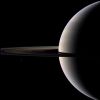
Saturn-PIA12318.jpgCosmic Vision (Natural Colors; credits: NASA/JPL/Space Science Institute)54 visiteCaption NASA:"Looking cool and serene, Saturn shares its soft glow with Cassini. This view of Saturn, its Rings and the moon Tethys represents "Target 1" in the fall 2009 edition of the Cassini Scientist for a Day contest.
(See http://saturn.jpl.nasa.gov/education/scientistforaday8thedition/.) The contest is designed to give students a taste of life as a scientist by challenging them to write an essay describing the value of one target choice among three for Cassini to image.
A bonus feature in the image is the presence of bright Spokes on and just above the ansa, or curved edge of the darkened Ring-Plane. The Spokes are made visible here by sunlight scattering through the dust-sized icy particles and toward Cassini's cameras.
Images taken using red, blue and green spectral filters were combined to create this color view.
The images were acquired with the Cassini wide-angle camera on Oct. 11, 2009 at a distance of approx. 1,7 MKM (a little more than 1 MMs) from Saturn".
Nota Lunexit: la dizione "Natural" l'abbiamo aggiunta noi, dato che la NASA - curiosamente - parla solo di "Color View" (insomma, adesso non fanno più nemmeno la fatica di dirci se si tratta di Natural, Approximate True, True e/o False Colors...bah!).MareKromium
|
|

Hyperion-PIA11617.jpgTumbling Hyperion (Natural Colors; credits: Lunexit)54 visiteCaption NASA:"The Cassini Spacecraft peers at the pitted Surface of the small and irregularly-shaped moon Hyperion.
See PIA09728 to learn how these pits are created on low-density Hyperion (about 270 Km, or approx. 168 miles across). To watch a movie of this "tumbling moon", see PIA07683.
Scale in the original image was 9 Km (approx. 5,5 miles) per pixel. The image has been magnified by a factor of three and contrast-enhanced to aid visibility.
The image was taken in Visible Light with the Cassini Spacecraft narrow-angle camera on Sept. 5, 2009. The view was obtained at a distance of approx. 1,4 MKM (such as about 870.000 miles) from Hyperion and at a Phase Angle of 91°".MareKromium
|
|

Tethys-N00143887-N00143908.gifSpace Speedway (GIF-Movie; credits: Dr G. Barca)54 visitenessun commentoMareKromium
|
|

Tethys-N00143729-N00143747.gifTethys and "The Runners" (GIF-Movie; credits: Dr G. Barca)54 visitenessun commentoMareKromium
|
|
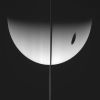
Saturn-W00061084.jpgWhat a Shadow!54 visiteUn'ombra davvero imponente (che evidenzia - molto bene! - anche le "penumbral areas") è disegnata sul disco illuminato di Saturno.
Le Original Captions NASA non ci sono di aiuto, anzi: confondono le idee (come leggerete)!
Dunque rivolgiamo il quesito a Voi: di quale Luna Saturniana è l'ombra che vediamo in questo frame?
Buon Lavoro!
W00061084.jpg was taken on November 07, 2009 and received on Earth November 08, 2009. The camera was pointing toward SATURN that, at the time, was approx. 2.059.699 Km away; the image was taken using the CB2 and CL2 filters. This image has not been validated or calibrated. A validated/calibrated image will be archived with the NASA Planetary Data System in 2010.MareKromium
|
|

Tethys-N00145736-N00145747-N00145784-N00145803.gifMoons Carousel (GIF-Movie; credits: Dr G. Barca)54 visiteLo Spettacolo dello Spazio di Saturno: meraviglioso!MareKromium
|
|
| 2245 immagini su 188 pagina(e) |
 |
|
|
|
|
180 | |
|
|
|
|





