| Piú viste - Saturn: the "Ringed Beauty" and His Moons |
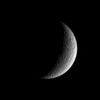
Rhea-PIA08186.jpgRhea: so "old" and yet so "beautiful...85 visiteCaption NASA:"Rhea displays a prominent scar in this view from Cassini. A large and ancient impact basin can be seen at upper right. The giant feature occurs within a terrain that appears rugged and which likely is saturated with other smaller craters.
Rhea is Saturn's second-largest moon at 1.528 Km (about 949 miles) across. This view shows terrain on the moon's Trailing Hemisphere.
North is up.
The image was taken in polarized ultraviolet light with the Cassini spacecraft narrow-angle camera on April 24, 2006 at a distance of approx. 2 MKM (such as about 1,2 MMs) from Rhea and at a Sun-Rhea-spacecraft, or phase, angle of 117°. Resolution in the original image was approx. 12 Km (about 7 miles) per pixel. The image has been magnified by a factor of two and contrast-enhanced to aid visibility".
|
|

Janus-Rotating-20080220.gifJanus "in motion" (GIF-Movie)85 visitenessun commentoMareKromium
|
|

Enceladus-EB_(2).gifAlways Enceladus, but NOT ONLY Enceladus... (GIF-Movie; credits: Elisabetta Bonora - Lunexit Team)85 visitenessun commentoMareKromium
|
|

Enceladus-N00161056-57-EB-LXTT.jpgIs there any "Luminescence" over the "Tiger Stripes"? (2 - Superdefinition; credits for the additional process. and color.: Elisabetta Bonora - Lunexit Team)85 visitenessun commentoMareKromium
|
|

Hyperion-MF-PCF-LXTT-1.jpgHyperion and its Surfacing Hydrocarbons (Absolute Natural Colors; credits for the additional process. and color.: Drr Marco Faccin and Paolo C. Fienga)85 visiteNota: questa colorizzazione "Naturale Assoluta" (e cioè che risponde a quello che, a nostro parere, un essere umano vedrebbe se si trovasse a bordo della Sonda CASSINI) è un prodotto UNICO ed ESCLUSIVO del "Lunexit Team". MareKromium
|
|

Pan from Voyager 1.jpgPan from Voyager 184 visiteIl "Flautista" Pan: una Luna Minore e, nel contempo, uno dei Ring-Master di Saturno. Difficilissimo da vedere ma non per questo meno affascinante.
Provate ad immaginarVi, per esempio, a ciò che potreste vedere alzando gli occhi se Vi trovaste a "passeggiare" - anche solo per pochi istanti, su questo piccolo mondo di pietra...
|
|

Japetus-A-U-The Wall.jpgThe "Wall" of Japetus (detail mgnf)84 visiteOsserviamo bene questo "muro" e cerchiamo di svolgere delle considerazioni: si tratta, se usiamo la logica convenzionale, di un semplice rilievo montuoso, alto circa 19 Km e largo altrettanti, che circonda il pianeta quasi completamente. E' "inusuale", certo, ma che cosa c'è di "usuale" nello Spazio? Questa spettacolare increspatura potrebbe aver avuto origine durante la fase di raffreddamento di Giapeto, agli albori della sua storia, così come potrebbe essere, invece, il residuo visibile di un crack di dimensioni planetarie (causato da eventi sismici di portata - per noi - inimmaginabile, o magari da un impatto particolarmente violento e/o da entrambi questi fattori) il quale, con il tempo, si è "cicatrizzato", generando quello che vediamo oggi. Il rilievo, inoltre, è fortemente craterizzato: lo è al pari di tutta la superficie di questa luna. Ebbene, un simile dato può farci pensare che l'ipotesi della sua formazione (contemporanea o quasi) con la "nascita" di Giapeto, sia - tutto sommato - accettabile.
|
|

Dione-PIA07744.jpgDione and Saturn (natural colors)84 visiteOriginal caption:"Speeding toward pale, icy Dione, Cassini's view is enriched by the tranquil gold and blue hues of Saturn in the distance. The horizontal stripes near the bottom of the image are Saturn's Rings. The spacecraft was nearly in the plane of the Rings when the images were taken, thinning them by perspective and masking their awesome scale. The thin, curving shadows of the C-Ring and part of the B-Ring adorn the Northern Latitudes visible here, a reminder of the Rings' grandeur.
It is notable that Dione, like most of the other icy Saturnian satellites, looks no different in natural color than in monochrome images. Images taken on Oct. 11, 2005, with blue, green and infrared (centered at 752 nnmts) spectral filters were used to create this color view, which approximates the scene as it would appear to the human eye. The images were obtained with the Cassini spacecraft wide-angle camera at a distance of approx. 39.000 Km from Dione and at a phase angle of 22°.
The image scale is about 2 Km/pixel".
|
|

Rhea-PIA08871.jpgRhea (natural & false colors)84 visiteSide-by-side natural color and false-color views highlight the wispy terrain on Rhea's Trailing Hemisphere. The extreme false color image makes it clear that the wisps - likely networks of fractures as on Dione - cut across older, cratered terrain.
In addition, a set of thin, North-South trending lineaments (also likely fractures) is visible on the left side of both views.
The natural color view was created by compositing images taken using red, green and blue spectral filters.
To create the false-color view, ultraviolet, green and infrared images were combined into a single picture that isolates and maps regional color differences. This "color map" was then superimposed over a clear-filter image that preserves the relative brightness across the body.
The combination of color map and brightness image shows how colors vary across the surface of Rhea. The origin of the color differences is not yet understood, but may be caused by subtle differences in the surface composition or the sizes of grains making up the icy surface material. North on Rhea (1,528 kilometers, or 949 miles across) is up.
The images were taken with the Cassini spacecraft narrow-angle camera on Jan. 17, 2007 at a distance of approximately 597,000 kilometers (371,000 miles) from Rhea. Image scale is 4 kilometers (2 miles) per pixel.
|
|

Enceladus-PIA11108.jpgBaghdad Sulcus84 visiteCaption NASA:"This Cassini image was the 4th 'skeet shoot' narrow-angle image captured during the Oct. 31, 2008, flyby of Saturn's moon Enceladus.
The source region for jet VI (see PIA08385) has been identified. The image was taken with the Cassini Spacecraft narrow-angle camera on Oct. 31, 2008, at a distance of approximately 3417 Km (about 2135 miles) from Enceladus and at a Sun-Enceladus-Spacecraft, or Phase, Angle of 75°.
Image scale is roughly 38 meters (125 feet) per pixel".MareKromium
|
|
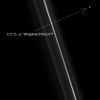
The_Rings-N00124205.jpgAnother UFO in the Space of Saturn?84 visiteCaption NASA:"N00124205.jpg was taken on November 16, 2008 and received on Earth November 17, 2008. The camera was pointing toward SATURN-RINGS which, at the time, were approximately 382.907 Km away, and the image was taken using the CL1 and CL2 filters. This image has not been validated or calibrated".MareKromium
|
|

Japetus-4230263249_738ebb224f_o.jpgIce Deposits on Japetus (Image-Mosaic - Possible Natural Colors; credits: Dr M. Faccin - Lunexit Team)84 visitenessun commentoMareKromium
|
|
| 2245 immagini su 188 pagina(e) |
 |
|
|
|
|
18 | |
|
|
|
|





